
Bikaner Camel Festival 2027 – Rajasthan's Desert Carnival
बीकानेर ऊँट महोत्सव
When is the Bikaner Camel Festival in 2027?
The Bikaner Camel Festival is expected in early-to-mid January 2027, most likely on the 9th and 10th, though Rajasthan Tourism confirms the exact two days only a few weeks ahead. It is a cultural celebration of the camel – the animal that made life in the Thar desert possible – held near Junagarh Fort in Bikaner.
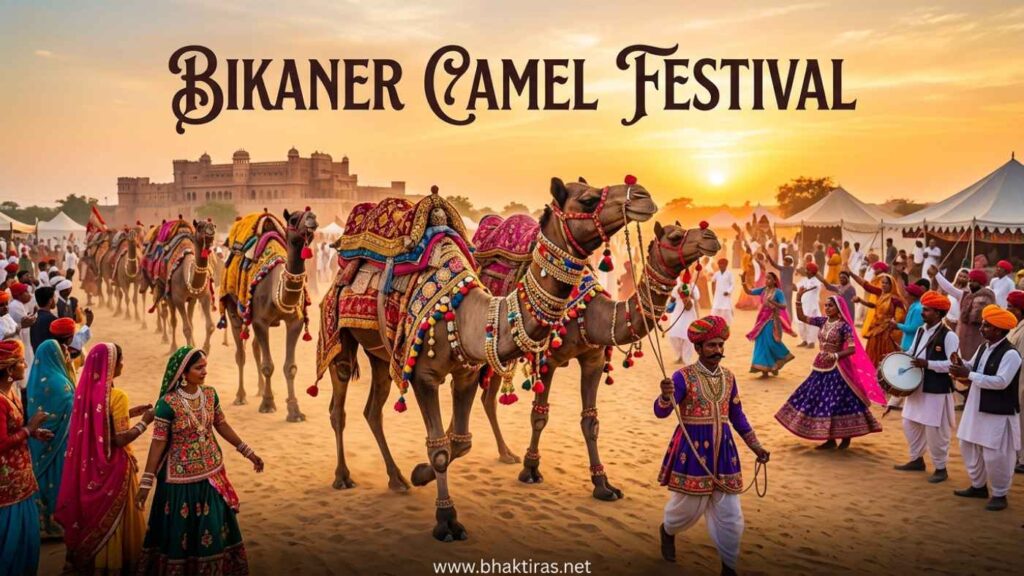
The Bikaner Camel Festival is a two-day open-air carnival that Rajasthan Tourism throws every January to honour the camel, the animal locals still call the ship of the desert. For a couple of days the sandy grounds below Junagarh Fort fill with camels groomed like grooms at a wedding – fur clipped into patterns, backs draped in mirrored cloth – alongside races, folk singers, fire dancers and enough camel-milk tea to keep the winter chill at bay. It is less a temple festival than a love letter to desert life.
Bikaner Camel Festival 2026-2028: Dates & Calendar
The festival is a fixed-season winter event rather than a lunar-calendar one, so it lands in January every year, but the exact two days are set by Rajasthan Tourism and announced afresh each season. The dates below are the usual window; treat them as approximate until the tourism board publishes the official schedule.
| Year | Likely dates | Month | Notes |
|---|---|---|---|
| 2026 | Mid-January | January | Held in January as usual |
| 2027 | Around 9-10 January | January | Next occurrence (approximate) |
| 2028 | Around 8-9 January | January | Approximate; awaits official dates |
Because the festival is tied to the tourist season and not to a tithi, the two days can shift by a week either way. If you are travelling specifically for it, book flexible dates and confirm on the Rajasthan Tourism site or with the Bikaner district administration.
Why the Bikaner Camel Festival Is Celebrated
The festival celebrates the camel’s central place in Bikaner’s history, economy and folk culture, and puts the region’s desert traditions in front of visitors from across the world.
Bikaner grew up as a caravan town on the old trade routes, and the camel carried its goods, its soldiers and its water across country where nothing else could. The festival is the city’s public thank-you to that animal, wrapped in music, colour and a fair bit of friendly competition.
Honouring the ship of the desert
In a land of sand dunes and scarce water, the camel was transport, dairy and livelihood all at once. The festival gives that quiet workhorse two days at the centre of attention, with decorated camels leading a procession through the streets.
A showcase for desert culture
Beyond the camels, the event is a stage for Rajasthani folk arts – Kalbeliya snake-charmer dance, fire dancers, drummers and turban-tying displays. It lets Bikaner present its living traditions to travellers rather than shutting them behind museum glass.
Support for camel breeders and research
Bikaner is home to the National Research Centre on Camel, and the festival’s best-breed judging and decoration contests keep local pastoral communities and their camel herds in the spotlight at a time when the animal’s numbers are falling.
What Happens at the Festival, Step by Step
The programme runs across two days, moving from a grand daytime procession to evening music and fireworks.
- Opening procession. The festival kicks off with a parade of ornately decorated camels winding through Bikaner, their coats brushed, dyed and dressed in mirror-work cloth, often with Junagarh Fort as the backdrop.
- Camel decoration and fur-cutting contest. Handlers compete to dress their camels most beautifully, while barbers clip the animals’ fur into intricate raised patterns – a genuine local art form judged on the spot.
- Best-breed judging. Camels are shown and assessed for breed quality and condition, a nod to Bikaner’s role as a camel-breeding centre.
- Camel races and dances. The crowd gathers for camel races across the sand, and for the curious spectacle of trained camels performing dance steps to drumbeats.
- Camel milk tea and sweets. Stalls serve tea and sweets made with camel milk alongside regular Rajasthani snacks, so visitors can taste the desert dairy the festival celebrates.
- Folk performances. Kalbeliya dancers, fire dancers and folk musicians take over through the afternoon and evening, filling the grounds with drumming and song.
- Turban-tying and Mr Bikaner contests. Lighter competitions invite visitors and locals to try their hand at safa-tying and to compete in the moustache-and-turban Mr Bikaner pageant.
- Fireworks finale. The event usually closes with a fireworks display lighting up the winter night sky over the fort.
What to Eat at the Bikaner Camel Festival
The festival is a good excuse to eat your way through Bikaner’s famously rich desert cuisine, camel-milk specialities included.
Camel milk tea and sweets
The signature taste of the event: tea brewed with camel milk, plus kulfi and other sweets made from it. Camel milk is thinner and slightly saltier than cow’s milk, so the flavour surprises most first-timers.
Bikaneri bhujia
The crisp, spiced gram-flour noodle snack that made Bikaner’s name across India. It is sold on every corner and makes an easy, portable bite between performances.
Rajasthani thali
A full plate of desert cooking: dal baati churma, gatte ki sabzi, ker sangri and bajra roti – dishes built to keep in a dry climate and heavy on ghee, chilli and pulses.
Sweets and ghevar
Local sweet shops set up stalls with ghevar, rasgulla and jalebi. Bikaner’s sweets are known for being generous with sugar and ghee, a warm counter to the January cold.
Bikaner Camel Festival Do's and Don'ts
A few practical pointers to enjoy the festival comfortably and respectfully.
Do
- Carry warm layers – January nights in the Thar get genuinely cold.
- Book accommodation well in advance, as Bikaner fills up during the festival.
- Try the camel milk tea and sweets at least once; they are the point.
- Ask handlers before photographing them or their camels up close.
- Confirm the official dates with Rajasthan Tourism before you travel.
Avoid
- Don’t assume the dates are fixed – they shift yearly and are announced late.
- Don’t crowd or startle the camels during races and the procession.
- Don’t leave valuables loose in the dense festival crowds.
- Don’t rely on finding rooms last-minute during the two days.
- Don’t skip sun protection by day even though the evenings are chilly.
Frequently Asked Questions
When is the Bikaner Camel Festival in 2027?
The Bikaner Camel Festival 2027 is expected around 9-10 January, in line with its usual mid-January slot. Rajasthan Tourism sets and announces the exact two days each season, so treat this as approximate and confirm on the official listing before booking.
When is the Bikaner Camel Festival in 2026 and 2028?
The 2026 festival was held in January as usual, and the 2028 edition is expected around early-to-mid January (roughly 8-9 January). Because it is a tourism-board event rather than a lunar-calendar one, dates fall in January every year but are confirmed afresh annually.
Why is the Bikaner Camel Festival celebrated?
The Bikaner Camel Festival celebrates the camel, the animal that made survival and trade possible in the Thar desert. It honours the region’s pastoral heritage and desert culture while giving camel breeders, folk artists and the local tourism economy a public stage.
Is the Bikaner Camel Festival a religious festival?
No, the Bikaner Camel Festival is a cultural and tourism event, not a religious one. It has no presiding deity or temple ritual; instead it revolves around camel processions, races, decoration contests, folk music and Rajasthani food.
What are the main events at the festival?
The main draws are the grand procession of decorated camels, camel races and camel dances, best-breed and fur-cutting contests, folk performances such as Kalbeliya and fire dance, turban-tying and Mr Bikaner competitions, and a fireworks finale. Much of it takes place near Junagarh Fort.
Where is the Bikaner Camel Festival held?
The Bikaner Camel Festival is held in the city of Bikaner in northern Rajasthan, India, with events staged in and around the grounds near Junagarh Fort. Bikaner is also home to the National Research Centre on Camel, which ties into the festival’s theme.
What food is served at the Bikaner Camel Festival?
Visitors can try camel milk tea and camel-milk sweets, the crunchy local Bikaneri bhujia, and full Rajasthani thalis of dal baati churma, gatte ki sabzi and ker sangri. Sweet stalls sell ghevar, jalebi and rasgulla alongside.
How do I attend the Bikaner Camel Festival?
Reach Bikaner by train, road or the nearest airport at Jaisalmer or Jodhpur, then attend the free public events near Junagarh Fort over the two festival days. Book rooms early, carry warm clothes for the January chill, and check Rajasthan Tourism for the confirmed dates before travelling.
If you love the desert, the camel and a good dose of colour, Bikaner in January is hard to beat – padharo sa, come and see it for yourself.