
Raghupati Raghav Raja Ram
रघुपति राघव राजा राम, पतित पावन सीता राम
What is Raghupati Raghav Raja Ram?
Raghupati Raghav Raja Ram Raghupati Raghav Raja Ram is a short, repetitive Hindu devotional chant (Ram Dhun) that praises Lord Rama as the purifier of the fallen, composed by Lakshmanacharya and made famous nationwide by Mahatma Gandhi.
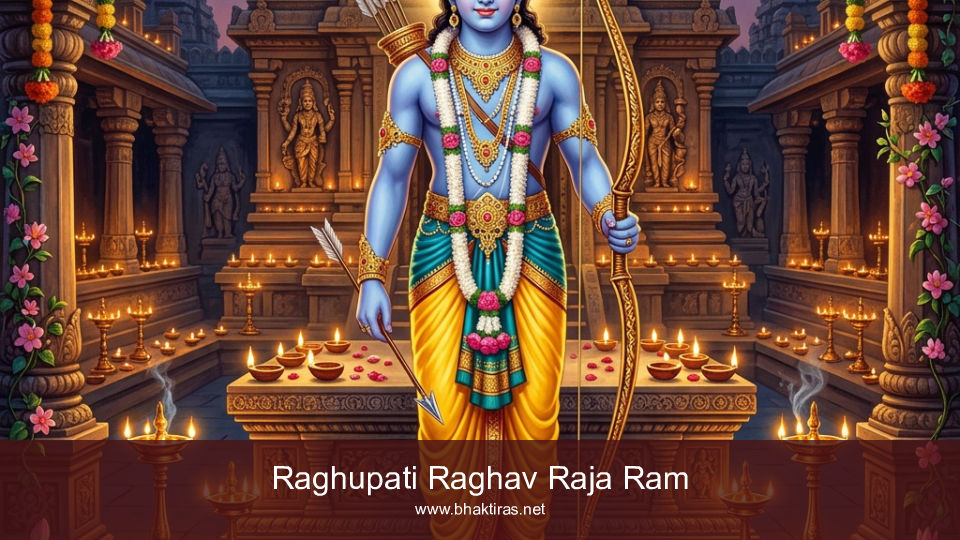
Few chants in India are as instantly recognisable as these two opening lines. Raghupati Raghav Raja Ram is a Ram Dhun — a rhythmic call-and-response verse repeated over and over until the sound itself settles the mind. The words come from a 19th-century composition by Lakshmanacharya, but the version most people hum today carries an extra couplet added during the freedom movement, when Mahatma Gandhi sang it at prayer meetings and on his marches. What began as a temple bhajan became, in his hands, a plain-spoken prayer for shared decency across faiths. It works because it asks nothing of the singer except repetition: a handful of names for Rama, a request for good sense for everyone, and a tune simple enough for a crowd of thousands to carry together.
Raghupati Raghav Raja Ram Lyrics
Roman transliteration for easy chanting. Tap “Meaning” under any verse for the English translation.
Refrain
Raghupati Raghav Raja Ram,
Patit Pavan Sita Ram
Sundar Vigrah Meghshyam,
Ganga Tulsi Shaligram
Meaning
His beautiful form is dark as a rain-cloud. He is worshipped through the sacred Ganga, the tulsi leaf, and the shaligram stone. The line paints Rama through the things devotees actually hold sacred in daily worship — water, plant, and stone — rather than through abstract description.
Bhadragirishwar Sitaram,
Bhagat-Janpriya Sitaram
Meaning
Sita and Rama, the presiding lords of the Bhadra hill, dear to every devotee. This couplet ties the divine couple to a specific place of worship and, in the same breath, to the affection ordinary people feel for them — both remote lord and beloved companion.
Janaki Ramana Sitaram,
Jaya Jaya Raghav Sitaram
Meaning
Rama, the delight and beloved of Janaki (Sita), victory upon victory to the descendant of Raghu and to Sita-Rama. Here Rama is named through his relationship with Sita, and the verse closes with a jaikara — a shout of triumph — that lifts the chant into celebration.
Ishwar Allah Tero Naam,
Sabko Sanmati De Bhagwan
Meaning
Ishwar and Allah are alike your names; grant everyone right thinking, O God. This is the couplet Gandhi carried into public life — a request not for favours but for good sense and goodwill across every community. It reframes the whole dhun as a prayer for shared conscience rather than sectarian identity.
Meaning & Significance
The strength of Raghupati Raghav Raja Ram is that it says very little and repeats it endlessly, which is exactly the point of a dhun. The core is the refrain: Rama is patit pavan, the one who purifies those who have fallen. Everything after that simply adds ways of picturing and naming him — his cloud-dark form, the Ganga and tulsi and shaligram through which he is honoured, his home on the Bhadra hill, his bond with Sita.
Then comes the line that changed how the country hears the song. When Gandhi added Ishwar Allah tero naam, sabko sanmati de Bhagwan, he turned a temple chant into a public prayer. It stops asking Rama for personal blessing and starts asking, on behalf of everyone, for the wisdom to live well together. Sung slowly at a prayer meeting or briskly on a march, the same words can be quiet contemplation or a call to conscience — which is why the dhun outlived its origins and still gets sung at gatherings that have nothing to do with any one temple.
How Do You Perform the Aarti?
- Begin with the refrain — Start by singing 'Raghupati Raghav Raja Ram, Patit Pavan Sita Ram' at a slow, steady pace so the tune settles before you build speed.
- Add one antara at a time — After the refrain, sing an antara (verse 1, then 2, then 3), returning to the refrain between each. This call-and-return rhythm is what makes it easy for a group to follow.
- Include the Gandhi couplet — When singing the interfaith version, add 'Ishwar Allah tero naam, Sabko sanmati de Bhagwan' before looping back — it closes the prayer with goodwill for all.
- Repeat and let it speed up — A dhun is meant to be repeated many times. Let the tempo rise naturally over successive rounds, keeping the words clear rather than rushing them.
- Chant in a group where you can — The song is built for collective singing — one voice leads a line, the rest answer. Even a small group singing together carries it better than a solo.
What Are the Benefits of Singing This Aarti?
Regular chanting of this Ram Dhun is valued by devotees for reasons that are as practical as they are devotional:
- Easy to learn: With just a few short lines and a repeating tune, anyone can join within minutes — no training, no printed sheet required.
- Calms a restless mind: The steady repetition works like a rhythm to breathe by, which is why it is often used to settle the mind before or after prayer.
- Built for groups: Its call-and-answer shape makes it ideal for satsang, kirtan, and community gatherings where a crowd sings as one.
- Carries a message of harmony: The Gandhi couplet turns personal devotion outward into a wish for goodwill and good sense across all communities.
- Fits any occasion: Short enough for a daily home routine, it also scales up to Ram Navami, prabhat pheris, and public prayer meetings.
Who Wrote This Aarti?
The original Ram Dhun is attributed to Lakshmanacharya, whose verses drew on the tradition of naming Rama through his lineage, his consort Sita, and his role as the purifier of the fallen. In this older form it was a straightforward devotional chant sung in temples and homes.
Its national fame, however, came through Mahatma Gandhi, who adopted it as a favourite at his prayer meetings during the freedom struggle. Gandhi added the couplet Ishwar Allah tero naam, Sabko sanmati de Bhagwan, reshaping the bhajan into an interfaith prayer that matched his belief in unity across religions. It is the version he sang — including on the Dandi Salt March — that most people know today, which is why the song is remembered as much for its message of harmony as for its devotion to Rama.
Frequently Asked Questions
What is Raghupati Raghav Raja Ram?
Raghupati Raghav Raja Ram is a short, repetitive Hindu devotional chant (Ram Dhun) that praises Lord Rama as the purifier of the fallen, composed by Lakshmanacharya and made famous nationwide by Mahatma Gandhi.
Who wrote Raghupati Raghav Raja Ram?
The original Ram Dhun is attributed to the 19th-century composer Lakshmanacharya. The widely-sung version, with the added interfaith couplet 'Ishwar Allah tero naam, Sabko sanmati de Bhagwan', was popularised by Mahatma Gandhi.
What does 'Ishwar Allah tero naam' mean?
It means 'Ishwar and Allah are alike your names' — a line asking God, by whatever name people call him, to grant everyone good sense (sanmati). Gandhi added it to express harmony between religions.
What does 'Patit Pavan Sita Ram' mean?
'Patit Pavan' means 'purifier of the fallen', so the line praises Sita and Rama as the ones who lift up and cleanse those who have sinned or slipped, regardless of their past.
When is Raghupati Raghav Raja Ram sung?
It is sung as a daily bhajan, at satsang and kirtan gatherings, during Ram Navami celebrations, and at prayer meetings and prabhat pheris — anywhere a simple, communal chant is wanted.
Is Raghupati Raghav Raja Ram a bhajan or an aarti?
It is best described as a Ram Dhun — a repetitive devotional chant — rather than a formal aarti offered with lamps. It is commonly counted among Rama bhajans and sung in group devotion.
॥ जय श्री राम ॥