
Jai Surya Bhagwan Aarti
जय सूर्य भगवान, प्रभु जय सूर्य भगवान
What is Jai Surya Bhagwan?
Jai Surya Bhagwan Aarti Jai Surya Bhagwan is a Hindi devotional aarti sung in praise of Surya, the Hindu Sun God, honouring him as the eye of the world, the seven-horsed rider of the dawn chariot, and the giver of light, health, and life.
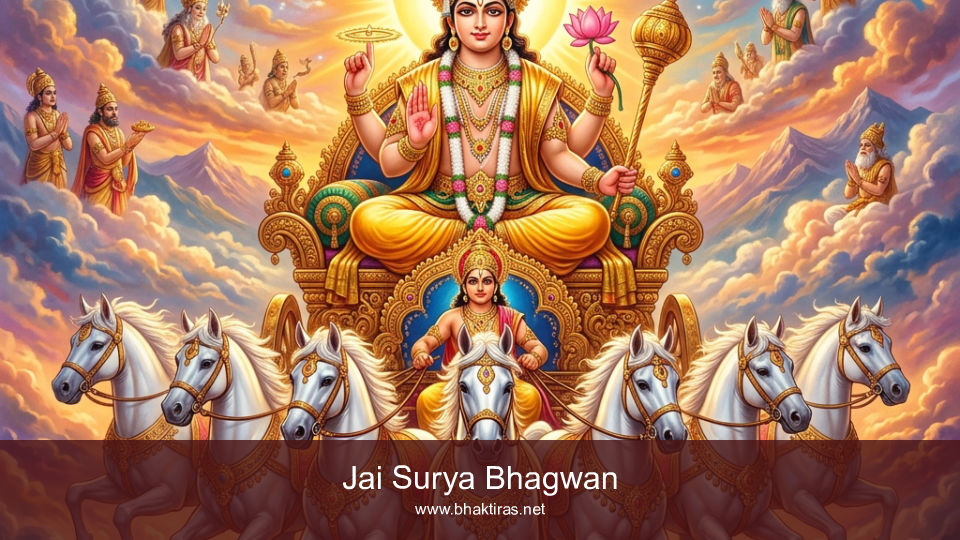
Sung at sunrise on Sundays and with special fervour on Ratha Saptami, this aarti gathers the many faces of Surya into a few short verses. It pictures him as the eye through which the whole world sees, the rider whose chariot Arun drives across the sky, and the source that pours warmth and health into every living thing. Families sing it while facing east, offering water and light back to the one who first gave them both.
Jai Surya Bhagwan Lyrics
Roman transliteration for easy chanting. Tap “Meaning” under any verse for the English translation.
Refrain
Jai Surya Bhagwan, Prabhu Jai Surya Bhagwan
Jagat ke netra-swarupa, tum ho triguna-swarupa
Dharat sab hi tav dhyan, Prabhu jai Surya Bhagwan
Sarathi Arun hai prabhu tum, shwet kamal-dhari
Tum char bhuja-dhari
Ashwa hai saat tumhare, koti kiran pasare
Tum ho dev mahan
Meaning
Arun guides your chariot, Lord, while you hold a white lotus in your four arms. Seven horses draw you forward, scattering countless rays as you rise — you are the great and shining deity.
Ushakal mein jab tum, udayachal aate
Sab tab darshan pate
Phailate ujiyara, jagta tab jag sara
Kare sab tav gungan
Meaning
When you climb the eastern hills at first light, all beings get your sight. You spread brightness everywhere, the whole world wakes, and everyone sings of your qualities.
Sandhya mein bhuvaneshwar, astachal jate
Godhan tab ghar aate
Godhuli bela mein, har ghar har aangan mein
Ho tav mahima gaan
Meaning
At dusk, Lord of the worlds, you sink behind the western hills as the cattle return home. In that twilight hour, every house and courtyard fills with songs of your glory.
Dev danuj nar-nari, rishi-munivar bhajte
Aditya-hriday japte
Strot ye mangalkari, iski hai rachna nyari
De nav-jeevan-daan
Meaning
Gods, titans, men and women, and the great sages all worship you and recite the Aditya-Hridaya hymn. This auspicious prayer, unlike any other, grants the gift of new life.
Tum ho trikal rachaiyta, tum jag ke adhar
Mahima tav aparampar
Pranon ka sinchan karke, bhakton ko apne dete
Bal-buddhi aur gyan
Meaning
You are the maker of past, present, and future, and the support of the world; your greatness has no end. By nourishing our breath itself, you give your devotees strength, sharpness of mind, and understanding.
Bhoochar jalchar khechar, sab ke pran tumhi
Sab jeevon ke pran tumhi
Ved-puran bhakhane, dharm sabhi tumhen mane
Tum hi sarv-shaktiman
Meaning
Creatures of land, water, and sky — you are the life within them all. The Vedas and Puranas declare it, every faith acknowledges you: you alone hold all power.
Pujan karti dishayen, pujen sab dikpal
Tum bhuvnon ke pratipal
Rituyen tumhari dasi, tum shashta avinashi
Shubhkari anshuman
Meaning
The directions themselves worship you, and every guardian of the quarters bows to you, keeper of all the worlds. The seasons serve you as handmaids; you are the eternal, undying ruler — the bringer of good, radiant with a thousand rays.
Meaning & Significance
The aarti moves like a single day. It opens by naming Surya the netra-swarupa — the eye of the world — the light by which every creature is able to see at all. From there it follows the sun across the sky: the dawn arrival driven by Arun and drawn by seven horses, the noon blaze that wakes the world, the dusk descent as cattle come home and courtyards fill with song.
Underneath the imagery is a steady theological claim. Surya is not only a fire in the sky but trikal rachaiyta, the maker of the three tenses of time, and the pran — the breath — inside every land, water, and sky creature. The verses tie him to scripture (the Aditya-Hridaya hymn, the Vedas and Puranas) and then widen further: the directions, the guardians of the quarters, and even the seasons are shown serving him. The closing word anshuman, “the one with rays,” folds all of this back into the plain fact a worshipper sees each morning — light, warmth, and the return of the day.
How Do You Perform the Aarti?
- Wake before or at sunrise and bathe; Surya worship is traditionally done facing the rising sun in the east. —
- Set a small brass or copper lamp with a ghee wick, and keep a vessel of clean water ready for arghya (the water offering). —
- Light the lamp and offer arghya by slowly pouring the water from a raised vessel so the stream catches the sunlight, looking toward the sun through the falling water. —
- Sing the aarti steadily, ideally standing, moving the lamp in gentle clockwise circles before the sun or the image of Surya. —
- On Sundays and on Ratha Saptami, add red flowers, jaggery, or wheat, and offer the arghya seven times if observing the fuller ritual. —
- Close by folding your hands, asking for health and clarity, and sharing any prasad such as jaggery or fruit. —
What Are the Benefits of Singing This Aarti?
Singing the Jai Surya Bhagwan aarti is woven into daily and weekly sun worship. Devotees associate the practice with:
- A disciplined morning rhythm: Rising for the sunrise arghya builds an early, steady daily routine that many find grounding.
- Focus on health and vitality: Surya is invoked as the breath and strength within all beings, so the aarti is sung with prayers for good health and energy.
- Mental clarity: The verses ask Surya for bal, buddhi, and gyan — strength, intellect, and knowledge — making it a common prayer before study or important work.
- A fitting Ratha Saptami observance: On Surya's chariot festival the aarti pairs naturally with the seven-fold arghya and sun-facing worship.
- A sense of gratitude: Facing the light that makes sight and life possible turns the daily sunrise into a moment of thanks rather than habit.
Who Wrote This Aarti?
Like most Hindu aartis, Jai Surya Bhagwan is a traditional composition without a single documented author, passed down through prayer books, temple singing, and family practice. Its verses sit within the wider stream of Surya devotion that runs from the Vedic sun hymns through the Aditya-Hridaya stotra named in the fourth verse. It is most often sung to the same familiar tune as the well-known aarti “Om Jai Jagdish Hare,” which is why the refrain here reads “Jai Surya Bhagwan, Prabhu Jai Surya Bhagwan.”
Frequently Asked Questions
What is Jai Surya Bhagwan?
Jai Surya Bhagwan is a Hindi devotional aarti sung in praise of Surya, the Hindu Sun God, honouring him as the eye of the world, the seven-horsed rider of the dawn chariot, and the giver of light, health, and life.
When is the Jai Surya Bhagwan aarti sung?
It is most often sung at sunrise, especially on Sundays, which are dedicated to Surya, and with particular devotion on Ratha Saptami, the festival marking the Sun God's chariot turning toward the north.
What tune is Jai Surya Bhagwan sung to?
It is commonly sung to the same melody as the popular aarti 'Om Jai Jagdish Hare,' which is why its refrain follows the same 'Jai Surya Bhagwan, Prabhu Jai Surya Bhagwan' pattern.
What do the seven horses in the aarti mean?
The seven horses that draw Surya's chariot, guided by the charioteer Arun, are a classic image of the sun's daily journey across the sky and are traditionally linked to the seven colours of sunlight and the days of the week.
What is offered while singing this aarti?
Worshippers typically offer arghya — water poured toward the rising sun — along with a lit lamp, red flowers, and jaggery, often facing east during the recitation.
॥ जय सूर्य भगवान ॥