
Chhath Maiya Aarti
जय छठी मैया, जय छठी मैया
What is Chhath Maiya Aarti?
Chhath Maiya Aarti Chhath Maiya Aarti is a traditional Bhojpuri folk hymn sung during Chhath Puja to honour Chhathi Maiya and the Sun God Surya, offered at the riverbank during the evening and morning arghya.
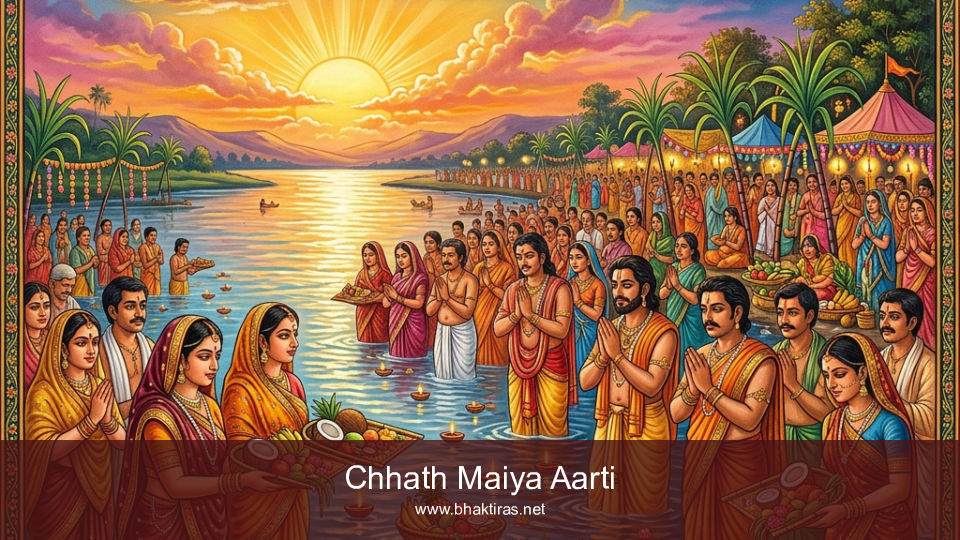
Sung at the water’s edge as the sun dips low and again before it rises, this aarti carries the heart of Chhath Puja in plain Bhojpuri words. Instead of Sanskrit praise, it tells a small, tender story: a parrot (sugna) settling on fruit-laden branches, a stray arrow, and a grieving mate who calls on Aditya — the Sun — for help. Devotees who keep the four-day vrat repeat it while standing knee-deep in the river, holding the soop of offerings, tying the folk imagery of harvest and family to the worship of Chhathi Maiya and Surya.
Chhath Maiya Aarti Lyrics
Roman transliteration for easy chanting. Tap “Meaning” under any verse for the English translation.
Refrain
Jai Chhathi Maiya, Jai Chhathi Maiya
U je kerava je farela ghavad se
Oh par suga menrarae
Meaning
The banana grows in heavy clusters on the plant, and a parrot circles above the ripe bunch — the everyday scene of a Bihar orchard that opens the song.
Marabo re sugava dhanukh se
Suga gire murjhae
Meaning
When the parrot is struck by an arrow from the bow, it falls and wilts — a sudden loss that turns the harvest picture into a story of grief.
U je sugani je roeli viyog se
Aadit hoi na sahay
Meaning
The female parrot weeps in the pain of separation and cries out to Aditya, the Sun, to come to her aid — the plea that links the folk tale directly to Surya worship.
U je nariyar je farela ghavad se
Oh par suga menrarae
Meaning
Now the coconut hangs in bunches and the parrot circles over it, repeating the pattern with a second offering-fruit of the Chhath basket.
U je amarudava je farela ghavad se
Oh par suga menrarae
Meaning
The guava too bears fruit and draws the parrot above it — each fruit named is one that devotees place in the soop for the arghya.
U je sharifava je farela ghavad se
Oh par suga menrarae
Meaning
The custard apple ripens and the parrot hovers close, continuing the roll-call of seasonal fruits gathered for the festival.
U je sevava je farela ghavad se
Oh par suga menrarae
Meaning
The apple hangs heavy and the parrot circles over it — one more fruit added to the abundance laid before Chhathi Maiya.
Sabhe falava je farela ghavad se
Oh par suga menrarae
Meaning
Finally all the fruits together ripen in clusters and the parrot circles them all — the whole harvest is gathered up and dedicated in the offering.
Closing
Marabo re sugava dhanukh se
Suga gire murjhae
U je sugani je roeli viyog se
Aadit hoi na sahay
Meaning & Significance
The Chhath Maiya Aarti works through imagery, not doctrine. Its central figure is the sugna — a parrot — moving from tree to tree as each fruit ripens: banana, coconut, guava, custard apple, apple, and at last all fruits together. Those are exactly the fruits a devotee heaps into the bamboo soop and daura for the arghya, so the song is quietly cataloguing the offering itself.
The turn comes with the arrow. The parrot is struck, falls, and wilts; its mate, the sugani, weeps in separation and calls on Aadit — Aditya, the Sun. In a single couplet the folk tale folds into theology: the one who can restore what is lost is Surya, and Chhathi Maiya is invoked as the power who carries that plea. Loss, longing, and the sun’s returning warmth are the same forces that shape the vrat, where families stand in cold water at dusk and dawn asking the Sun for health and the continuity of their children.
Because it is Bhojpuri rather than Sanskrit, the aarti belongs to the household voice — sung by women leading the vrat, passed down without a printed book. Its repetition is deliberate: each stanza changes only the fruit, so a crowd at the ghat can join in after hearing one line.
How Do You Perform the Aarti?
- Prepare at the ghat — Sing the aarti during Chhath at the riverbank or a clean water body, at sandhya arghya (evening) and usha arghya (dawn), when the vrati stands in the water facing the sun.
- Hold the offering — Keep the soop and daura of fruits, thekua, sugarcane and diyas ready, since the aarti names the very fruits being offered.
- Start with the refrain — Open with 'Jai Chhathi Maiya' and let the group settle into the tune before the first antara.
- Sing each antara in order — Move stanza by stanza through the fruits — banana, coconut, guava, custard apple, apple, then all together — returning to the refrain after each.
- Close with the plea — End on the couplet of the grieving parrot calling Aditya, then offer arghya to the setting or rising sun with folded hands.
What Are the Benefits of Singing This Aarti?
Why families sing the Chhath Maiya Aarti during the four-day vrat:
- Anchors the arghya: The song accompanies the exact moment of offering water and fruit to the sun, giving the ritual its voice.
- Prayer for children and family: Chhath is kept above all for the wellbeing and long life of one's children, and the aarti's plea to the Sun carries that wish.
- Gratitude for the harvest: By naming each ripe fruit, it thanks Surya and Chhathi Maiya for the seasonal bounty the offerings are drawn from.
- Easy for all to join: Its repeating structure lets an entire ghat sing together, binding the community in one shared prayer.
- Keeps the folk tradition alive: Sung in Bhojpuri and handed down through households, it preserves a regional devotional voice rather than a formal liturgy.
Who Wrote This Aarti?
This aarti has no single named author. It is a traditional Bhojpuri folk composition from the Mithila–Bhojpur region of Bihar and eastern Uttar Pradesh, carried orally across generations of families who keep the Chhath vrat. Its language, imagery of local orchards, and the sugna-and-arrow motif are hallmarks of the region’s lokgeet tradition rather than of classical Sanskrit hymnody. Because it lives in performance, small wording differences appear between families and villages; the version here follows the most widely published and sung form.
Frequently Asked Questions
What is Chhath Maiya Aarti?
Chhath Maiya Aarti is a traditional Bhojpuri folk hymn sung during Chhath Puja to honour Chhathi Maiya and the Sun God Surya, offered at the riverbank during the evening and morning arghya.
Who is worshipped in the Chhath Maiya Aarti?
The aarti honours Chhathi Maiya together with Surya, the Sun God. In Chhath tradition Chhathi Maiya is closely linked to the Sun, and the folk verses call directly on Aditya (the Sun) for help.
When is the Chhath Maiya Aarti sung?
It is sung during the four-day Chhath festival, especially at the sandhya arghya (evening offering to the setting sun) and the usha arghya (dawn offering to the rising sun), while the vrati stands in the water.
What language is the aarti in?
It is in Bhojpuri, the regional language of Bihar and eastern Uttar Pradesh where Chhath is most widely observed, which is why its words are plainer and more folk than a classical Sanskrit aarti.
What does the parrot (sugna) in the aarti mean?
The parrot moving over fruit-laden trees mirrors the fruits being offered, while the wounded parrot and its grieving mate calling on the Sun turn the folk image into a prayer for restoration and mercy from Surya.
॥ जय सूर्यदेव, जय छठी मैया ॥