
Annapurna Aarti
श्री अन्नपूर्णा माता की आरती
What is the Annapurna Aarti?
Annapurna Aarti The Annapurna Aarti is a Hindi devotional hymn to Goddess Annapurna, the giver of food and nourishment, sung with the refrain 'Barambar Pranam' to seek her grace and abundance.
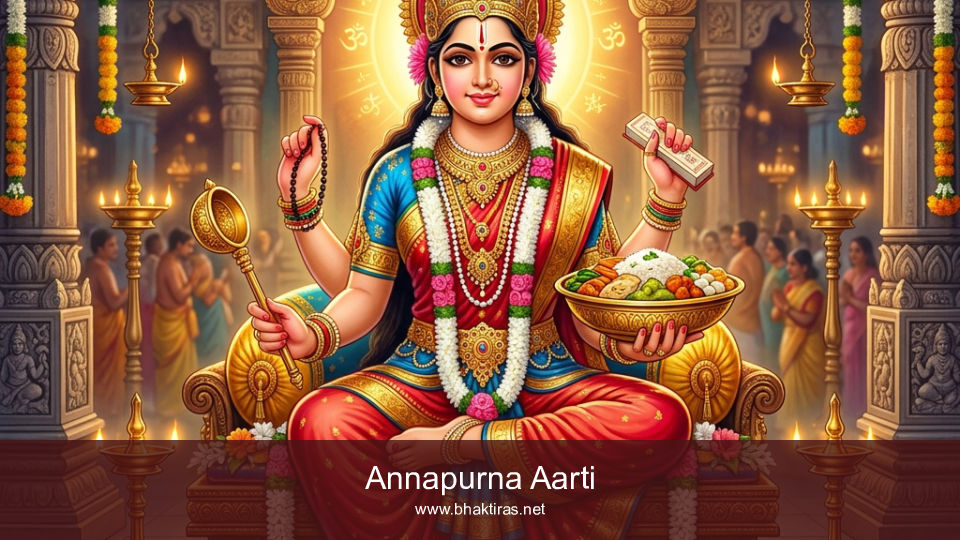
The Annapurna Aarti honours Goddess Annapurna, the form of Parvati worshipped as the source of food and plenty at Kashi. Each stanza returns to the line Barambar Pranam, Maiya Barambar Pranam, offering repeated salutations to the Mother who keeps no household hungry. Devotees sing it during kitchen worship, on Annapurna Jayanti, and at Annakut celebrations.
Annapurna Aarti Lyrics (English)
Roman transliteration for easy chanting. Tap “Meaning” under any verse for the English translation.
Refrain
Barambar pranam,
maiya barambar pranam.
Jo nahin dhyave tumhein Ambike, kahan use vishram.
Annapurna Devi naam tiharo, let hot sab kaam.
Meaning
Whoever fails to meditate on you, Mother Ambika, finds no rest or peace anywhere. Simply uttering the name Annapurna is enough to see every task fulfilled.
Pralay yugantar aur janmantar, kalantar tak naam.
Sur suron ki rachna karti, kahan Krishna kahan Ram.
Meaning
Through cosmic dissolution, changing ages, countless births and the long march of time, your name endures. You bring forth gods and beings alike, present long before Krishna or Ram appeared.
Chumahi charan chatur chaturanan, charu chakradhar Shyam.
Chandrachud chandranan chakar, shobha lakhahi lalaam.
Meaning
Four-faced Brahma and the dark, discus-bearing Vishnu touch your feet in reverence. Moon-crested Shiva serves you like an attendant, and all gaze upon your matchless radiance.
Devi Dev dayaniya dasha mein, daya-daya tab naam.
Trahi-trahi sharanagat vatsal, sharan roop tab dhaam.
Meaning
When a devotee is reduced to a pitiable state, your very name becomes compassion itself. Tender toward those who surrender, you answer the cry of 'save me, save me' and are their true shelter.
Shreem, Hreem shraddha Shri Ai vidya, Shri Kleem Kamla kaam.
Kanti, bhrantimayi, kanti shantimayi, var de tu nishkaam.
Meaning
You are the seed-mantras Shreem and Hreem, and the living powers of faith, fortune, knowledge, Kleem and Kamala. Radiant and peace-giving, grant your blessing freely, untouched by any selfish motive.
Meaning & Significance
The aarti reads as a chain of salutations. Every stanza praises one aspect of Goddess Annapurna and then folds back into the refrain Barambar Pranam, so the act of bowing repeats like the act of eating each day. The name Annapurna joins two words, anna meaning grain or food and purna meaning complete, so she is the one whose store of food is never empty.
Beyond literal nourishment, the verses treat her as the power behind creation itself. She is said to endure past the dissolution of worlds, to be served by Brahma, Vishnu and Shiva, and to answer anyone who surrenders in distress. The closing stanza gathers her into the seed-syllables of Shakta worship, asking for a boon given without expectation of return.
How Do You Perform the Aarti?
- Prepare the space — Clean the kitchen or altar, place an image or idol of Goddess Annapurna, and keep a small offering of cooked food or grain ready.
- Light the lamp — Light a ghee diya and an incense stick, ideally facing the deity, and take a moment to settle the mind before you begin.
- Begin with the refrain — Start with 'Barambar Pranam, Maiya Barambar Pranam' and move through the verses at a steady, singable pace, returning to the refrain between stanzas.
- Circle the lamp — Rotate the lit diya gently in a clockwise motion before the deity as you sing, keeping the flame steady.
- Close and share — End with 'Mata Annapurna Ki Jai', offer the food as prasad, and distribute it so that no one present goes without.
What Are the Benefits of Singing This Aarti?
Regular recitation is believed to invite Goddess Annapurna’s grace over the home, especially where food and daily provision are concerned.
- Fullness in the home: The prayer is sung to ask that the kitchen and grain store stay stocked and that the family never faces want of food.
- A grateful mindset: Singing before meals or during cooking turns everyday eating into an act of thanks rather than something taken for granted.
- Calm and focus: The repeating refrain gives the chant a rhythm that steadies the breath and quiets a restless mind.
- A habit of giving: Offering the prasad and sharing it afterward keeps the practice tied to feeding others, which is the heart of Annapurna worship.
- Devotional continuity: It fits naturally into Annapurna Jayanti, Annakut and daily puja, giving households a simple, repeatable way to honour the goddess.
Who Wrote This Aarti?
The Annapurna Aarti is a traditional Hindi devotional composition and no single author is recorded for it. It has passed down through oral practice and printed aarti collections, and is closely tied to the worship of Goddess Annapurna at Kashi (Varanasi), where her temple stands near the Kashi Vishwanath shrine. Small wording differences appear between printed versions, which is common for hymns carried by memory rather than a fixed manuscript.
Frequently Asked Questions
What is the Annapurna Aarti?
The Annapurna Aarti is a Hindi devotional hymn to Goddess Annapurna, the giver of food and nourishment, sung with the refrain 'Barambar Pranam' to seek her grace and abundance.
Who is Goddess Annapurna?
Annapurna is a form of Parvati worshipped as the goddess of food and plenty. Her name means 'full of food', and her main shrine is at Kashi (Varanasi), close to Kashi Vishwanath.
When should the Annapurna Aarti be sung?
It is commonly sung during daily kitchen worship, on Annapurna Jayanti (Margashirsha Purnima), and at Annakut celebrations after Diwali, though it can be recited any day with devotion.
What does 'Barambar Pranam' mean?
'Barambar Pranam, Maiya Barambar Pranam' means 'repeated salutations, O Mother, again and again salutations'. It is the recurring refrain that ties the whole aarti together.
What are the benefits of singing the Annapurna Aarti?
Devotees sing it to seek an unfailing supply of food and prosperity for the home, to cultivate gratitude at mealtimes, and to keep the tradition of sharing food with others.
॥ माता अन्नपूर्णा की जय ॥