
Aarti Kije Hanuman Lala Ki
आरती कीजै हनुमान लला की
What is Aarti Kije Hanuman Lala Ki?
Aarti Kije Hanuman Lala Ki Aarti Kije Hanuman Lala Ki is the most widely sung Hindi aarti to Lord Hanuman, praising him as the destroyer of the wicked and Rama's mighty servant, and it is offered with a lamp especially on Tuesdays and Saturdays.
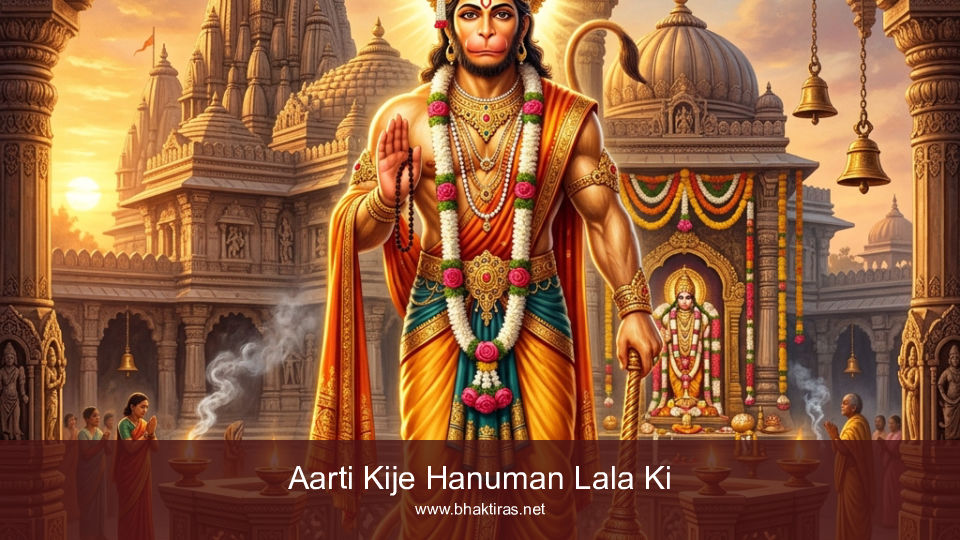
If you have ever attended a Hanuman temple as the evening lamp is raised, this is almost certainly the aarti you heard the crowd sing. “Aarti Kije Hanuman Lala Ki” is short enough to learn by heart in a single sitting, yet it packs the whole arc of Hanuman’s story into a handful of couplets — the leap across the ocean, the burning of Lanka, the rescue of Lakshmana with the sanjivani herb, and the pulling apart of Ahiravana in the netherworld. Devotees favour it on Tuesday and Saturday, the two days traditionally set aside for Hanuman worship, and the closing couplet credits the sentiment to the poet-saint Tulsidas. Below you will find the verses in Devanagari with a clean Roman transliteration and a plain-English meaning for each part, so you can both sing along and understand what you are singing.
Aarti Kije Hanuman Lala Ki Lyrics
Roman transliteration for easy chanting. Tap “Meaning” under any verse for the English translation.
Refrain
Aarti kije Hanuman lala ki
Dusht dalan Raghunath kala ki
Jaake bal se girivar kaampe
Rog dosh jaake nikat na jhaanke
Meaning
Before his strength even great mountains shudder; near a devotee of his, no illness or fault dares to come close.
Anjani putra mahabaldaayi
Santaan ke prabhu sada sahaai
Meaning
Son of Anjana and bestower of immense might, he is ever the protector who stands by his devotees like a guardian of their family.
De beera Raghunath pathaae
Lanka jaari siya sudh laae
Meaning
Entrusted with the mission by Rama, he crossed to Lanka, set the city aflame, and brought back news of Sita.
Lanka so kot samudra si khaai
Jaat pavansut baar na laai
Meaning
Lanka was ringed by a fortress and a moat as wide as the sea, yet the son of the wind crossed over without a moment's delay.
Lanka jaari asur sanhaare
Siyaram ji ke kaaj sanvaare
Meaning
He burned Lanka, put its demons to rout, and set right every task in the service of Sita and Rama.
Lakshman moorchhit pade sakaare
Aani sanjivan praan ubaare
Meaning
When Lakshmana lay unconscious at daybreak, Hanuman fetched the life-giving sanjivani herb and revived him.
Paithi pataal tori jamkaare
Ahiravan ki bhuja ukhaade
Meaning
He descended into the netherworld, shattering its bars, and tore the arms from the demon Ahiravana.
Baayein bhuja asur dal maare
Daahine bhuja santjan taare
Meaning
With his left arm he strikes down armies of demons, and with his right he lifts up and delivers the righteous.
Sur-nar-muni jan aarti utaare
Jai jai jai Hanuman uchaare
Meaning
Gods, humans and sages together wave the lamp before him, raising the cry of victory: Jai Jai Jai Hanuman.
Kanchan thaar kapoor lau chhaai
Aarti karat Anjana maai
Meaning
On a golden platter the camphor flame glows, and mother Anjana herself performs the aarti of her son.
Closing
Lankvidhwans kinh Raghuraai
Tulsidas prabhu keerti gaai
Meaning & Significance
The heart of this aarti is a single idea repeated in the refrain: Hanuman is both a destroyer of what is harmful (dusht dalan) and an extension of Rama’s own power (Raghunath kala). Everything that follows is evidence for that claim, drawn straight from the Ramayana.
The middle couplets move quickly through his best-known feats — leaping a sea-wide moat, torching Lanka, carrying back word of the captive Sita, and reviving a wounded Lakshmana with the sanjivani herb brought from the mountains. The verse about descending into the netherworld to defeat Ahiravana comes from the later folk-Ramayana tradition and shows Hanuman rescuing Rama and Lakshmana themselves, not just serving them.
Two images carry the emotional weight. The left-arm-and-right-arm couplet frames him as perfectly balanced — fierce toward evil, gentle toward the sincere. And the final scenes, where gods and sages wave the lamp and his own mother Anjana performs his aarti, turn the singer into one more participant in a worship that the whole cosmos is already offering. The signature line names Tulsidas, tying the hymn to the devotional stream of the Ramcharitmanas.
How Do You Perform the Aarti?
- Choose the day and a clean spot — Tuesday and Saturday are the customary days for Hanuman worship; sit facing an image or picture of Hanuman in a tidy, quiet place.
- Light the lamp and camphor — Place a ghee or oil lamp, or a piece of camphor, on a metal plate. Light it and, if you wish, add a stick of incense.
- Offer a simple invocation — Bow, fold your hands, and remember Hanuman and Lord Rama before you begin. A short 'Jai Shri Ram' or 'Jai Hanuman' sets the intent.
- Sing the aarti while circling the lamp — Move the lit plate gently in clockwise circles before the image as you sing, beginning and returning to the refrain 'Aarti kije Hanuman lala ki'.
- Close with the flame and prasad — After the final couplet, hold the plate steady, pass your palms over the flame and to your eyes, and share any offered prasad such as boondi, jaggery or fruit.
What Are the Benefits of Singing This Aarti?
Devotees turn to this aarti as a short, steadying daily practice. The following are traditional beliefs and cultural associations, not medical or guaranteed claims.
- Courage in the face of fear: Hanuman is invoked as the remover of fear; singing his aarti is felt to steady the mind before difficult tasks.
- A sense of protection: The refrain names him as the crusher of the wicked, and devotees sing it seeking shelter from harm and negativity.
- Focus and discipline: Its short length makes it easy to sing daily, building a simple, repeatable devotional habit.
- Strength through service: The verses celebrate selfless service to Rama, offering a model of humility paired with great capability.
- Community and belonging: As the most common Hanuman aarti, it is one almost everyone can join in temples and home gatherings, especially on Tuesdays and Saturdays.
Who Wrote This Aarti?
The closing couplet carries the signature of Tulsidas (c. 1532–1623), the poet-saint best known for the Ramcharitmanas and the Hanuman Chalisa. As with much devotional aarti, the text circulated orally for generations and appears in slightly different regional wordings, so it is best regarded as a traditional composition in the Tulsidas devotional stream rather than a single fixed authored work. The version given here follows the widely sung standard recension.
Frequently Asked Questions
What is Aarti Kije Hanuman Lala Ki?
Aarti Kije Hanuman Lala Ki is the most widely sung Hindi aarti to Lord Hanuman, praising him as the destroyer of the wicked and Rama's mighty servant, and it is offered with a lamp especially on Tuesdays and Saturdays.
On which days is this Hanuman aarti sung?
It is most commonly sung on Tuesday and Saturday, the two days traditionally associated with Hanuman worship, though devotees may sing it any day as part of their daily prayers.
Who wrote Aarti Kije Hanuman Lala Ki?
The final couplet bears the signature of the poet-saint Tulsidas, but the aarti has been passed down orally in several regional wordings, so it is best treated as a traditional composition in his devotional tradition.
What does the aarti describe?
It recounts Hanuman's famous feats from the Ramayana — leaping across the ocean, burning Lanka, bringing news of Sita, reviving Lakshmana with the sanjivani herb, and defeating the demon Ahiravana in the netherworld.
How long does it take to sing?
The aarti is short, usually taking about three to four minutes to sing at a normal pace, which is part of why it is so popular for daily worship.
जय जय जय हनुमान गोसाईं। कृपा करहु गुरुदेव की नाईं॥ जय श्री राम, जय हनुमान॥