
Vautha Mela 2026 – Gujarat's Great Donkey and Camel Fair
વૌઠાનો મેળો
When is Vautha Mela in 2026?
Vautha Mela peaks on Kartik Purnima, which falls on Tuesday 24 November 2026. The fair runs for roughly five days, from Kartik Sud Ekadashi to the full-moon night, at Vautha village in Dholka taluka, Ahmedabad district, Gujarat. It is India’s largest donkey fair and one of the biggest rural animal markets in the country.
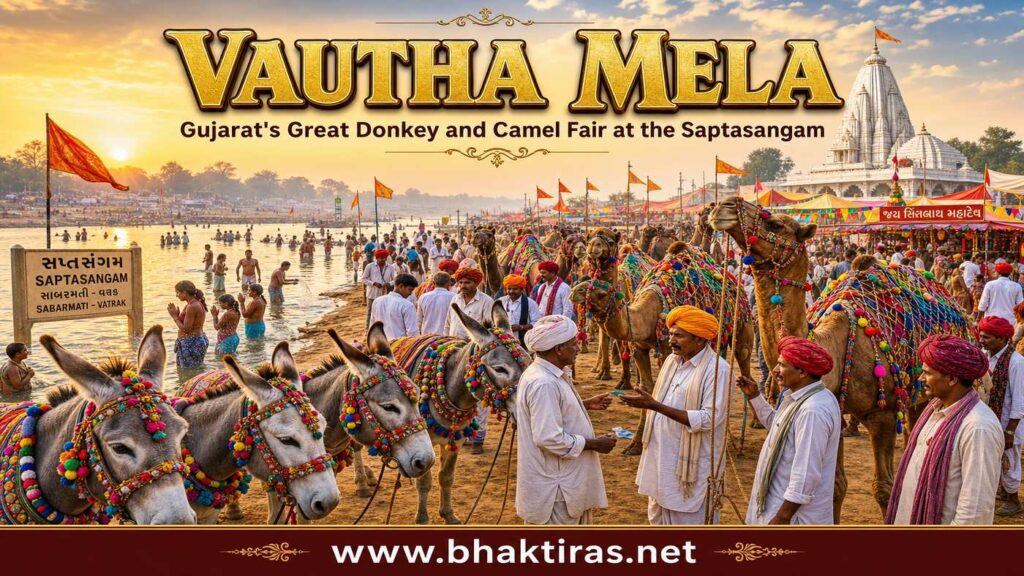
Vautha Mela is Gujarat’s largest rural fair, held every year at Vautha, a small village where the Sabarmati and Vatrak rivers meet at a spot locals call the Saptasangam, the meeting of seven waters. It runs for about five days around Kartik Purnima, the November full moon, and pulls in lakhs of visitors. Two things happen side by side here: a vast livestock market where thousands of donkeys and camels change hands, and a sacred gathering where pilgrims take a holy dip at the confluence and worship at the Siddhanath Mahadev temple.
Vautha Mela 2026-2028: Dates & Calendar
Vautha Mela is timed to Kartik Purnima, so its main day shifts each year with the Hindu lunar calendar. The 2026 fair peaks on 24 November, with trading and bathing spread over the days leading up to it.
| Year | Kartik Purnima | Day | Notes |
|---|---|---|---|
| 2026 | 24 November | Tuesday | Fair runs approx. 20-24 November |
| 2027 | 14 November | Sunday | Fair around 10-14 November |
| 2028 | 2 November | Thursday | Fair around late October to 2 November |
The animal market usually builds up over the earlier days of the fair, while the largest crowds for the holy dip gather on the full-moon night itself. Local administration sets up the mela ground, water and sanitation only for this short window each year.
Why Vautha Mela Is Held
Vautha Mela sits at the crossing of faith and rural trade. It marks Kartik Purnima at a river confluence considered sacred, and it has grown over generations into the biggest animal fair in Gujarat.
The site itself is the draw. Vautha lies where the Sabarmati and Vatrak join, and older tradition counts this as the Saptasangam, the confluence of seven streams. Bathing at a river meeting on a full-moon night carries deep merit in Hindu practice, and Kartik Purnima is one of the holiest bathing days of the year.
The Saptasangam
Vautha’s confluence is remembered as the joining of seven waters, chiefly the Sabarmati and Vatrak. Bathing where rivers meet is held to wash away sins, and doing so on Kartik Purnima multiplies that belief. Pilgrims travel from across Gujarat for this single dip.
Kartik Purnima merit
Kartik Purnima closes the holy month of Kartik and is linked to Shiva’s victory over the demon Tripurasura and to Kartikeya, Shiva’s son. Fairs and river baths across India mark the day. At Vautha the observance and the trade fair fall together.
A rural marketplace
For herding and trading communities, the mela is a working event, not only a religious one. It is one of the few large fairs in India where donkeys are the main animal sold, drawing breeders and buyers who plan their year around it.
Folk and social life
Beyond the animals and the dip, the fair is a meeting ground. Families camp on the sandy riverbanks, stalls and folk performers arrive, and the event doubles as a rural social gathering for the region around Dholka.
Deities & Figures Worshipped
Worship at Vautha centres on Shiva at the local Siddhanath Mahadev temple and on the sacred river confluence itself. The fair is traditionally associated with Kartikeya, Shiva’s son.
Siddhanath Mahadev
The Siddhanath Mahadev temple at Vautha is the focus of temple worship during the mela. Pilgrims offer prayers to Shiva here after bathing at the confluence, and the temple stays busy through the full-moon days.
Kartikeya
The fair is linked to Kartikeya, the son of Shiva and Parvati. Folk memory holds that he performed rituals on this riverbank during Kartik Purnima, which is why the day carries special weight at Vautha.
The Saptasangam
The river confluence is itself treated as sacred. The holy dip at the meeting of the waters, rather than any single idol, is what many pilgrims come for, and it is the spiritual heart of the gathering.
A Visit to Vautha, Step by Step
A typical day at the mela weaves together the sacred dip, temple darshan and a long walk through the animal market and fair.
- Reach the mela ground. Vautha is about 60 km south of Ahmedabad, near Dholka. Most visitors arrive by road; extra buses and parking are arranged for the fair days.
- Take the holy dip. Pilgrims bathe at the Saptasangam, the confluence of the Sabarmati and Vatrak, ideally at dawn on Kartik Purnima. The full-moon bath is the central religious act of the fair.
- Offer prayers at Siddhanath Mahadev. After the dip, devotees head to the Siddhanath Mahadev temple for Shiva darshan, offering water, flowers and bel leaves.
- Walk the animal market. The livestock ground is where thousands of donkeys and camels, along with horses and other animals, are shown and traded. Many donkeys are painted and decorated for display.
- Explore the cultural fair. Rows of stalls sell handicrafts, utensils, sweets and everyday goods. Folk performers, rides and food vendors turn the riverbank into a small temporary town.
- Stay for the evening. Lamps and the full-moon light on the water make the night atmospheric, and it is when the crowds and the fair energy peak.
Food at Vautha Mela
Fair food here is classic Gujarati mela fare – hot, fried, sweet and eaten standing up between the stalls.
Ganthiya & fafda
Crisp gram-flour ganthiya and fafda are the default snack at any Gujarati fair, usually served with fried green chillies and a tangy chutney. Vendors fry them fresh through the day.
Jalebi
Coils of jalebi, fried and soaked in syrup, are sold hot from bubbling pans. The fafda-jalebi pairing is a beloved Gujarati combination and easy to find across the mela.
Local sweets & farsan
Stalls carry an assortment of Gujarati sweets and savoury farsan, from pedas and chikki to dhokla and samosas, meant for eating on the move.
Chai & sugarcane juice
Cups of milky masala chai and glasses of fresh sugarcane juice keep visitors going through long, dusty hours of walking the fair grounds.
Where Vautha Mela Fits
Vautha is a local fair with a wide reach – a Gujarat event that draws traders and pilgrims from across the state and neighbouring regions.
Vautha & Dholka
The fair is held at Vautha village in Dholka taluka, Ahmedabad district, on the sandy banks where the Sabarmati and Vatrak meet. For most of the year the site is quiet farmland; the mela transforms it for a few days.
Gujarat's largest animal fair
Among Gujarat’s many fairs, Vautha is the biggest rural animal market, and unusual across India for centring on donkeys. It sits alongside events like the Tarnetar fair in the state’s calendar of folk gatherings.
Trading communities
Herding and trading communities, including the Vanzara (Banjara), bring animals here from across the region. For them the mela is an annual economic fixture as much as a festival.
Vautha Mela Do's and Don'ts
A short guide for visiting the fair respectfully and comfortably.
Do
- Reach the confluence early for the dawn holy dip, before the biggest crowds arrive
- Carry water, a hat and comfortable shoes; the mela ground is large, sandy and dusty
- Keep cash handy, as many stalls and traders do not take cards
- Be gentle and considerate around the animals, and give working donkeys and camels space
- Keep an eye on children and belongings in the dense full-moon crowds
Avoid
- Do not encourage or photograph any mistreatment of the fair animals; report welfare concerns to authorities
- Do not enter the temple with footwear or in a hurry during peak darshan
- Do not litter or leave plastic on the riverbanks after bathing
- Do not wade into deep or fast water at the confluence; stay in the safe bathing area
- Do not haggle aggressively or handle animals you are not buying
Frequently Asked Questions
When is Vautha Mela in 2026?
Vautha Mela peaks on Kartik Purnima, which falls on Tuesday 24 November 2026. The fair runs for about five days, from Kartik Sud Ekadashi up to the full-moon night, at Vautha village in Dholka taluka, Ahmedabad district, Gujarat.
When is Vautha Mela in 2027 and 2028?
Vautha Mela follows Kartik Purnima each year. In 2027 the full moon falls on Sunday 14 November, and in 2028 it is on Thursday 2 November. The exact fair dates can shift by a day depending on the regional panchang.
Where is Vautha Mela held?
Vautha Mela is held at Vautha, a village in Dholka taluka of Ahmedabad district, Gujarat, about 60 km south of Ahmedabad city. The fairground sits at the Saptasangam, where the Sabarmati and Vatrak rivers meet.
Why is Vautha Mela famous?
Vautha Mela is famous as India’s largest donkey fair and Gujarat’s biggest rural animal market, where thousands of donkeys and camels are traded. It combines this huge livestock fair with a sacred Kartik Purnima dip at the river confluence and worship at the Siddhanath Mahadev temple.
What animals are traded at Vautha Mela?
The main animals traded at Vautha Mela are donkeys and camels, with donkeys being the signature attraction; horses and other livestock are also sold. Traders, including the Vanzara community, bring thousands of animals, many of them painted and decorated for display.
Which god is worshipped at Vautha Mela?
Worship at Vautha centres on Shiva at the Siddhanath Mahadev temple, and the fair is traditionally associated with Kartikeya, Shiva’s son. The sacred confluence of the Sabarmati and Vatrak is itself treated as holy, and the Kartik Purnima dip is the central religious act.
How many people attend Vautha Mela?
Vautha Mela draws very large crowds, with attendance estimated at several lakh visitors over its five days. They include pilgrims coming for the holy dip, animal traders and buyers, and families visiting the cultural fair.
How do I reach Vautha for the mela?
Vautha is reached by road, roughly 60 km south of Ahmedabad near Dholka. During the fair, extra buses and transport run to the site; visitors can also drive or hire a taxi, then walk into the mela ground on foot.
Whether you go for the dawn dip at the Saptasangam or to watch a sea of decorated donkeys change hands, Vautha Mela is one of Gujarat’s most memorable gatherings.