
Mahishadal Rath Yatra 2026 – Bengal's Towering Wooden Chariot
মহিষাদল রথযাত্রা
When is Mahishadal Rath Yatra in 2026?
Mahishadal Rath Yatra falls on Thursday, 16 July 2026. It is held on Ashadha Shukla Dwitiya, the same day as the Puri Rath Yatra. The Rajbari’s 75-foot wooden chariot of Madangopal is pulled through Mahishadal town, and a fair runs for about a week until Ulto Rath (the return journey).
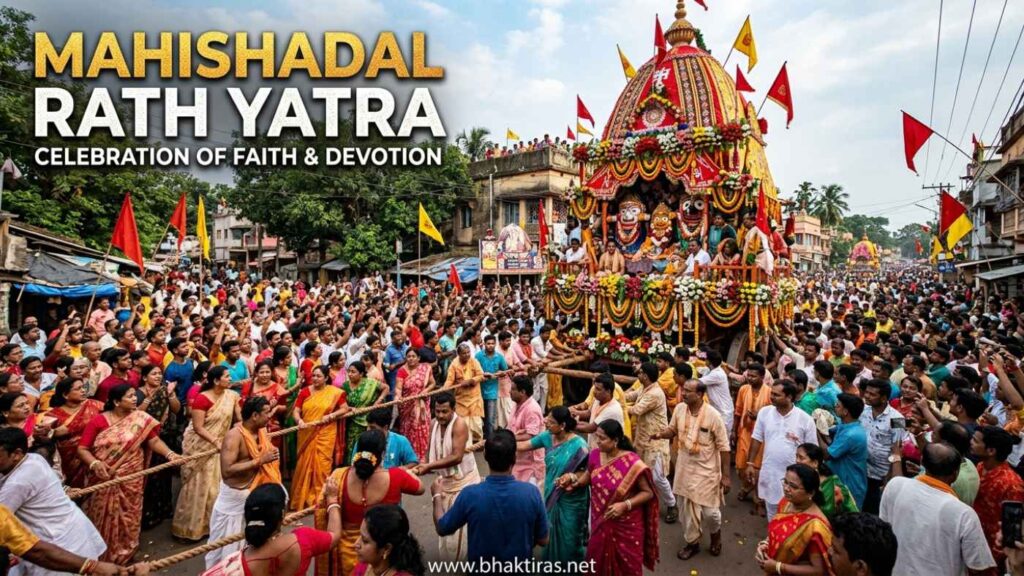
Mahishadal Rath Yatra is one of West Bengal’s oldest and largest chariot festivals, held every year at Mahishadal in Purba Medinipur district. Started by Rani Janaki Devi of the Mahishadal royal estate in 1776, it centres on Madangopal, a form of Krishna, whose deities ride a giant wooden rath through the town. Falling on Ashadha Shukla Dwitiya (16 July in 2026), the same day as Puri, it draws enormous crowds to a fair that runs for roughly a week until the return journey, Ulto Rath.
Mahishadal Rath Yatra 2026-2028: Dates & Calendar
The next Mahishadal Rath Yatra is on 16 July 2026. The date shifts each year because it follows the Hindu lunar month of Ashadha, not the Western calendar.
| Year | Rath Yatra | Day | Ulto Rath (return) |
|---|---|---|---|
| 2025 | 27 June | Friday | 5 July |
| 2026 | 16 July | Thursday | 24 July |
| 2027 | 5 July | Monday | 13 July |
| 2028 | 24 June | Saturday | 2 July |
The main pulling of the rath happens on the first day; the deities stay at the Gundicha-style resting spot for the week, and the reversed chariot procession (Ulto Rath) brings them back. The fair around Rath-tala continues for close to a month.
Why Mahishadal Rath Yatra Is Celebrated
Mahishadal Rath Yatra celebrates the annual outing of Madangopal, a form of Krishna, on a huge wooden chariot, a tradition the royal family has kept alive since 1776.
The festival marks the day the deity leaves his temple to travel among ordinary people, echoing the Puri belief that on this one day everyone, regardless of caste or standing, may pull the ropes and earn merit. In Mahishadal that idea is wrapped around more than two centuries of Rajbari patronage, making it as much a community heritage event as a religious one.
A royal vow from 1776
Rani Janaki Devi, who ruled the Mahishadal estate from 1770 to 1804, built the Madangopal temple around 1774 and began the Rath Yatra in 1776. The festival has run every year since, funded and led by the royal family for over 200 years.
The world's tallest wooden rath
The Mahishadal chariot stands about 75 feet high on a 28-foot square base and rolls on 36 wheels. It is widely described as the tallest wooden chariot in India, and locals take real pride in that claim.
From 17 spires to 13
The rath was originally a 17-pinnacle structure. In 1860 it was reduced to 13 spires, with the lower four replaced by carved wooden figures holding flags. The idle chariot rests all year at Rath-tala, the square at the town’s centre.
One of Bengal's big three
Alongside the Mahesh Rath Yatra near Serampore and Puri’s grand procession, Mahishadal is counted among the most celebrated chariot festivals of eastern India. Each has its own flavour, but all share the same tithi and the same joy.
Deities & Figures Worshipped
The presiding deity is Madangopal, a playful form of Krishna, worshipped at the Rajbari’s temple. During the yatra the Jagannath triad also rides in the chariot.
Madangopal
Madangopal is a form of Krishna as the charming cowherd god, the family deity of the Mahishadal royal house. His temple, built around 1774, is the heart of the whole festival, and the rath is named the Madangopal Jew Rath in his honour.
Jagannath, Balabhadra & Subhadra
A smaller shrine within the temple holds the images of Jagannath, his brother Balabhadra and sister Subhadra. These are the deities placed on the towering rath and drawn through the town, tying Mahishadal directly to the Jagannath tradition of Puri.
Key Rituals, Step by Step
The day follows a fixed order, blending temple worship with the very public act of dragging a 75-foot chariot through a crowd.
- Morning worship. Priests perform the day’s puja to Madangopal at the Rajbari temple, and the small images of Jagannath, Balabhadra and Subhadra are readied for their journey.
- Deities carried to the rath. The three images are brought out in procession and installed on the decorated wooden chariot standing at Rath-tala.
- The royal first pull. By old custom the chariot only begins to move after a member of the royal family, arriving in a palanquin from the palace, tugs at the ropes first.
- Pulling the rath. Four thick ropes are used, and one of them is kept for women. Thousands of devotees haul the huge chariot slowly along the route while drums, conches and chants fill the air.
- The week-long stay. The deities rest at the destination for about a week, treated as honoured guests, while daily worship continues.
- Ulto Rath. On the return day the chariot is drawn back the reverse way to the temple, completing the cycle. In 2026 this falls on 24 July.
- The fair. Around all of this the Rather Mela spreads out near Rath-tala, running for close to a month with stalls, food, toys and rides.
Special Foods of Mahishadal Rath Yatra
Food is half the fun of a Bengali rath. The temple offers a traditional bhog, while the mela is famous for sticky sweets and crunchy fried snacks.
Khichuri bhog
The classic Rath Yatra offering in Bengal is khichuri cooked with fragrant Gobindobhog rice, served with labra (a mixed vegetable dish), fritters and payesh. It is distributed as prasad and eaten by families through the day.
Jilipi (jalebi)
No Bengali rath fair is complete without jilipi, spirals of batter fried and soaked in syrup. Children wander the mela with hands sticky from these bright orange coils.
Papor bhaja
Crisp papor bhaja, or fried papad, is sold hot from open pans across the fairground. It is the salty, crunchy partner to all the sweets.
Bengali sweets
Stalls pile up malpoa, khir, chhanar sweets and seasonal treats. Along with these, kids gravitate to the paper-cone snacks and colourful sugar sticks unique to rath fairs.
Mahishadal in Bengal's Rath Yatra Map
Mahishadal sits within a wider Bengali chariot tradition. A quick comparison shows how it stands beside the other famous raths.
Mahishadal, Purba Medinipur
Set in the town of Mahishadal near Haldia, this is a Rajbari-led festival built around Madangopal. Its selling point is the sheer height of the chariot and the royal ritual of the first pull, followed by a fair that lasts weeks.
Mahesh, Hooghly
The Mahesh Rath Yatra near Serampore is often called the second oldest in India after Puri, running since 1396. Its iron chariot and 600-plus year history make it Bengal’s most historic rath, and a natural companion visit to Mahishadal.
Puri, Odisha
The Puri Rath Yatra is the grandest of all, with three separate chariots for Jagannath, Balabhadra and Subhadra and crowds in the lakhs. Mahishadal shares its exact date and its Jagannath connection, but keeps a distinctly Bengali, small-town warmth.
Mahishadal Rath Yatra Do's and Don'ts
The chariot pulling draws a dense crowd, so a little planning keeps the day joyful and safe.
Do
- Reach Rath-tala early to find a good, safe vantage point before the crowd swells.
- Keep children close and hold hands during the rope pulling.
- Carry water and wear light cotton clothing for the July heat and humidity.
- Try the temple khichuri bhog and the fair jilipi and papor.
- Respect the royal family’s ritual first pull before joining the ropes.
Avoid
- Do not push or rush toward the moving chariot; the rath is enormous and slow to stop.
- Do not bring young infants into the thickest part of the pulling crowd.
- Do not litter the fairground or temple precinct.
- Do not block the rath’s path or climb the wheels for photos.
- Do not leave valuables loose in your pockets in the packed mela.
Frequently Asked Questions
When is Mahishadal Rath Yatra in 2026?
Mahishadal Rath Yatra is on Thursday, 16 July 2026. It falls on Ashadha Shukla Dwitiya, the same day as the Puri Rath Yatra, and the return journey (Ulto Rath) follows around 24 July 2026.
When is Mahishadal Rath Yatra in 2027 and 2028?
Mahishadal Rath Yatra falls on 5 July 2027 (Monday) and 24 June 2028 (Saturday). The date moves each year because it is fixed to Ashadha Shukla Dwitiya in the Hindu lunar calendar, which usually lands in late June or July.
Why is Mahishadal Rath Yatra celebrated?
Mahishadal Rath Yatra celebrates the yearly outing of Madangopal, a form of Krishna, on a giant wooden chariot. Rani Janaki Devi of the Mahishadal royal estate began the tradition in 1776, and the royal family has continued it for over 200 years.
Which deity is worshipped at Mahishadal Rath Yatra?
The presiding deity is Madangopal, a form of Krishna and the family deity of the Mahishadal royal house. The images of Jagannath, Balabhadra and Subhadra are the ones placed on the chariot and pulled through the town.
How tall is the Mahishadal chariot?
The Mahishadal rath stands about 75 feet high on a 28-foot square base and runs on 36 wheels. It is widely regarded as the tallest wooden chariot in India, and once had 17 spires before being reduced to 13 in 1860.
Where is Mahishadal Rath Yatra held?
Mahishadal Rath Yatra is held at Mahishadal, a town in Purba Medinipur district of West Bengal, near Haldia. The chariot is pulled from the Rajbari’s Rath-tala square, and a large fair spreads around the town.
How is Mahishadal different from the Puri and Mahesh Rath Yatras?
Mahishadal shares the same date and the Jagannath link with Puri, but it is a royal, small-town festival led by the Mahishadal family since 1776 with a record-tall wooden chariot. The Mahesh Rath Yatra near Serampore is older, dating to 1396, with an iron chariot, while Puri is the grandest, using three separate raths.
What is Ulto Rath at Mahishadal?
Ulto Rath is the return chariot journey, held about a week after the main Rath Yatra, when the deities are drawn back to the temple. In 2026 it falls around 24 July, and the fair around Rath-tala continues well beyond it.
May Madangopal’s rath roll smoothly and bring joy to every hand on the rope. Ratha Yatrar shubhechha!