
Sakrain 2027 – Old Dhaka's Kite Festival
সাকরাইন
When is Sakrain in 2027?
Sakrain falls on 14 January 2027 (Thursday). It is the kite festival held on the last day of the Bengali month of Poush, coinciding with Poush Sankranti (Makar Sankranti). Rooftops across Old Dhaka fill with colourful kites by day, and the night sky lights up with fireworks and paper lanterns.
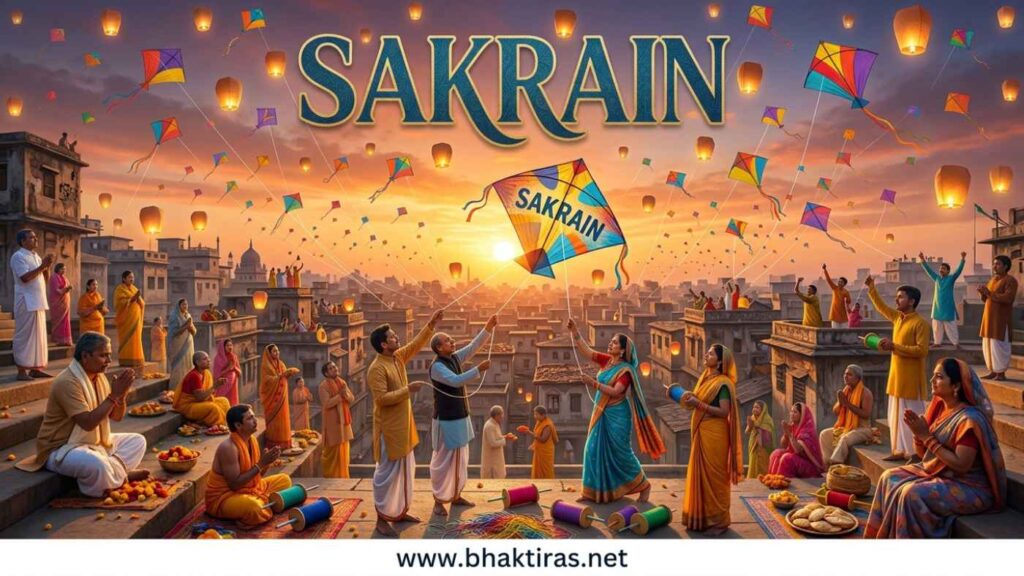
Sakrain is the winter kite festival of Old Dhaka, held on the last day of the Bengali month of Poush – the same day Bengalis mark Poush Sankranti and much of India keeps Makar Sankranti. It is a folk and seasonal celebration rather than a temple ritual: neighbourhoods take to their rooftops, cut each other’s kites through the afternoon, and then turn the evening over to fireworks, floating lanterns and music. In 2027 it falls on 14 January, closing the winter harvest and welcoming the month of Magh.
Sakrain 2026-2028: Dates & Calendar
The next Sakrain is on 14 January 2027. The date is fixed by the sun, not the moon, so it lands on 14 or 15 January every year, on the last day of Poush.
| Year | Date | Day | Notes |
|---|---|---|---|
| 2026 | 14 January | Wednesday | Poush Sankranti |
| 2027 | 14 January | Thursday | Next Sakrain |
| 2028 | 15 January | Saturday | Leap-year shift to the 15th |
The festival is a single day, running from morning kite-flying through to fireworks and lanterns late into the night. Because it tracks the sun rather than the lunar tithi, it does not drift the way most Hindu festivals do; the 15 January date in 2028 is the usual leap-year adjustment.
Why Sakrain Is Celebrated
Sakrain marks the end of Poush and the winter harvest, celebrated on Poush Sankranti with kite-flying, fireworks and community feasting. It is a seasonal and cultural festival for Old Dhaka’s Bengali community rather than a worship of any one deity.
End of Poush, start of Magh
The festival falls on the last day of Poush, the ninth month of the Bengali calendar, as the sun turns north on Sankranti. It quietly celebrates the close of the winter paddy harvest and the shift into Magh, when date-palm sap and fresh rice are at their best.
A rooftop tradition of Old Dhaka
Sakrain is most closely tied to Puran Dhaka (Old Dhaka), where flat rooftops turn into open-air arenas. Local histories trace the kite-flying custom in the old city back to around the 1740s, under the Mughal-era administrator Nawajesh Muhammad Khan, giving it nearly three centuries of continuity.
From daytime duels to night lights
The day belongs to kites and cutting contests; the night belongs to spectacle. Over recent decades the celebration has grown a second half, with fireworks, floating paper lanterns (fanush) and fire-blowing displays after sundown, turning the same rooftops into a light show.
A shared, cross-community day
For generations, Hindu and Muslim families of the old city have flown kites side by side on Sakrain. It works less as a religious observance and more as a neighbourhood bonding day, where rooftops, food and music are shared across households.
What Happens on Sakrain
Sakrain unfolds in two halves: kite duels through the day, then fireworks, lanterns and music after dark.
- Rooftops made ready. Families clear their roofs, string up decorations and lay in stocks of kites (ghuri, called ghuddi in the old town), reels of thread and food for the day.
- Daytime kite-flying. From late morning the sky over Old Dhaka fills with kites of every colour and shape, flown from roof to roof across the narrow lanes.
- Kite-cutting duels (manja). Fliers try to snap rivals’ strings in mid-air; a kite sent drifting free is a win, and children chase the fallen ones through the alleys below.
- Music and feasting. Groups gather on rooftops with speakers and traditional Jari, Shari and Bhatiali songs, sharing pithas, muri and winter sweets between rounds of flying.
- Sundown fireworks. As light fades the kites come down and fireworks go up, with crackers and sky-shots set off from rooftops along the Buriganga.
- Lanterns and fire displays. Paper lanterns (fanush) drift up into the dark, and fire-blowers on the roofs breathe streams of flame for the crowds below.
- Late-night gatherings. The celebration carries on well into the night, with music, food and lights keeping neighbourhoods awake across the old city.
Special Foods of Sakrain
Sakrain shares the winter-harvest table of Poush Sankranti: pithas, date-palm jaggery sweets and rice-milk puddings.
Bhapa pitha
Steamed rice-flour cakes filled with molten date-palm jaggery (khejur gur) and grated coconut. Soft, warm and lightly sweet, they are the signature pitha of the Poush season on both sides of Bengal.
Patishapta
Thin rice-and-flour crepes rolled around a filling of coconut, khoya and jaggery. They are among the most loved Poush Sankranti sweets, made fresh at home for the festival.
Payesh
A slow-cooked rice pudding of milk, freshly harvested rice and, in winter, nolen gur (fresh date-palm jaggery), which gives it a deep caramel colour and aroma special to this time of year.
Muri and chira
Puffed rice (muri) and flattened rice (chira), often with jaggery or molasses, are the easy rooftop snacks passed around between kite-flying rounds through the day.
Date-palm jaggery sweets
Khejur gur, tapped from date palms in the cold months, flavours a whole range of Poush sweets and syrups. Its short winter season is part of why the festival lands when it does.
Regional Names & Variations
The same Poush Sankranti day is kept differently across Bengal and beyond.
Old Dhaka (Sakrain / Ghuri Utsob)
The best-known kite version, centred on Puran Dhaka. Here the day is defined by rooftop kite duels, and the night by fireworks, fanush lanterns and fire-blowing shows unique to the old city’s celebration.
West Bengal (Poush Sankranti / Poush Parbon)
In West Bengal the day is Poush Parbon, marked mainly at home with pitha-making, payesh and family gatherings, and at riverside fairs and holy dips rather than large kite contests.
Wider Bengal and diaspora
Bengali communities elsewhere keep the day as a harvest and pitha festival, with kite-flying carried on by families and clubs with roots in Old Dhaka wherever they have settled.
Across India (Makar Sankranti)
The same solar Sankranti is Makar Sankranti nationwide, celebrated as Uttarayan with kites in Gujarat, as Pongal in Tamil Nadu and as Lohri and Magh Bihu further north and east.
Sakrain Do's and Don'ts
A few sensible habits keep the day joyful and safe for people, birds and rooftops.
Do
- Fly kites from safe, walled rooftops and keep young children back from the edge.
- Choose bird-safe cotton thread and avoid sharp glass-coated or synthetic manja.
- Handle fireworks and fanush lanterns with adult supervision and water kept nearby.
- Share food, music and space generously with neighbours – it is that kind of day.
- Clear away fallen kite string afterwards so it does not trap birds or animals.
Avoid
- Do not use glass-coated or metallic (Chinese) manja – it cuts birds, people and power lines.
- Do not lean out over unguarded roof edges while chasing or cutting kites.
- Do not set off fireworks near dry decorations, gas lines or crowded stairwells.
- Do not fly kites near overhead electric wires or transformers.
- Do not leave lanterns or crackers within reach of small children.
Frequently Asked Questions
When is Sakrain in 2027?
Sakrain is on 14 January 2027 (Thursday). It is held on the last day of the Bengali month of Poush, the same day as Poush Sankranti. Being a solar festival, it stays fixed to mid-January each year.
When is Sakrain in 2026 and 2028?
Sakrain was on 14 January in 2026 (Wednesday) and will be on 15 January in 2028 (Saturday). The shift to the 15th in 2028 is the usual leap-year adjustment, since the festival tracks the sun’s entry into Capricorn rather than the moon.
Is Sakrain the same as Makar Sankranti?
Sakrain falls on the same day as Makar Sankranti, both fixed by the sun’s turn into Capricorn on Poush Sankranti. Sakrain is specifically the kite-flying form of the day celebrated in Old Dhaka, while Makar Sankranti is the broader Indian harvest festival marked in many regional styles.
Why is Sakrain celebrated?
Sakrain celebrates the end of the Bengali month of Poush and the winter paddy harvest, on the day of Poush Sankranti. It is a folk and seasonal festival of kite-flying, fireworks and feasting rather than the worship of a particular deity, and it doubles as a community bonding day for Old Dhaka.
Where is Sakrain celebrated?
Sakrain is most famously celebrated in Puran Dhaka (Old Dhaka), Bangladesh, where rooftops fill with kites. The same Poush Sankranti day is kept in West Bengal as Poush Parbon, mainly with pithas and family gatherings, and by Bengali communities in the diaspora.
What happens on Sakrain?
On Sakrain, people fly colourful kites (ghuri) from rooftops all day and hold cutting duels to snap rivals’ strings. After sundown the celebration turns to fireworks, floating paper lanterns and fire-blowing displays, with music and Bengali pithas shared late into the night.
How is Sakrain different from the International Kite Festival?
Sakrain is a rooftop community festival tied to Poush Sankranti in Old Dhaka, focused on kite duels and night fireworks. The International Kite Festival is a large organised event, best known in Ahmedabad, Gujarat, where the same Makar Sankranti season draws professional and international kite-fliers to open grounds.
What foods are eaten on Sakrain?
Sakrain shares the winter-harvest foods of Poush Sankranti: Bengali pithas such as bhapa pitha and patishapta, payesh (rice-milk pudding), and sweets made with date-palm jaggery (khejur gur). Puffed rice and other easy snacks are passed around on the rooftops through the day.
However you keep the day – a kite in Old Dhaka or a plate of pitha in Bengal – Subho Poush Sankranti and happy Sakrain.