
Vaikasi Visakam 2027 – Birth Star of Lord Murugan
வைகாசி விசாகம்
When is Vaikasi Visakam in 2027?
Vaikasi Visakam falls on Thursday, 20 May 2027. It marks the birth star of Lord Murugan (Kartikeya), observed on the day the Visakam (Vishakha) nakshatra rises in the Tamil month of Vaikasi. Devotees throng the six abodes of Murugan, the Arupadai Veedu, for abhishekam, kavadi and grand deity processions.
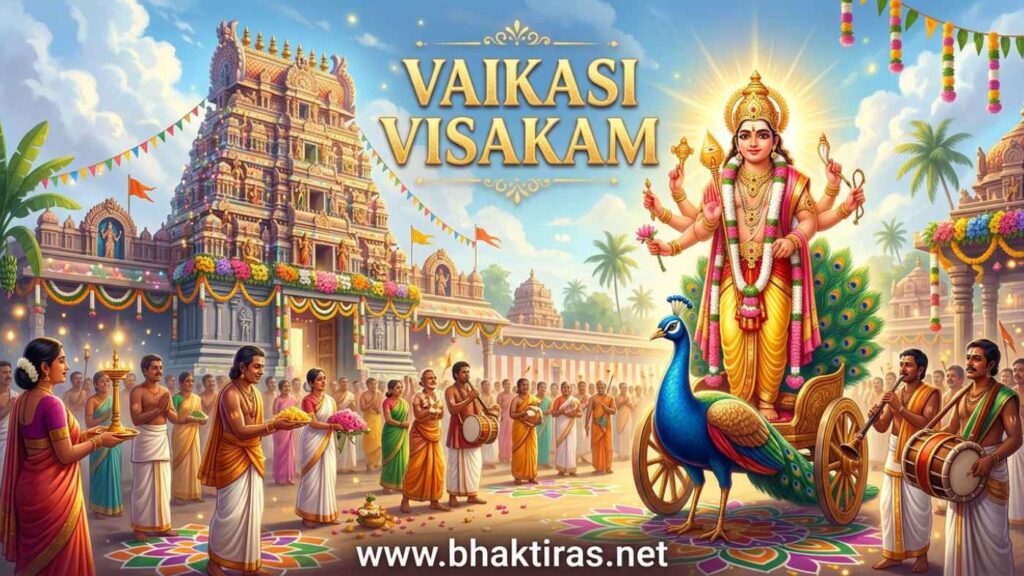
Vaikasi Visakam honours the birth star of Lord Murugan, the six-faced warrior god also called Kartikeya, Subramanya and Skanda. It is kept on the day the Visakam nakshatra rises during Vaikasi, the Tamil month spanning mid-May to mid-June, and in 2027 that day is Thursday, 20 May. Across Tamil Nadu and the wider Tamil world, temples pour milk and sandal over the deity at dawn, carry Murugan through the streets, and receive devotees bearing kavadi in fulfilment of vows.
Vaikasi Visakam 2026-2028: Dates & Calendar
The next Vaikasi Visakam is on Thursday, 20 May 2027. The date shifts each year because it depends on when the Visakam nakshatra falls within the Tamil solar month of Vaikasi, so it drifts across late May and early June.
| Year | Date | Day | Notes |
|---|---|---|---|
| 2026 | 30 May | Saturday | Already passed this year |
| 2027 | 20 May | Thursday | Next occurrence |
| 2028 | 5 June | Monday | Falls later, early Vaikasi |
The nakshatra window opens the previous evening, so many temples begin special poojas and abhishekam from the night before and continue into the main morning.
Why Vaikasi Visakam Is Celebrated
Vaikasi Visakam celebrates the appearance of Lord Murugan, marking the birth star under which the child-warrior god came into the world to protect the devas.
In the Kanda Puranam, the asura Surapadman and his brothers grew so powerful through penance that they seized control of the three worlds and tormented the gods. No ordinary weapon could end them, so Shiva opened his third eye and released six sparks of fire. Carried by Agni and the Ganga, the sparks came to rest in the reeds of Saravana Poigai, where they became six radiant infants tended by the six Krittika mothers.
When Parvati embraced the six children they merged into one body with six faces and twelve arms – Shanmukha, the six-faced one. Grown swiftly into a youthful commander, Murugan led the celestial army, and at Tiruchendur he hurled his vel, the divine spear, to split Surapadman in two. The halves became his peacock mount and the rooster on his banner. Vaikasi Visakam remembers the star of that appearance.
The birth star of a saviour
Visakam (Vishakha) is Murugan’s own janma nakshatra. Worshipping him on this day is held to carry the same merit as being present at his appearance, which is why the temples fill from before dawn.
An auspicious month
Vaikasi is considered a fortunate month for divine appearances in Tamil tradition; it is also linked to the birth of the poet-saint Thiruvalluvar. A Murugan festival within it draws on that sense of a blessed season.
Victory of courage over tyranny
The festival honours Murugan as the god of courage, wisdom and command who ended Surapadman’s reign. His story is read as the triumph of clarity and valour over ego and force, a theme devotees carry into their vows.
Deities & Figures Worshipped
Vaikasi Visakam is dedicated to Lord Murugan, worshipped under many names, and honours the symbols and companions tied to his story.
Murugan (Kartikeya)
The son of Shiva and Parvati, brother of Ganesha, worshipped across the Tamil lands as Murugan, Subramanya, Skanda, Kartikeya and Shanmukha. He is the youthful commander of the divine army and the patron of Tamil devotion, Kaumaram.
The vel and the peacock
Murugan’s vel, the leaf-shaped spear given by Parvati, stands for piercing wisdom that cuts through ignorance. His peacock mount and the rooster on his flag both arose from the defeated Surapadman, and are honoured in temple imagery on this day.
Valli and Deivanai
Murugan’s two consorts, Valli the hunter-chief’s daughter and Deivanai the daughter of Indra, are shown beside him in the festival processions as Valli Devasena Sametha Subramanya.
Key Rituals, Step by Step
Temple worship on Vaikasi Visakam centres on bathing the deity, feeding devotees and carrying Murugan through the streets. A typical day at a Murugan temple runs roughly as follows.
- Pre-dawn abhishekam. Priests bathe the Murugan idol with milk, curd, honey, sandal paste, rosewater, holy ash and panchamirtham while Skanda hymns are chanted, then dress and garland the deity.
- Special alankaram and deepa aradhana. The freshly adorned deity is shown to the gathering with lamps and camphor, and the vel is decorated and honoured.
- Kavadi offerings. Devotees who took vows carry the kavadi, an arched wooden yoke bearing pots of milk, on their shoulders around the temple, some with cheek or tongue skewers, walking to fulfil their promise.
- Paal kudam, the milk-pot offering. Simpler vows are kept by carrying a decorated pot of milk on the head to the shrine, where it is poured over the deity as abhishekam.
- Archana and Kanda Sashti Kavasam. Devotees offer archana in their family name and recite hymns such as the Kanda Sashti Kavasam and Skanda Shashti verses.
- The deity procession. A festival idol is placed on a mount, often a peacock, silver chariot or palanquin, and taken in procession through the temple streets accompanied by nadaswaram, drums and chanting.
- Annadhanam and prasad. Free meals are served to all who come, and panchamirtham, sacred ash and fruit are distributed as prasad to close the day.
Special Foods of Vaikasi Visakam
Offerings lean towards simple, temple-style prasad, with Palani’s famous panchamirtham the best known item.
Panchamirtham
A thick mix of banana, jaggery, ghee, honey and cardamom, sometimes with dates and sugar candy. The Palani version, made from hill bananas, is offered to Murugan and given as prasad; it carries a Geographical Indication tag.
Sakkarai pongal
Sweet pongal of rice and moong dal cooked with jaggery, ghee, cashews and cardamom, cooked as a naivedyam and shared after the abhishekam.
Fresh fruits and coconut
Bananas, especially the small hill variety, along with coconut and betel, are common offerings placed before the deity and returned as blessed prasad.
Vibhuti and vibudhi prasad
Sacred ash smeared on the forehead, plus sandal and kumkum, are received alongside the food as part of the day’s blessings.
The Six Abodes & Tamil Diaspora
The grandest celebrations are at the Arupadai Veedu, the six war-camps of Murugan, though every Murugan temple and Tamil community keeps the day.
Tiruttani
The northern hill shrine near Chennai, where Murugan is said to have rested after his battles. Vaikasi Visakam here draws long queues for the abhishekam and hill-top darshan.
Tiruchendur
The seashore temple where Murugan slew Surapadman with his vel. Sea-side rituals and a multi-day festival make it one of the busiest of the six abodes on this day.
Palani
The hill temple of Dandayudhapani, the ascetic Murugan holding a staff. A ten-day festival culminates on Vaikasi Visakam with the therottam chariot procession and famous panchamirtham prasad.
Swamimalai
Near Kumbakonam, where the child Murugan taught the meaning of the Pranava, Om, to his own father Shiva. The teacher-god is honoured here with special abhishekam.
Thiruparankundram & Pazhamudirchola
The remaining two abodes, near Madurai and in the Alagar hills, complete the six; both hold poojas and processions on the day.
Tamil diaspora
Murugan temples in Sri Lanka, Malaysia, Singapore, Mauritius and among Tamil communities in the UK, Canada and Australia keep Vaikasi Visakam with kavadi, milk-pots and processions of their own.
Vaikasi Visakam Do's and Don'ts
A few simple points help you keep the day with the right spirit at home or at the temple.
Do
- Wake before sunrise, bathe, and visit a Murugan temple for the morning abhishekam.
- Wear clean, simple clothes; many devotees choose yellow, orange or saffron.
- Recite the Kanda Sashti Kavasam, Subramanya Bhujangam or Skanda hymns.
- If you have taken a vow, carry your kavadi or milk-pot with care and humility.
- Share food through annadhanam and give alms to those in need.
Avoid
- Avoid non-vegetarian food and alcohol on the day of the fast.
- Do not break a kavadi or milk-pot vow lightly once it has been made.
- Avoid quarrels, harsh speech and anger while observing the vratam.
- Do not treat the vel or the deity’s images carelessly during processions.
- Avoid crowding others out; move patiently in the long temple queues.
Frequently Asked Questions
When is Vaikasi Visakam in 2027?
Vaikasi Visakam 2027 falls on Thursday, 20 May 2027. It is observed on the day the Visakam (Vishakha) nakshatra rises in the Tamil solar month of Vaikasi, which is when Lord Murugan’s birth star occurs.
When is Vaikasi Visakam in 2026 and 2028?
Vaikasi Visakam fell on Saturday, 30 May 2026, and will next occur on Thursday, 20 May 2027. In 2028 it moves to Monday, 5 June. The date shifts each year because it tracks the Visakam nakshatra within the Vaikasi month.
Why is Vaikasi Visakam celebrated?
Vaikasi Visakam is celebrated as the birth star of Lord Murugan, the six-faced warrior god born from Shiva’s spark to destroy the asura Surapadman. Worshipping Murugan on his own nakshatra is believed to bring courage, wisdom and protection.
Which god is worshipped on Vaikasi Visakam?
Lord Murugan is worshipped on Vaikasi Visakam. He is also known as Kartikeya, Subramanya, Skanda and Shanmukha, the son of Shiva and Parvati and the younger brother of Ganesha, revered especially across Tamil Nadu and the Tamil diaspora.
What is the difference between Vaikasi Visakam and Thaipusam?
Both are major Murugan festivals but fall on different stars and months. Thaipusam is on the Pusam nakshatra in the Tamil month of Thai (January-February), while Vaikasi Visakam is on the Visakam nakshatra in Vaikasi (May-June) and marks Murugan’s birth star. Kavadi is carried at both.
How is Vaikasi Visakam different from Skanda Sashti?
Vaikasi Visakam marks Murugan’s birth star in Vaikasi (May-June), while Skanda Sashti, also called Kanda Sashti, falls in the month of Aippasi (October-November) and commemorates his six-day battle and victory over Surapadman. Skanda Sashti runs for six days ending on the sixth tithi.
Where is Vaikasi Visakam celebrated most grandly?
The grandest celebrations are at Murugan’s six abodes, the Arupadai Veedu: Tiruttani, Tiruchendur, Palani, Swamimalai, Thiruparankundram and Pazhamudircholai. Palani holds a ten-day festival with a chariot procession, and Tiruchendur, the site of the vel battle, is especially crowded.
What is kavadi and why is it carried?
Kavadi is an arched wooden or metal frame, often bearing pots of milk, that devotees carry on their shoulders to a Murugan temple to fulfil a vow. It is a symbolic burden offered in thanks or petition, and is a central act of devotion on Vaikasi Visakam and Thaipusam.
May Lord Murugan’s vel clear every obstacle from your path this Vaikasi Visakam. Vetrivel Muruganukku Arohara!