
Onathallu & Onam Games 2026 – Kerala's Folk Sports of the Harvest
ഓണത്തല്ല്
What are Onathallu and the Onam games (Onakalikal)?
Onathallu is a bare-hand combat sport, and Onakalikal is the wider set of folk games and arts played across Kerala during Onam. They fill the ten harvest days that peak on Thiruvonam, which falls on Wednesday, 26 August 2026. Alongside Onathallu you will see snake-boat races (Vallamkali), the Pulikali tiger dance, Kummattikali masked dance, women’s Thiruvathirakali and flower carpets (Onapookalam).
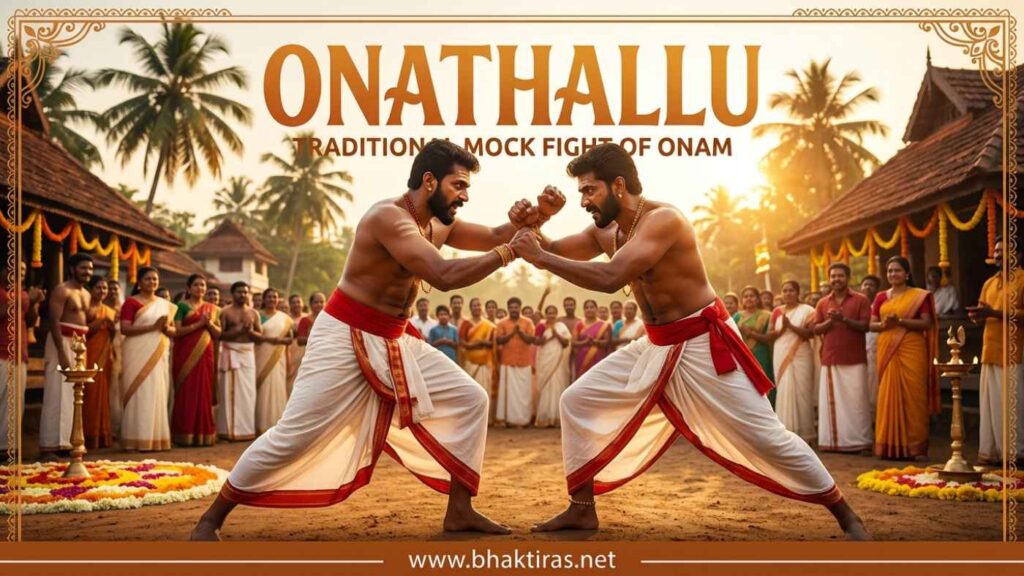
During Onam, Kerala does more than eat a grand feast and lay out flower carpets. The ten harvest days fill with sport and performance the Malayali call Onakalikal – the games of Onam. The best known is Onathallu, a bare-hand combat contest in which two lines of men trade open-palm blows across a village ground. Around it sit snake-boat races, the striped Pulikali tiger dance, masked Kummattikali and the women’s Thiruvathirakali, all timed to the celebration that peaks on Thiruvonam. This page is a companion to our main Onam guide, focused on how the festival is played.
Onam & Onathallu 2026-2028: Dates & Calendar
The games run through the ten Onam days and peak on Thiruvonam, which in 2026 is Wednesday, 26 August. The dates shift each year because Onam follows the Malayalam solar calendar and the Thiruvonam star.
| Year | Thiruvonam | Day | Notes |
|---|---|---|---|
| 2026 | 26 August | Wednesday | Next occurrence – peak of the games |
| 2027 | 12 September | Sunday | Chingam falls later this year |
| 2028 | 1 September | Friday | Ten-day celebration as usual |
The ten days open on Atham (around 16 August in 2026) and build through Uthradom, the eve of Thiruvonam. Boat races and the Thrissur Pulikali are often held a few days after Thiruvonam rather than on it, so the sporting calendar stretches slightly beyond the main day.
Why Onam Is Celebrated Through Games
Onam remembers the just reign of King Mahabali, and the games are how ordinary people relive that remembered golden age together.
Malayali tradition holds that under Mahabali there was neither want nor deceit, and the demon-king was allowed to return once a year to see his people happy. So the games are not a sideshow. They are the proof his subjects offer that all is still well: fields harvested, bodies strong, villages at play.
A shared golden age
The contests are open and public by design. Anyone could watch or wager on Onathallu, cheer a boat crew or join a swing. That levelling spirit, where the whole village takes part, echoes the equality people associate with Mahabali’s rule.
Harvest strength on display
Onam lands at the close of the harvest, when granaries are full and there is finally time to spare. Feats of strength and skill – combat, rowing, tug-of-war – let farming communities show off the fitness the season demanded and then celebrate the rest that follows.
Binding the community
Boat crews of a hundred oarsmen, tiger troupes from a dozen villages, women dancing in a circle: almost every Onam game needs a group, not a soloist. The play knits neighbourhoods together and passes skills and songs to the next generation.
The Figures Behind Onam
Onam centres on King Mahabali and the Vamana avatar of Vishnu, whose story frames the festival that the games celebrate.
Mahabali (Maveli)
Mahabali was a generous asura king whose rule Malayali memory paints as a golden age of honesty and plenty. Granted a yearly visit to his old kingdom, he is welcomed home each Thiruvonam. The joy of the games is the welcome his people prepare for him.
Vamana (Vishnu)
Vamana, the fifth avatar of Vishnu, came as a small brahmin and asked Mahabali for three paces of land, then grew vast and covered the worlds in two strides. For the third he set his foot on the king’s head, sending him below – but blessed him with the annual homecoming that Onam marks.
The Games of Onam, One by One
Here are the main games and performances of Onakalikal, roughly in the order a visitor meets them across the ten days.
- Onapookalam (flower carpet). Households begin on Atham with a small floral circle and add rings of fresh petals each day, so the design grows to a wide, many-coloured mandala by Thiruvonam. Neighbourhoods often compete for the finest layout.
- Onathallu (bare-hand combat). Two teams of men face off on an open ground and strike with open palms only – no fists, no kicks – each side pushing into the other’s territory while warding off blows. Central Kerala keeps this old contest alive, and it still draws crowds and spirited betting.
- Vallamkali (snake-boat race). Long chundan boats carrying up to a hundred oarsmen race down the backwaters to the beat of vanchipattu rowing songs. The Aranmula and Nehru Trophy races on the Pampa and Punnamada lakes are the most famous.
- Pulikali (tiger dance). A few days after Thiruvonam, men paint their bodies as tigers and hunters in yellow, red and black and dance through the streets to the chenda and udukku. Thrissur’s Swaraj Ground hosts the grandest gathering.
- Kummattikali (masked dance). Dancers in carved wooden masks and grass skirts move house to house, acting out stories with gestures and folk song. It is playful where Pulikali is fierce, and is strongest in central Kerala.
- Thiruvathirakali. Women in cream and gold circle a lit lamp, clapping and singing as they dance in graceful unison – the women’s signature performance of the Onam days.
- Talappanthukali and ball games. Village men gather for ball-and-hand games such as talappanthukali and naadanpanthukali, along with old favourites like kilithattu and cheettukali, on any open patch of ground.
- Oonjal (swings), Uriyadi and Vadamvali. Swings hung from tall trees give the young their turn; in Uriyadi a blindfolded player tries to break a swinging clay pot of curd; and Vadamvali, plain tug-of-war, pits neighbourhood against neighbourhood.
What the Games Are Played Around
The sport shares the day with the Onasadya, the great vegetarian feast served on a banana leaf, so a word on the food that fuels the celebration.
Onasadya
The Onasadya is a vegetarian banquet of two dozen or more dishes laid on a banana leaf – rice, sambar, avial, thoran, olan, pickles and pappadam – eaten with the family before or after a day of games. It is the shared centre the whole celebration circles.
Payasam
No sadya ends without payasam, a milk-or-jaggery pudding of rice, lentils or vermicelli. Ada pradhaman and palada payasam are the classic Onam versions, ladled out warm to close the meal.
Feast then play
Custom is to eat well and then spill outdoors for the games, so the sadya and Onakalikal are two halves of the same day – the feast for the family, the sport for the whole village.
Where to See the Games
Different corners of Kerala are known for different Onam spectacles, so the games map onto specific places.
Aranmula & Punnamada (boat races)
The Aranmula Uthrattathi Vallamkali on the river Pampa and the Nehru Trophy Boat Race on Punnamada Lake in Alappuzha are the headline snake-boat events, drawing huge crowds to the backwaters.
Thrissur (Pulikali)
Thrissur is the home of Pulikali. Hundreds of painted tiger-dancers from surrounding villages converge on Swaraj Ground a few days after Thiruvonam for the state’s biggest tiger dance.
Central Kerala (Onathallu & Kummatti)
The old combat game of Onathallu and the masked Kummattikali are strongest in the central districts, especially around Thrissur and Palakkad, where village grounds still host the contests.
Across Kerala & the diaspora
Flower carpets, Thiruvathirakali and simpler village games happen almost everywhere Malayalis live, from home courtyards in Kerala to Onam gatherings among the diaspora in the Gulf and beyond.
Onam Games Do's and Don'ts
A few sensible pointers for taking part in or watching the sports safely.
Do
- Do join the flower carpet, swings and circle dances – they are made for everyone to share.
- Do watch Onathallu from the edge of the ground and leave the palm-strikes to trained players.
- Do reach boat-race venues early; banks fill fast and viewing spots go quickly.
- Do stay hydrated and shaded during the long, warm festival days.
- Do respect that Pulikali, Kummatti and boat crews rehearse for weeks – give performers room.
Avoid
- Don’t wander onto an Onathallu ground mid-contest; the open-palm blows land hard.
- Don’t lean over or crowd the water’s edge at snake-boat races.
- Don’t try combat or pot-breaking games without someone experienced guiding you.
- Don’t gamble beyond your means, whatever the local betting on Onathallu.
- Don’t block performers or their percussionists to take photographs.
Frequently Asked Questions
What is Onathallu?
Onathallu is a traditional bare-hand combat sport of Kerala’s Onam festival, sometimes called Kayyankali or Attakalam. Two teams of men strike each other with open palms only – no fists or kicks – while advancing across a village ground and warding off blows. It is one of the oldest of the Onam games and remains strongest in central Kerala.
What are the Onam games (Onakalikal)?
Onakalikal are the folk games and performances played across Kerala’s ten Onam days. They include Onathallu (palm combat), Vallamkali (snake-boat races), Pulikali (tiger dance), Kummattikali (masked dance), Thiruvathirakali (women’s circle dance), swings, tug-of-war and ball games, plus the Onapookalam flower carpets.
How do the Onam games relate to the Onam festival?
The games are the sporting and performing side of Onam, Kerala’s harvest festival that remembers King Mahabali. They fill the ten days that peak on Thiruvonam, running alongside the Onasadya feast and flower carpets. For the festival’s full story, dates and rituals, see our main Onam page.
When are the Onam games held in 2026?
The Onam games are held across the ten-day festival that peaks on Thiruvonam, which in 2026 falls on Wednesday, 26 August. The celebration opens on Atham around 16 August, and some events like the Thrissur Pulikali and major boat races take place a few days after Thiruvonam.
What is Vallamkali?
Vallamkali is the snake-boat race of Onam, in which long chundan boats carrying up to a hundred oarsmen race along Kerala’s backwaters to rhythmic vanchipattu songs. The Aranmula race on the river Pampa and the Nehru Trophy Boat Race on Punnamada Lake are the most celebrated.
What is Pulikali?
Pulikali, or tiger dance, is an Onam performance in which men paint their bodies in yellow, red and black stripes as tigers and hunters and dance through the streets to the chenda drum. It is held a few days after Thiruvonam, with Thrissur’s Swaraj Ground hosting the largest gathering of hundreds of dancers.
Which figures does Onam celebrate?
Onam celebrates King Mahabali, the generous asura king whose reign Malayali tradition remembers as a golden age, and Vamana, the dwarf avatar of Vishnu who sent him to the netherworld but granted him a yearly homecoming. The games are the welcome his people prepare each Thiruvonam.
Are the Onam games only for men?
Many of the strength games like Onathallu, boat racing and tug-of-war are traditionally played by men, but Onam has games for everyone. Women lead the graceful Thiruvathirakali circle dance, families build flower carpets together, and swings and lighter games are open to all ages.
However you take part – laying petals, cheering a boat crew or watching the tigers dance – may the games carry Onam’s easy joy. Onashamsakal!