
Hoysala Mahotsava 2027 – Dance & Music at Belur and Halebidu
होयसळ महोत्सव
When is Hoysala Mahotsava in 2027?
Hoysala Mahotsava is usually held in March, across two to three evenings at the Chennakeshava temple in Belur and the Hoysaleswara temple in Halebidu, Karnataka. It is a secular heritage and performing-arts festival organised by Karnataka Tourism, so the exact dates are announced afresh each year rather than fixed to a lunar calendar. For 2027, check the Karnataka Tourism calendar closer to the date.
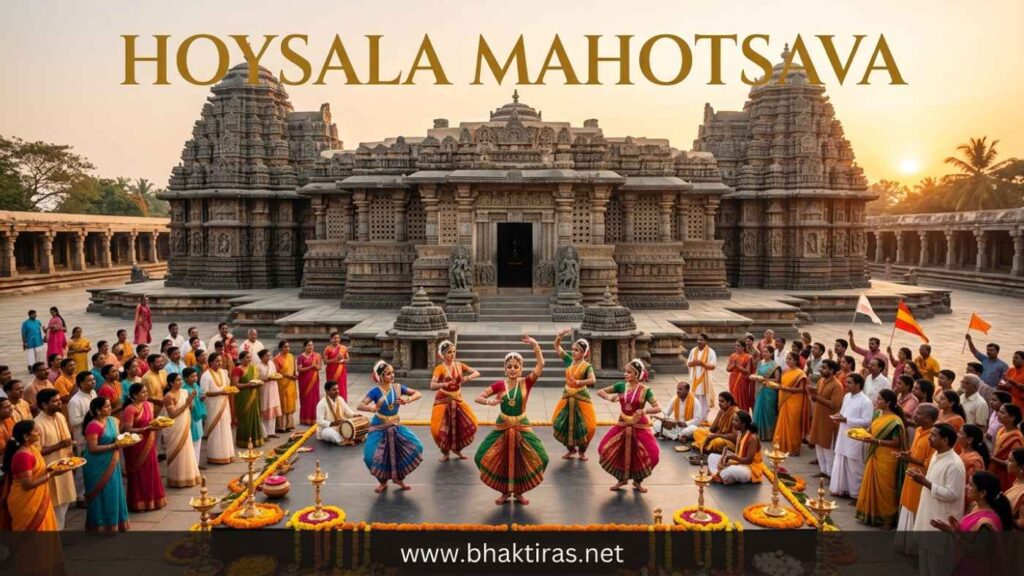
Hoysala Mahotsava is a heritage and performing-arts festival that Karnataka Tourism holds each year, usually in March, at the two great Hoysala temples of Hassan district: the Chennakeshava temple at Belur and the Hoysaleswara temple at Halebidu. For two or three evenings, Bharatanatyam, Kuchipudi, Kathak and Odissi dancers along with Carnatic and Hindustani musicians perform in front of the illuminated 12th-century soapstone shrines. It is a celebration of architecture and the classical arts rather than a religious observance, and it draws travellers doing the Belur-Halebidu-Shravanabelagola circuit.
Hoysala Mahotsava Dates & Timing
Hoysala Mahotsava is a state-organised cultural festival, so its dates are set administratively each year rather than by a fixed tithi. It has typically fallen in March, sometimes spilling into early April.
| Year | Typical month | Duration | Notes |
|---|---|---|---|
| 2026 | March | 2-3 days | Held at Belur and Halebidu |
| 2027 | March (to be announced) | 2-3 days | Confirm with Karnataka Tourism |
| 2028 | March (to be announced) | 2-3 days | Dates released nearer the event |
Because this is a tourism-department event and not a temple ritual, the schedule can shift by a few weeks and the performer line-up changes every year. Treat March as the season to watch and verify the exact evenings before you book travel.
Why Hoysala Mahotsava Matters
Hoysala Mahotsava exists to spotlight two of India’s finest medieval temples and to keep the classical performing arts in public view. It is a heritage celebration, not a devotional rite.
The setting is the point. Belur and Halebidu, about 16 km apart in Hassan district, hold temples built by the Hoysala dynasty in the 12th century. The Chennakeshava temple at Belur was commissioned by King Vishnuvardhana around 1117 CE; the Hoysaleswara temple at Halebidu followed in the old Hoysala capital, then called Dwarasamudra.
Carved in soapstone
Hoysala sculptors worked in chloritic schist, or soapstone, which is soft when freshly quarried and hardens with exposure. That property let them cut jewellery-fine detail: bracelets you can count, friezes of elephants and horsemen, and the famous madanikas, the sculpted bracket-figures at Belur.
A UNESCO World Heritage listing
In 2023 UNESCO inscribed the ‘Sacred Ensembles of the Hoysalas’ on the World Heritage List, India’s 42nd site. The serial listing covers three temples: Chennakeshava at Belur, Hoysaleswara at Halebidu and the Keshava temple at Somanathapura.
The Jakanachari legend
Local tradition ties the temples to Amarashilpi Jakanachari, the eternal sculptor of Kannada folklore. In the best-known tale his estranged son spots a flaw in an idol at Belur, and Jakanachari vows to cut off his hand if it is proven; the story is folklore, not documented history, but it lives on in Karnataka’s memory of these craftsmen.
Keeping classical arts alive
By staging Bharatanatyam, Kuchipudi, Kathak, Odissi and Carnatic and Hindustani music against the temple walls, the festival gives performers a rare open-air heritage stage and gives visitors a reason to linger after the day-trippers have left.
The Hoysala Temples & Heritage
Hoysala Mahotsava is built around monuments rather than a presiding festival deity. The two host temples are themselves the focus, though each enshrines a living Hindu deity.
Chennakeshava Temple, Belur
A Vaishnava temple dedicated to Vishnu in his Chennakeshava (handsome Keshava) form, consecrated around 1117 CE. Its outer walls carry the celebrated madanika bracket-figures and rows of finely cut friezes, and it remains an active place of worship.
Hoysaleswara Temple, Halebidu
A twin-shrine Shaiva temple dedicated to Shiva, built in the old Hoysala capital. Its plinth is wrapped in continuous bands of carved elephants, lions, horsemen and scenes from the epics, considered among the densest relief sculpture in India.
Somanathapura (the third ensemble)
The Keshava temple at Somanathapura, near Mysuru, is the third temple in the 2023 UNESCO listing. It sits outside the festival’s Belur-Halebidu core but completes the Sacred Ensembles of the Hoysalas.
What Happens at Hoysala Mahotsava
This is a curated cultural programme, so ‘what happens’ means recitals, illumination and craft displays rather than temple rituals. A typical evening runs like this.
- Temple illumination. As dusk falls, the Chennakeshava and Hoysaleswara temples are lit so the carved surfaces stand out in relief, which is when the soapstone detail reads best.
- Inauguration. Karnataka Tourism and district officials open the festival, often with a lamp-lighting and a short introduction to the Hoysala legacy.
- Classical dance recitals. Invited artists perform Bharatanatyam, Kuchipudi, Kathak and Odissi on an open-air stage set against the temple facade.
- Music concerts. Carnatic and Hindustani vocalists and instrumentalists perform, the temple’s stone acoustics adding to the atmosphere.
- Crafts and cultural stalls. Handicraft, handloom and regional-food stalls usually run alongside the performances, showcasing Karnataka’s artisans.
- Daytime temple viewing. Between evening shows, visitors tour the two temples in daylight, when guides point out the madanikas, friezes and sculptors’ signatures.
- Circuit trips. Many attendees pair the festival with a day at Shravanabelagola, home to the 57-foot Gomateshwara (Bahubali) monolith, roughly an hour away.
What to Eat Around Belur and Halebidu
Hassan district sits in Karnataka’s Malnad belt, so the local plate leans on millets, rice and coconut. There is no festival-specific dish; this is regional home cooking you will find nearby.
Akki Roti
A soft, hand-patted flatbread of rice flour, often studded with onion, chilli and coriander, griddled and served with chutney. A common breakfast across Hassan and the wider Malnad region.
Ragi Mudde
Steamed finger-millet balls eaten with a thin lentil or vegetable saaru. Hearty, filling and typical of everyday Karnataka meals in this belt.
South Indian filter coffee
Strong decoction coffee frothed with hot milk, the standard pick-me-up between temple visits. Small local cafes around Belur and Hassan serve it well.
Jain and vegetarian thalis
Around Shravanabelagola you will find simple Jain and Marwari-style vegetarian messes serving unfussy rice-and-curry thalis, handy if you extend the trip to the Bahubali monolith.
Where It's Held & the Wider Circuit
Hoysala Mahotsava is a single-region festival, staged only at Belur and Halebidu, but it sits inside one of Karnataka’s best-known heritage circuits.
Belur
The Chennakeshava temple town, the main hub for the Vaishnava temple, its star-shaped platform and the bracket-figure sculptures. Most festival dance recitals are staged here.
Halebidu
About 16 km from Belur, the old Hoysala capital and home to the Hoysaleswara temple, famous for the near-continuous bands of relief carving that ring its base.
Shravanabelagola
Roughly an hour away, a major Jain pilgrimage centre with the towering monolithic Gomateshwara statue reached by around 700 rock-cut steps. It rounds out the classic Hassan-district loop.
Hoysala Mahotsava Do's and Don'ts
A little heritage etiquette keeps the temples and the experience in good shape for everyone.
Do
- Arrive before dusk so you can see the carvings in daylight, then again under the festival lighting.
- Hire a licensed guide or join a temple tour to understand the friezes, madanikas and sculptors’ marks.
- Carry water, a hat and comfortable footwear; you will do a lot of standing and walking on stone.
- Confirm the exact festival dates with Karnataka Tourism before booking, as they change each year.
- Book Hassan or Belur accommodation early, since festival evenings fill nearby hotels.
Avoid
- Do not touch, climb on or lean against the carved surfaces; the soapstone is soft and easily damaged.
- Avoid flash and tripods where signage prohibits them, and never block others’ view of the stage.
- Do not treat the venues as a picnic spot; carry your litter out and use the bins provided.
- Avoid loud phone calls or talking over performers during recitals.
- Do not assume dates are fixed; there is no set tithi, so never plan around an unconfirmed schedule.
Frequently Asked Questions
When is Hoysala Mahotsava in 2027?
Hoysala Mahotsava is usually held in March, but the exact 2027 dates are announced each year by Karnataka Tourism rather than set by a lunar calendar. It runs for two to three evenings at the Belur and Halebidu temples in Hassan district. Check the Karnataka Tourism calendar nearer the date to confirm.
Where is Hoysala Mahotsava held?
Hoysala Mahotsava is held at two Hoysala-era temples in Hassan district, Karnataka: the Chennakeshava temple at Belur and the Hoysaleswara temple at Halebidu, which are about 16 km apart. Performances take place on open-air stages set against the temples in the evenings.
What happens during Hoysala Mahotsava?
During Hoysala Mahotsava, classical dancers perform Bharatanatyam, Kuchipudi, Kathak and Odissi and musicians present Carnatic and Hindustani recitals against the illuminated temples. Craft and food stalls usually run alongside, and visitors tour the two temples by day. It is a cultural and heritage festival, not a religious ritual.
Is Hoysala Mahotsava a religious festival?
No, Hoysala Mahotsava is a secular heritage and performing-arts festival organised by Karnataka Tourism to promote the Belur and Halebidu temples and classical arts. The temples themselves are active places of worship, but the festival celebrates architecture, dance and music rather than a specific religious observance.
Why are the Belur and Halebidu temples famous?
The Belur and Halebidu temples are famous for their 12th-century Hoysala architecture, with entire surfaces carved in soapstone in extraordinary detail, from madanika bracket-figures to continuous friezes of elephants and epics. In 2023 they were inscribed on the UNESCO World Heritage List as part of the ‘Sacred Ensembles of the Hoysalas’, India’s 42nd World Heritage Site.
Who built the Hoysala temples?
The Hoysala temples were built by the Hoysala dynasty in the 12th and 13th centuries, with the Chennakeshava temple at Belur commissioned by King Vishnuvardhana around 1117 CE. Karnataka folklore also credits the legendary sculptor Amarashilpi Jakanachari with the region’s temple carving, though that is traditional lore rather than documented record.
How do I reach Belur and Halebidu?
Belur and Halebidu are in Hassan district, Karnataka; Hassan town is the usual base and is well connected by road and rail from Bengaluru and Mysuru. From Hassan, Belur is about 40 km and Halebidu roughly 30 km, and the two temple towns are around 16 km apart. Many visitors add Shravanabelagola to make a full heritage circuit.
What else can I see near the festival?
Near Hoysala Mahotsava you can visit Shravanabelagola, a Jain pilgrimage site about an hour away with the 57-foot Gomateshwara (Bahubali) monolith reached by around 700 steps. The Belur-Halebidu-Shravanabelagola loop is the classic Hassan-district heritage circuit, easily covered over a weekend.
If you love stone that seems to breathe, an evening of dance in front of Belur or Halebidu is worth the journey. Nammaskara, and enjoy the Malnad hills.