
Pattadakal Dance Festival 2027 – Classical Dance Amid Chalukya Temples
ಪಟ್ಟದಕಲ್ಲು ನೃತ್ಯ ಉತ್ಸವ
When is the Pattadakal Dance Festival in 2027?
The Pattadakal Dance Festival is a Karnataka Tourism event held every year in mid-January at the UNESCO World Heritage temple complex in Pattadakal, Bagalkot district. The 2026 edition ran from 14 to 20 January. Exact 2027 dates are announced by the Department of Tourism, Government of Karnataka, usually a few weeks in advance, so check karnatakatourism.org before you travel.
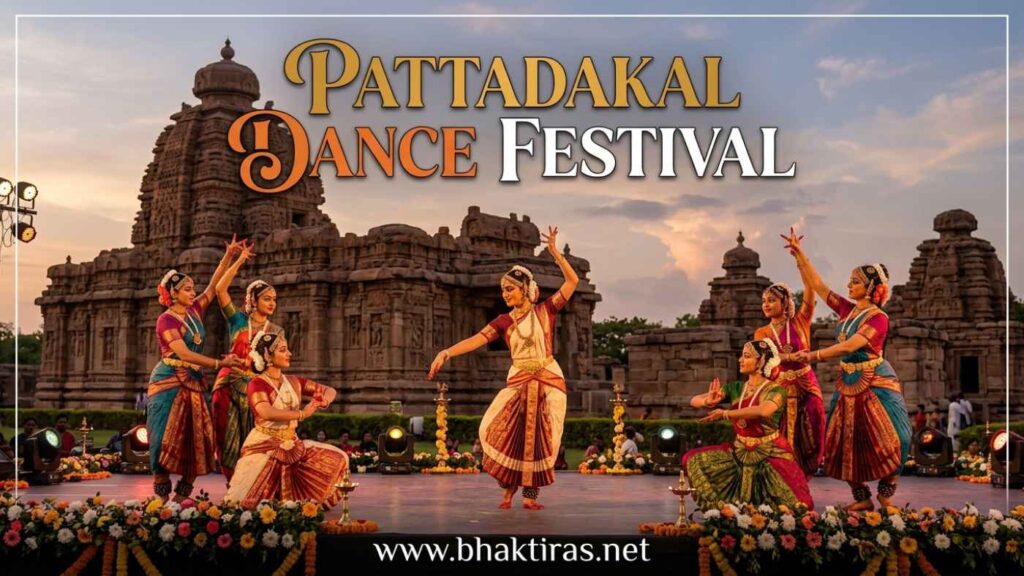
The Pattadakal Dance Festival is a cultural celebration staged by Karnataka Tourism against one of India’s finest groups of early temples. For a few evenings each January, dancers trained in Bharatanatyam, Kuchipudi, Kathak, Odissi and other classical forms perform on open lawns beside the floodlit sandstone shrines of Pattadakal in Bagalkot district. It is a secular heritage event rather than a religious observance, and its whole point is to let audiences experience living Indian dance in the same setting where Chalukya sculptors carved dancers and musicians into stone more than twelve centuries ago.
Pattadakal Dance Festival 2026-2028: Dates & Schedule
The festival is an annual mid-January event fixed by Karnataka Tourism rather than by the Hindu lunar calendar, so its timing is a tourism-department decision and can shift slightly from year to year.
| Year | Dates | Window | Status |
|---|---|---|---|
| 2026 | 14-20 January | Mid-January | Held |
| 2027 | Mid-January (to be announced) | Mid-January | Announced by Karnataka Tourism |
| 2028 | Mid-January (expected) | Mid-January | Not yet scheduled |
Because the event is a state tourism initiative, there is no religious tithi attached to it. Performances typically run in the evenings once the temples are lit, with a daytime crafts and food fair alongside.
Why the Pattadakal Dance Festival Matters
The festival matters because it pairs living classical dance with a UNESCO World Heritage site, turning a monument you would normally only photograph into an evening of performance.
Pattadakal was a ceremonial capital of the Chalukyas of Badami between the 7th and 8th centuries CE. Its name comes from pattada kallu, the coronation stone on which Chalukya kings were crowned, and the village grew up around that royal function. The dance festival is Karnataka Tourism’s way of keeping the site culturally alive and drawing visitors to a corner of north Karnataka that many travellers miss.
A UNESCO monument as the stage
Pattadakal’s group of temples was inscribed on the UNESCO World Heritage list in 1987. Performing here means dancing beside 8th-century shrines whose walls already carry carved dancers, drummers and scenes from the epics, so the setting and the art form speak to each other directly.
Coronation capital of the Chalukyas
This was where Chalukya rulers were formally crowned. Celebrating dance on the same ground links a modern cultural programme to the royal ceremonies the site was built for, without turning it into a religious ritual.
A meeting of building styles
The temples famously blend the Nagara idiom of the north with the Dravidian idiom of the south. That spirit of fusion suits a festival that gathers dance traditions from across India onto a single set of lawns.
Support for regional culture
Karnataka Tourism uses the event to give both national dancers and local artists a platform, and the accompanying crafts fair helps keep north Karnataka’s handloom and handicraft makers in work.
The Pattadakal Temples & Heritage
There is no presiding festival deity, because this is a heritage and cultural event. What it honours is the temple complex itself and the classical arts, so the focus below is on the monuments that form the backdrop.
Virupaksha Temple
The largest and best-preserved shrine at Pattadakal, built around 745 CE by Queen Lokamahadevi to mark King Vikramaditya II’s victory over the Pallavas. It follows the Dravidian style and is the only temple in the group that remains an active place of worship.
Mallikarjuna Temple
Commissioned by Lokamahadevi’s sister, Queen Trailokyamahadevi, for the same royal victory. It closely mirrors the Virupaksha temple in plan but differs in details such as its parapet and crowning members, and the two are often described as the twin temples of Pattadakal.
Sangameshwara & other shrines
The Sangameshwara temple is among the oldest in the complex, and the site also holds the Kashi Vishwanatha, Galaganatha, Papanatha, Jambulingeshwara and other shrines, plus a Jain temple nearby, together showing the full range of early Chalukya experiment.
What Happens at the Festival, Step by Step
A visit usually moves from daytime sightseeing into an evening of performance. Here is how a typical festival day unfolds.
- Arrive by day. Reach Pattadakal in the afternoon, buy your monument entry ticket and walk the temple group while there is light to read the carvings.
- Browse the crafts and food fair. Stalls set up alongside the festival ground sell north Karnataka handlooms, handicrafts and local snacks, and this is a good time to eat before the recitals begin.
- Settle in as the lights come on. As dusk falls the temples are floodlit and the open-air stage is prepared, with seating arranged so the shrines form the backdrop.
- Formal opening. Karnataka Tourism officials and invited guests inaugurate the evening, often with a short introduction to the site and the artists.
- Classical dance recitals. Dancers perform Bharatanatyam, Kuchipudi, Kathak, Odissi and other forms in turn; some editions also feature Kathakali, Mohiniyattam or the Karnataka folk-classical form Yakshagana.
- Music and ensemble items. Recitals are backed by live or recorded classical music, and larger group compositions may close a night’s programme.
- Wind down. Performances usually run through the evening; plan your onward travel to Badami or Aihole in advance, as Pattadakal itself has limited stay options.
What to Eat Around Pattadakal
Food at the festival and in the surrounding towns is hearty north Karnataka fare, built around jowar and groundnut rather than rice.
Jowar roti (jolada rotti)
Flat, slightly crisp rotis made from sorghum flour are the staple of the region. They are usually served with a spread of chutneys, curries and a dollop of ghee or white butter.
Ennegayi (stuffed brinjal)
Small brinjals stuffed with a spiced groundnut, sesame and coconut paste, then simmered in a dark, nutty gravy. Eaten with jowar roti, it is the dish most associated with this belt of Karnataka.
Holige / puran poli
A soft flatbread stuffed with a sweet lentil-and-jaggery or coconut filling. It appears at festivals and celebrations across Karnataka and is a common treat at fair stalls.
Shenga (groundnut) chutney & spreads
Dry and wet groundnut chutneys, garlic chutney and a fiery red thecha-style mix are laid out to go with roti. They are a defining taste of a north Karnataka meal.
The Aihole-Badami-Pattadakal Circuit
Pattadakal is best understood as one stop on a compact heritage circuit in Bagalkot district, and most visitors combine all three sites in a single trip.
Badami
About 22 km from Pattadakal, Badami was the Chalukya capital and is known for its rock-cut cave temples carved into a red sandstone gorge above the Agastya lake. It usually serves as the base town for the circuit, with the widest choice of hotels.
Aihole
Roughly 10 km from Pattadakal, Aihole is often called an open-air school of temple architecture, with scores of early shrines including the Durga and Lad Khan temples where Chalukya builders first tested their ideas.
Pattadakal
The culmination of that experiment, where the mature temples stand together on the banks of the Malaprabha river. Seeing it after Aihole and Badami makes the progression from early trials to finished monuments easy to follow.
Getting there
The nearest railhead is Badami, and Hubballi (Hubli) is the closest airport at roughly 130 km. Most travellers hire a car or taxi to link the three sites, as public transport between them is sparse, especially in the evening.
Pattadakal Dance Festival Do's and Don'ts
Treat this as a heritage site first and an event second, and the visit will be smoother for you and safer for the monuments.
Do
- Confirm the current year’s dates and programme on karnatakatourism.org before you travel
- Book a stay in Badami early, as rooms near the site are limited during the festival
- Carry water, a hat and comfortable shoes for daytime temple walking
- Bring a light shawl or jacket, since January evenings in the region can turn cool
- Arrive before the recitals begin to get a clear view of the stage and shrines
Avoid
- Do not touch, lean on or climb the carvings and temple walls
- Do not use flash near performers or drones over the site without permission
- Do not litter on the lawns or leave food waste around the monuments
- Do not treat the temples as a religious festival venue; most are protected monuments, not active shrines
- Do not rely on last-minute transport back to Badami after dark; arrange it in advance
Frequently Asked Questions
When is the Pattadakal Dance Festival in 2027?
The Pattadakal Dance Festival is an annual mid-January event, but the exact 2027 dates are set and announced by Karnataka Tourism rather than fixed years ahead. The 2026 edition ran from 14 to 20 January, so a similar window is likely. Check karnatakatourism.org or utsav.gov.in for the confirmed programme before booking.
When was the festival held in 2026, and what about 2028?
The 2026 Pattadakal Dance Festival was held from 14 to 20 January. The 2028 dates have not been scheduled yet, but the festival has consistently fallen in mid-January, so travellers usually plan around the middle of that month and confirm once the tourism department publishes the programme.
Is the Pattadakal Dance Festival a religious festival?
No, the Pattadakal Dance Festival is a secular cultural and heritage event organised by Karnataka Tourism. It celebrates Indian classical dance and the UNESCO-listed Chalukya temples rather than any deity or religious ritual, even though the setting is a group of historic Hindu temples.
Which dance forms are performed at Pattadakal?
The festival features leading Indian classical styles, most commonly Bharatanatyam, Kuchipudi, Kathak and Odissi. Depending on the year’s line-up it may also include Kathakali, Mohiniyattam and Karnataka’s own Yakshagana, performed on an open-air stage beside the floodlit temples.
Where is the Pattadakal Dance Festival held?
The festival is held at Pattadakal, a village on the Malaprabha river in Bagalkot district, north Karnataka. The venue is the grounds beside the UNESCO World Heritage group of temples, about 22 km from Badami and roughly 10 km from Aihole.
How do I reach Pattadakal for the festival?
Most visitors base themselves in Badami, which has the nearest railway station and the best choice of hotels, then travel the short distance to Pattadakal by car or taxi. The closest airport is Hubballi (Hubli), about 130 km away, and hiring a vehicle is the easiest way to link Pattadakal with Aihole and Badami.
Why are the Pattadakal temples famous?
The Pattadakal temples are famous for blending the Nagara style of northern India with the Dravidian style of the south, built by the Chalukyas of Badami in the 7th and 8th centuries CE. The group was inscribed as a UNESCO World Heritage Site in 1987, and the Virupaksha temple remains an active place of worship.
Is there an entry fee for the festival?
Attending the dance performances is generally free or low-cost as a Karnataka Tourism event, but you pay the standard monument entry ticket to walk the temple complex during the day. Fees and any seating arrangements are confirmed in the official programme each year, so check before you go.
Come for the dance, stay for the stone: an evening at Pattadakal is one of the finest ways to meet India’s classical arts where they have belonged for centuries.