
Kapil Muni Mela 2026 – Kolayat's Kartik Purnima Fair
कपिल मुनि मेला
When is the Kapil Muni Mela in Kolayat in 2026?
The Kapil Muni Mela (Kolayat Fair) peaks on Kartik Purnima, 24 November 2026, and the surrounding fair runs for roughly five days at Kolayat in Bikaner district, Rajasthan. Pilgrims bathe in the Kapil Sarovar, float lamps at dusk and offer tarpan to their ancestors, while a large camel and cattle fair fills the desert town alongside the worship.
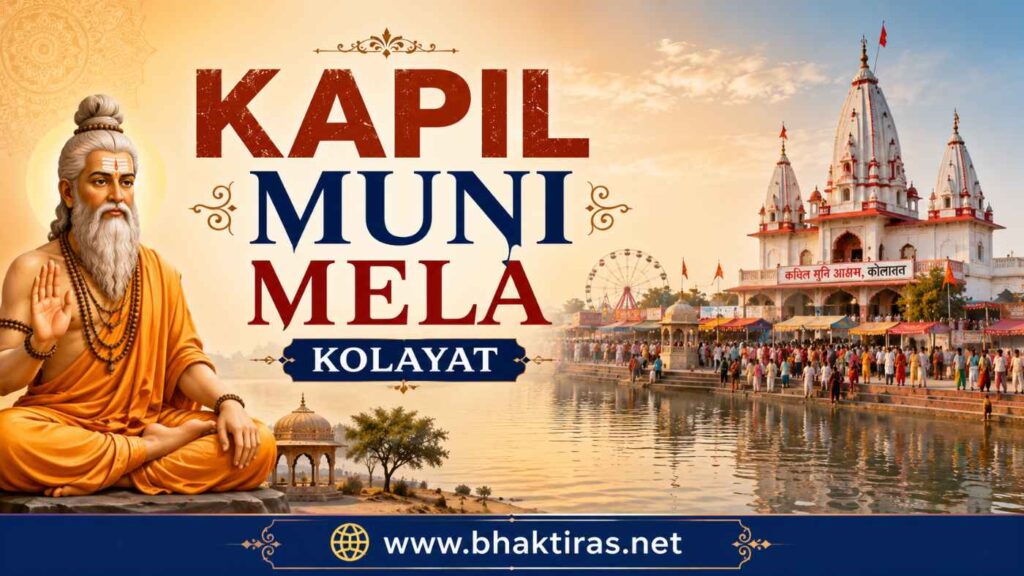
The Kapil Muni Mela, better known locally as the Kolayat Fair, gathers pilgrims each Kartik Purnima at the small desert town of Kolayat, about 50 kilometres south-west of Bikaner in Rajasthan. It is held in honour of Kapil Muni, the sage credited with founding the Samkhya school of Hindu thought, who is said to have meditated beside the spring-fed lake here. For five days the 52 stone ghats around Kapil Sarovar fill with bathers at dawn and flickering lamps at dusk, while a large camel and cattle market turns the town into one of Rajasthan’s liveliest gatherings.
Kapil Muni Mela 2026-2028: Dates & Calendar
The fair is timed to Kartik Purnima, the full-moon day of the Hindu month of Kartik, so its date moves each year with the lunar calendar. In 2026 the main day falls on 24 November.
| Year | Kartik Purnima (main day) | Day | Notes |
|---|---|---|---|
| 2026 | 24 November | Tuesday | Next occurrence; fair spans roughly 20-26 November |
| 2027 | 14 November | Sunday | Peak bathing day on Kartik Purnima |
| 2028 | 2 November | Thursday | Earlier date as Kartik shifts in the lunar year |
The mela does not have a fixed civil-calendar slot; local district notifications each autumn confirm the exact opening and closing days around the full moon.
Why the Kapil Muni Mela Is Held
The fair honours sage Kapil Muni and treats a Kartik Purnima dip in the Kapil Sarovar as an act that cleanses the bather and benefits departed ancestors.
The sage of Samkhya
Kapil Muni, or Kapila, is remembered as the founder of Samkhya, one of the oldest systems of Indian philosophy. Samkhya explains the world through two eternal principles, Purusha (consciousness) and Prakriti (matter), and its analytical method shaped much of later Hindu and yogic thought. Tradition holds that Kapila taught and meditated at Kolayat, giving the lake its sanctity.
A holy dip on Kartik Purnima
Kartik Purnima is one of the most auspicious bathing days in the Hindu year. Devotees believe a dip in the Kapil Sarovar on this full moon washes away wrongdoing and brings spiritual merit. The 52 ghats let large crowds bathe through the pre-dawn and morning hours.
Remembering ancestors
Many pilgrims come specifically to perform tarpan, the offering of water to departed forebears, at the lakeside. Kolayat is counted among the places where such rites for ancestors are considered especially fruitful, which draws families from across Rajasthan and beyond.
A desert oasis of faith
In an arid stretch of the Thar, a permanent lake fed by natural springs is itself remarkable. That a body of water never runs dry in the desert has long been read as a sign of the site’s blessing, and it is a practical reason the pilgrimage settled here.
Deity & Figure Worshipped
The fair centres on Kapil Muni, honoured at the lakeside Kapil Muni temple and regarded in several traditions as an incarnation of Vishnu.
Kapil Muni (Kapila)
The Vedic sage credited with founding Samkhya philosophy. Some Puranic texts count Kapila among the avatars of Vishnu, born to teach the path of knowledge. At Kolayat he is worshipped as the presiding rishi of the lake and its ghats.
Kapil Sarovar
The spring-fed lake itself is treated as sacred, ringed by 52 ghats, marble shrines and sandstone pavilions. The dip and the evening lamp offering are made in its waters, which local belief holds never dry up even in drought.
Key Rituals, Step by Step
A day at the mela moves from the pre-dawn dip through temple worship to the lamp offering at dusk.
- The holy dip. Pilgrims arrive before dawn to bathe at one of the 52 ghats of Kapil Sarovar, with the peak crowd on Kartik Purnima morning.
- Temple worship. After bathing, devotees visit the lakeside Kapil Muni temple to offer prayers, flowers and coconuts to the sage.
- Tarpan for ancestors. Families perform tarpan, pouring water in memory of departed forebears, often guided by local priests at the ghats.
- Charity and alms. Giving food, cloth or coins to the poor and to priests is a common part of the day, in keeping with Kartik Purnima practice.
- Deep-daan at dusk. As evening falls, thousands of earthen lamps are lit and set afloat on the lake in the Deep Malika, turning the water into a sheet of moving light.
- Sandhya aarti. The evening aarti at the temple and ghats gathers the crowds for shared prayer and song.
- The cattle and camel fair. Away from the water, herders trade camels, horses, cattle and buffaloes, while stalls, folk performers and rural sports run alongside.
Food at the Kapil Muni Mela
Fair food leans on the hearty vegetarian cooking of Bikaner, alongside temple prasad and sweets sold at the stalls.
Kachori and pakora
Hot fried snacks are everywhere at the fair. Bikaneri kachori, stuffed with spiced pulses, and crisp mirchi and onion pakoras are handed out steaming from stall griddles.
Bikaneri bhujia and namkeen
Bikaner is famous across India for its bhujia, a fine gram-flour savoury, and other namkeen. Bags of it are sold throughout the mela and carried home as a keepsake of the trip.
Ghevar and sweets
Rajasthani sweet-makers set up with ghevar, jalebi, malpua and laddus, giving pilgrims something to buy after the morning dip and as an offering.
Temple prasad
Simple prasad such as sweets and boiled or fried offerings is distributed at the Kapil Muni temple and shared among families and fellow travellers.
Where It Is Celebrated
The mela is a Rajasthani pilgrimage rooted at Kolayat, but it draws visitors well beyond the district.
Kolayat, Bikaner
The fair belongs to Kolayat town, roughly 50 kilometres from Bikaner city. The lake, ghats and Kapil Muni temple are the whole focus, and the town’s economy swells during the five fair days.
Across Rajasthan
Pilgrims and cattle traders come from Bikaner, Jaisalmer, Nagaur and neighbouring districts, making it one of the important autumn fairs of the state alongside Pushkar.
Wider pilgrim draw
Followers of the Samkhya tradition and families wishing to perform ancestral rites travel from other states, so the crowd is a mix of local herders, Rajasthani pilgrims and out-of-state visitors.
Kapil Muni Mela Do's and Don'ts
A few sensible habits keep a visit safe and respectful in a crowded lakeside setting.
Do
- Reach the ghats early, before the pre-dawn bathing rush peaks on Purnima.
- Keep to the built ghat steps for the dip and mind children near the water.
- Carry water, a hat and sun protection for the daytime desert heat.
- Handle floating lamps with care and clear them from the water responsibly.
- Respect the herders and animals if you walk through the cattle fair.
Avoid
- Do not swim out into deep water or bathe unsupervised.
- Do not litter or leave plastic and lamp waste in or around the sacred lake.
- Do not push in the dense crowds at the ghats and temple queues.
- Do not leave bags and valuables unattended in the fair grounds.
- Do not photograph pilgrims mid-ritual without asking first.
Frequently Asked Questions
When is the Kapil Muni Mela in 2026?
The Kapil Muni Mela peaks on Kartik Purnima, 24 November 2026, at Kolayat in Bikaner district, Rajasthan. The wider fair runs for about five days around that full moon, with the main bathing crowd on Purnima itself.
When is the Kapil Muni Mela in 2027 and 2028?
The mela follows Kartik Purnima, so it falls on 14 November 2027 and on 2 November 2028. The date shifts each year because it is fixed to the full moon of the Hindu month of Kartik, not to a set civil-calendar day.
Where is the Kapil Muni Mela held?
The fair is held at Kolayat, a temple town about 50 kilometres south-west of Bikaner city in Rajasthan. It centres on the Kapil Sarovar lake, its 52 ghats and the lakeside Kapil Muni temple.
Who is Kapil Muni?
Kapil Muni, or Kapila, is an ancient sage regarded as the founder of Samkhya, one of the oldest schools of Hindu philosophy. He is said to have meditated at Kolayat, and several traditions count him among the incarnations of Vishnu.
What do pilgrims do at the fair?
Pilgrims take a holy dip in the Kapil Sarovar, worship at the Kapil Muni temple, and perform tarpan for their ancestors. At dusk they float thousands of earthen lamps on the lake in the deep-daan ceremony, and a large camel and cattle fair runs alongside.
Why is the dip on Kartik Purnima considered special?
Kartik Purnima is one of the most auspicious bathing days in the Hindu year, and a dip in the sacred Kapil Sarovar on this full moon is believed to cleanse wrongdoing and earn spiritual merit. The rites for ancestors performed here are also held to be especially fruitful.
Is there an entry fee for the Kolayat Fair?
No, entry to the Kapil Muni Mela is free and open to all. Visitors only pay for their own travel, food, lodging and any purchases at the market and cattle fair.
What is the camel and cattle fair at Kolayat?
Alongside the religious bathing, herders gather to trade camels, horses, cattle and buffaloes, making Kolayat one of Rajasthan’s notable livestock fairs. Folk music, rural sports and craft stalls run beside the trading through the mela.
May a dip in the Kapil Sarovar and the lamps drifting on its waters bring you peace this Kartik Purnima.