
Salasar Balaji Mela 2026 – Rajasthan's Great Hanuman Fair
सालासर बालाजी मेला
When is the Salasar Balaji Mela in 2026?
The next Salasar Balaji Mela falls on the Ashwin Purnima, around 25-26 October 2026 (main day Monday, 26 October), at the Salasar Balaji Hanuman temple in Churu district, Rajasthan. Two great fairs are held here each year – one on Chaitra Purnima in spring and this larger one on Ashwin Purnima in autumn. Lakhs of devotees walk in on foot carrying nishan flags for the darshan of the bearded Balaji.
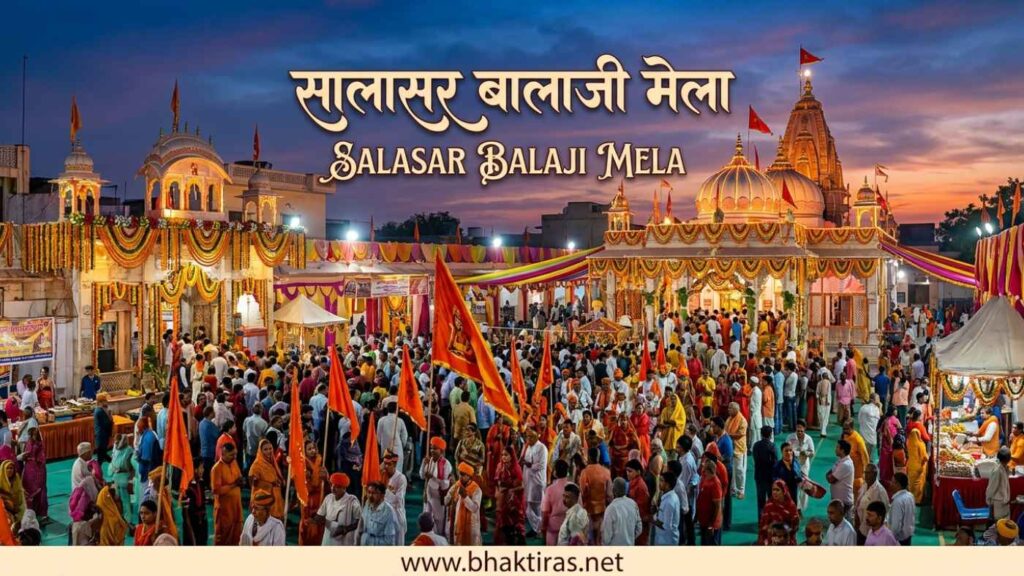
The Salasar Balaji Mela is the great fair held at the Salasar Balaji temple in Salasar, a small town near Sujangarh in Rajasthan’s Churu district. It honours a rare bearded, round-faced form of Hanuman known as Ashapura Balaji, the fulfiller of wishes. Two large melas fall each year, on Chaitra Purnima in spring and on the bigger Ashwin Purnima in autumn, with more gatherings around Hanuman Jayanti. Lakhs of pilgrims arrive on foot, many carrying tall nishan flags, making it one of the busiest Hanuman shrines in India.
Salasar Balaji Mela 2026-2028: Dates & Calendar
The next fair is the Ashwin Purnima mela on 25-26 October 2026. Both melas follow the full-moon (Purnima) tithi, so the Gregorian dates shift each year with the Hindu lunar calendar.
| Year | Chaitra Purnima Mela (spring) | Ashwin Purnima Mela (autumn) | Notes |
|---|---|---|---|
| 2026 | 2 April (Thursday) | 25-26 October | Chaitra fair has passed; Ashwin mela next |
| 2027 | 20 April (Tuesday) | 7 October (Thursday) | Chaitra fair coincides with Hanuman Jayanti |
| 2028 | 9 April (Sunday) | 14 October (Saturday) | Two fairs, roughly six months apart |
The Chaitra Purnima fair falls on the same tithi as Hanuman Jayanti, so it draws heavy Hanuman-Jayanti processions. The Ashwin Purnima fair, near Sharad Purnima, is usually the larger of the two, with the biggest foot-pilgrim numbers.
Why the Salasar Balaji Mela Is Held
The mela celebrates a self-manifested (swayambhu) idol of Hanuman that was found by a farmer and is worshipped as Ashapura Balaji, the god who grants sincere wishes.
Local tradition dates the idol’s discovery to the mid-eighteenth century. While ploughing a field at Asota village near Nagaur, a Ginthala Jat farmer’s blade struck a buried stone that turned out to be a Hanuman idol. When his wife brought bajra churma to the field, the couple offered it to the deity, and churma has stayed the temple’s signature bhog ever since. A Salasar saint, Mohandas, is said to have been directed in a dream to bring the idol to Salasar, where the shrine grew around it.
Ashapura, the wish-fulfiller
Balaji here is called Ashapura, meaning one who fills every hope. Pilgrims come to ask for a child, a job, a cure or a settled marriage, and return to complete the vow they made if the wish is granted. This vow-and-thanksgiving cycle is what keeps the two melas so crowded.
A self-manifested idol
The murti is regarded as swayambhu, not carved by human hands but revealed from the earth. That belief gives Salasar a special standing among Hanuman shrines and is a core reason lakhs of devotees make the journey during each fair.
One of Rajasthan's busiest shrines
Salasar is among the most visited Hanuman temples in the country, and the mela days concentrate that devotion. Foot pilgrims, flag processions and round-the-clock darshan turn the small town into a sea of people twice a year.
Who Is Worshipped
The fair centres on Salasar Balaji, a bearded and moustached form of Hanuman that is unusual among Indian temples.
Salasar Balaji
Salasar Balaji is Hanuman shown with a full beard and moustache and a rounded face – an iconography seen almost nowhere else, since Hanuman is usually depicted as a clean-shaven young warrior. The look gives the deity a calm, elder, protective air. Silver and gold ornaments, a coating of sindoor and fresh flowers dress the idol during the mela.
Hanuman as Ram-bhakt
As at every Hanuman shrine, Salasar Balaji is honoured as the tireless devotee of Rama, the giver of strength and courage. Tuesdays and Saturdays are the special weekly days, and the Chaitra fair overlaps with Hanuman Jayanti, his birth celebration.
Key Rituals of the Mela, Step by Step
A typical mela pilgrimage moves from the long foot journey to darshan and the fulfilling of a vow.
- Nishan yatra on foot. Groups set out days ahead, walking to Salasar while carrying tall triangular nishan (flags), often barefoot, chanting Balaji’s name along the highway.
- Arrival and queue. On reaching the town, pilgrims join the long darshan line that snakes toward the sanctum, which stays open through much of the night during the fair.
- Darshan of Balaji. Devotees glimpse the sindoor-coated bearded idol, bow, and silently place the wish or thanksgiving that brought them.
- Offering nishan and coconut. The nishan flag is tied at the temple, and a coconut, sweets or a chunri are offered as a token of the vow.
- Sawamani bhog. Those whose wishes came true sponsor a sawamani, a large offering of churma, laddoo or other food weighed out and shared as prasad with fellow pilgrims.
- Parikrama. Many circle the shrine in respect before leaving the sanctum area.
- Bhajan sandhya. Evenings fill with devotional singing and kirtan, with groups performing Balaji bhajans late into the night.
- Taking prasad home. Pilgrims carry back churma and besan prasad and the memory of the darshan to their families.
Special Foods of the Salasar Balaji Mela
Food at Salasar centres on churma, the coarse-sweet flour dish tied to the temple’s origin story, offered and shared as prasad.
Churma
Churma, made from coarsely crushed wheat or bajra with ghee and sugar or jaggery, is the temple’s defining offering, echoing the first churma given to Balaji by the farmer’s family. It is the prasad most pilgrims taste and take home.
Sawamani offering
A sawamani is a bulk offering, traditionally around one-and-a-quarter maunds of food such as churma or laddoo, sponsored by devotees whose wishes were granted and distributed free to whoever is present.
Laddoo and besan prasad
Boondi laddoo and besan sweets are sold and offered widely, packed into small boxes as prasad for the journey back.
Rajasthani mela food
Around the temple, stalls serve kachori, jalebi, dal-baati and hot tea to the crowds, the usual fare of a large Rajasthani fair.
Salasar in the Shekhawati Pilgrim Circuit
Salasar sits within a cluster of famous Rajasthan shrines that many pilgrims visit together.
Salasar and Sujangarh
Salasar lies about 12 km from Sujangarh in Churu district and sits on the Jaipur-Bikaner route, roughly 180 km from Jaipur, which makes it an easy stop for road pilgrims.
The Khatu-Salasar-Rani Sati triangle
Salasar Balaji, Khatu Shyam Ji near Sikar and the Rani Sati temple at Jhunjhunu form a well-worn devotional triangle, and many families cover all three in a single trip.
Foot pilgrims from across Rajasthan
During the fairs, padyatra groups converge from Sikar, Jhunjhunu, Churu and beyond, and the highways fill with walkers carrying flags and singing on their way to Balaji.
Salasar Balaji Mela Do's and Don'ts
A few simple habits make the crowded mela days safer and calmer.
Do
- Reach early, as darshan queues grow very long on the Purnima day.
- Keep water, comfortable footwear and light clothing for the long wait.
- Offer your nishan, coconut or chunri respectfully at the marked points.
- Sponsor or share a sawamani if you are completing a vow.
- Keep children close and note a meeting spot in case you get separated.
Avoid
- Do not carry valuables loosely in the dense crowd.
- Avoid pushing in the queue; the line moves steadily on its own.
- Do not leave elderly or young family members unattended.
- Avoid littering the temple grounds; use the bins provided.
- Do not rely on same-day rooms during the fair; book stay well ahead.
Frequently Asked Questions
When is the Salasar Balaji Mela in 2026?
The next Salasar Balaji Mela is the Ashwin Purnima fair, held around 25-26 October 2026, with the main full-moon day on Monday, 26 October. The earlier Chaitra Purnima fair of 2026 fell on 2 April and has already passed.
When are the Salasar Balaji melas in 2027 and 2028?
In 2027 the Chaitra Purnima fair falls on 20 April and the Ashwin Purnima fair on 7 October. In 2028 they fall on 9 April and 14 October. Both dates each year follow the Purnima (full-moon) tithi, so they shift with the Hindu lunar calendar.
Why are two melas held at Salasar Balaji every year?
Two melas are held because the temple observes both the spring Chaitra Purnima and the autumn Ashwin Purnima full moons as major festival days. The Chaitra fair coincides with Hanuman Jayanti, while the Ashwin fair is usually the larger of the two, drawing lakhs of foot pilgrims.
Which god is worshipped at Salasar Balaji?
Salasar Balaji is a form of Hanuman, worshipped here as Ashapura Balaji, the fulfiller of wishes. The idol is unusual for showing Hanuman with a beard and moustache, and it is believed to be swayambhu, self-manifested rather than carved.
Why does the Salasar Hanuman idol have a beard and moustache?
The Salasar Balaji idol shows Hanuman with a full beard and moustache, a form found almost nowhere else, since Hanuman is normally shown clean-shaven. Devotees connect it to the idol’s miraculous self-manifested origin and see it as a mature, protective aspect of the deity.
What is a sawamani offering at Salasar Balaji?
A sawamani is a large food offering, traditionally about one-and-a-quarter maunds of churma or laddoo, made by devotees whose wishes have been fulfilled. The food is offered to Balaji and then distributed free as prasad to other pilgrims at the temple.
What is the nishan yatra at the Salasar mela?
The nishan yatra is the tradition of walking to Salasar on foot while carrying tall triangular flags called nishan. Groups set out days before the mela, often barefoot, chanting Balaji’s name, and tie the flag at the temple on arrival.
How do I reach Salasar Balaji temple?
Salasar is in Churu district, Rajasthan, about 12 km from Sujangarh and roughly 180 km from Jaipur on the Jaipur-Bikaner route. Many pilgrims combine the visit with Khatu Shyam Ji near Sikar and the Rani Sati temple at Jhunjhunu in one trip.
May Salasar Balaji fulfil every sincere wish you carry to his door – Jai Balaji.