
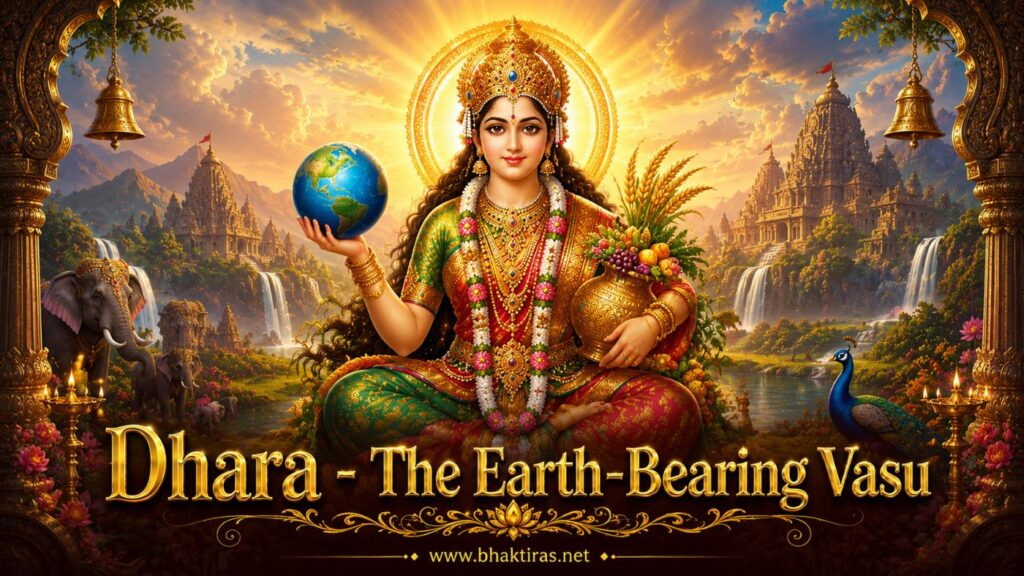
Dhara – The Earth-Bearing Vasu
धर
Dhara is the Vasu who embodies the earth and the quality of steadfastness, the firm ground that bears and supports all life. His name means the one who holds or sustains, and he is one of the eight Ashta Vasus.
Who Is Dhara?
Dhara is the Vasu of the earth, and his name comes from a root that means to hold, to bear or to support. That single idea captures his whole character, for the earth is the element that carries everything else, the fire, the water and the living beings that walk upon it. Where other Vasus flow or blaze or blow, Dhara simply stays, firm and dependable beneath our feet.
He is usually listed first among the eight Vasus, a fitting place for the element that forms the foundation of the physical world. In some accounts his name appears as Dharani, and he is closely linked with the idea of the earth as a bearing, sustaining ground rather than as a personified goddess in her own right.
Because his gift is steadiness, Dhara is sometimes associated with the immovable Pole Star and with the quality of endurance that keeps things in place through long stretches of time.
Element and Symbolism
Earth in Vedic imagery means far more than soil; it means support, patience and the quiet strength that holds everything up.
The Bearer
Dhara is the one who holds, the ground that carries mountains, rivers and every living thing without complaint, making him a symbol of selfless support.
Stability and Endurance
Earth does not rush or shift, and so Dhara stands for the calm steadiness that outlasts storms, a quality often linked with the fixed Pole Star.
Foundation of Life
Nothing grows without ground to grow in, so Dhara represents the firm base on which all creation depends, patient and enduring.
Dhara Among the Eight Vasus
Dhara is one of the Ashta Vasus, and he usually takes the first place in the list as the Vasu of earth. Beside Apas the water, Anala the fire, Anila the wind and Dyaus the sky, Dhara is the solid, unmoving member of the family, the base on which the other elements act. If the Vasus together form a picture of nature, then Dhara is the canvas itself, the steady ground that gives the rest their setting. Seeing him within the group makes his role clear, for he supports while the others move.
Vedic Worship and Relevance
Dhara has no widespread temple cult of his own; like the other Vasus he is invoked as part of the group in Vedic ritual, especially when the earth and the elements are honoured. The reverence Vedic people felt for the bearing, sustaining earth carries into the modern habit of touching the ground in respect before beginning something important. For a devotee today, Dhara is a reminder to value the qualities of patience and steadfastness, and to treat the land that sustains us with the gratitude owed to a faithful support.
Lore and Significance
The Steadfast Foundation
In the lists of the Vasus that appear in the Mahabharata and the Puranas, Dhara is named as the earth, the element that bears the weight of the world. His prominence comes not from dramatic adventures but from his role as the reliable ground, and this quiet steadiness is itself the lesson the tradition draws from him.
One of the Cursed Eight
Dhara shares in the great story of the Vasus, when the eight took the sage Vasishtha’s cow and were cursed to be born as mortals. As one of the seven who had merely assisted rather than led, Dhara was freed from human life soon after birth by the goddess Ganga, while the ringleader Dyaus remained to live on as Bhishma.
Frequently Asked Questions
What element does Dhara represent?
Dhara represents the earth. Among the eight Ashta Vasus he holds the element of the firm ground that supports and bears all life.
What does the name Dhara mean?
Dhara comes from a root meaning to hold, to bear or to support, which is why he stands for the earth as the sustaining, bearing foundation of the world.
Is Dhara connected to the Pole Star?
Because Dhara embodies steadiness and things that stay fixed in place, he is sometimes associated with the immovable Pole Star and with the quality of endurance.
Is Dhara the same as the earth goddess Bhudevi?
They are related in theme but distinct. Dhara is the Vasu who personifies the bearing, supporting quality of earth, while Bhudevi is the fuller goddess of the earth herself.
How is Dhara worshipped?
Dhara has no separate temple cult and is invoked as part of the eight Vasus in Vedic ritual, honoured whenever the earth and the natural elements are revered together.
Dhara teaches the quiet strength of patience, endurance and steadfast support.