
Masani Mela 2027 – Sheetla Mata Fair, Gurugram
मसानी मेला
When is the Masani Mela in 2027?
The main Masani Mela runs through the Hindu month of Chaitra, roughly 16 March to 15 April 2027, at the Sheetla Mata (Masani Devi) temple in old Gurugram, Haryana. Crowds peak on Mondays and on Sheetla Ashtami (Basoda), which falls on Tuesday, 30 March 2027. Lakhs of devotees come for darshan, first-tonsure ceremonies for children, and to seek the goddess’s protection from illness.
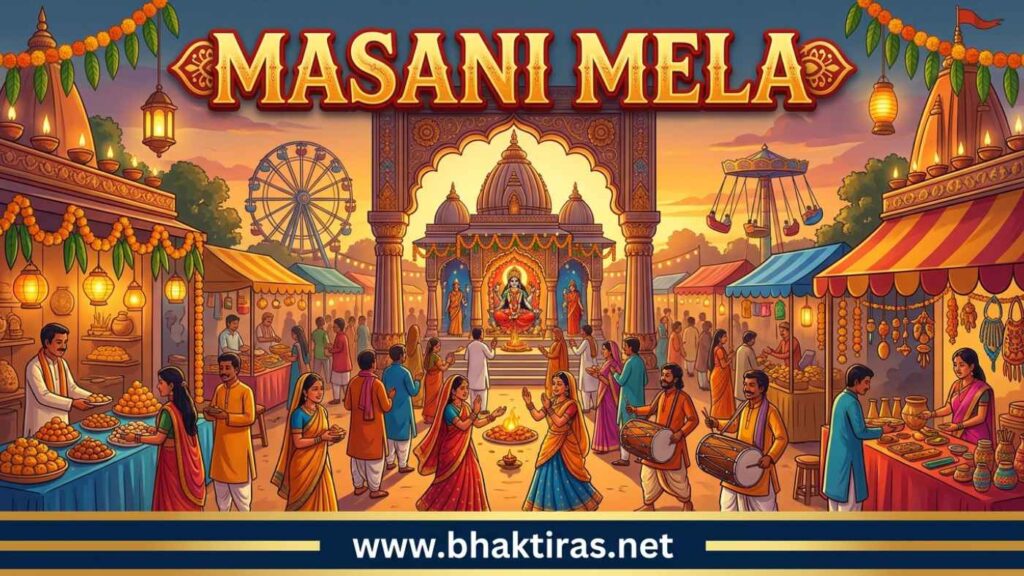
The Masani Mela is the great spring fair held at the Sheetla Mata temple in old Gurugram, Haryana, where the goddess is worshipped as Masani Devi, the mother who shields children from smallpox, measles and fever. Through the Hindu month of Chaitra, from about mid-March to mid-April, the shrine draws lakhs of pilgrims from Delhi, Haryana, Rajasthan and western Uttar Pradesh. Families come to fulfil vows, hold their child’s first haircut, and offer coins and cooled food to a goddess many have prayed to for generations.
Masani Mela 2026-2028: Dates & Calendar
The Masani Mela is not a single day but a Chaitra-long fair (roughly mid-March to mid-April) that swells to its busiest on Mondays and on Sheetla Ashtami. Because it follows the lunar Hindu calendar, the window shifts by a couple of weeks each year against the Gregorian date.
| Year | Chaitra Mela window | Sheetla Ashtami peak | Notes |
|---|---|---|---|
| 2025 | 16 March – 15 April | 22 March | One-month fair; heavy Monday footfall |
| 2027 | about 16 March – 15 April | 30 March (Tue) | Next big mela; Basoda peak |
| 2028 | about mid-March – mid-April | 18 March (Sat) | Chaitra Krishna Ashtami |
A second, smaller mela is also held later in the year around the Ashwin and Jyeshtha seasons, but the Chaitra fair is by far the largest. If you are travelling specifically for the peak, plan around Sheetla Ashtami and the Mondays on either side of it.
Why the Masani Mela Is Celebrated
The Masani Mela honours Sheetla Mata as Masani Devi, the goddess believed to guard families from smallpox, chickenpox, measles and the fevers of the hot season. Devotees come to give thanks for children’s health and to fulfil vows made in times of sickness.
The goddess who cools fever
Sheetla means ‘the cool one’. In folk belief she both sends and soothes the burning rash of pox and measles, so people pray to keep her pleased and her heat away from their homes. The Chaitra fair sits at the start of the hot months, exactly when such illnesses once spread, which is why the season and the goddess are so closely tied.
The Kripi and Dronacharya legend
Local tradition links the goddess to Kripi, also called Lalita, the wife of Guru Dronacharya, the teacher of the Pandavas and Kauravas. She is remembered for nursing sick children, especially those with smallpox. After her passing she came to be revered as Mata Sheetla or Masani, and the town’s name Gurugram itself recalls Dronacharya’s village.
A dream, a move and a royal shrine
By tradition the goddess appeared in a dream to a Gurgaon fief-holder, Singha, asking to move from Keshopur to Gurgaon. The present temple was raised in the 18th century by the ruling family of Bharatpur after invoking her blessings, and today it is one of Haryana’s most visited shrines, managed by the Shree Mata Sheetla Shrine Board.
A vow-keeping pilgrimage
Much of the crowd comes to keep a promise. Parents who prayed for a sick child’s recovery return during the mela to offer their child’s first haircut, cooled food and coins. This cycle of vow and thanksgiving, repeated across generations of families, is what keeps the fair alive.
Deities & Figures Worshipped
The presiding deity is Sheetla Mata, worshipped here as Masani Devi. The main image is a small polished golden idol set in a wooden casket on a marble platform, and the complex also houses several other gods.
Sheetla Mata (Masani Devi)
The main goddess, a form of the Devi associated with healing and protection from pox and fever. In popular iconography she rides a donkey and carries a broom, a small pot or kalash of cooling water, and sometimes a winnowing fan and neem leaves. The broom sweeps away disease, the pot holds the water that cools the fever, and the donkey is her steady mount.
Kripi / Lalita
The historical figure behind the shrine in local tradition, the wife of Guru Dronacharya, remembered for caring for children stricken with smallpox and later venerated as Sheetla.
Hanuman, Shiva, Shani and Durga
The temple grounds include shrines to Lord Hanuman, Shiva, Shani Dev and Durga, so many pilgrims complete a wider round of darshan while they are there.
Key Rituals, Step by Step
A visit during the mela follows a familiar rhythm, from bathing near the temple pond to the mundan hall and the darshan queue. Here is how a typical day unfolds for a devotee family.
- Bathe and prepare. Many pilgrims wash near the temple’s sacred pond before darshan and dress in fresh clothes, carrying their offerings in a small basket or cloth.
- Buy the offering thali. Stalls outside sell prasad baskets holding coconut, cooled sweet rice or halwa, chana, sindoor, a red chunri and coins to offer the goddess.
- Join the darshan queue. On peak days the line can stretch for hours, so families move slowly through the marked queue toward the golden idol in its wooden casket for a brief darshan.
- Offer cooled food and coins. Devotees present basi (cooled, previous-day) food, sweet rice, chana or halwa and drop coins as thanks, since Sheetla is offered food that is not freshly heated.
- Hold the mundan ceremony. Parents fulfilling a vow take their child to the temple’s dedicated mundan halls for the first-hair-cutting ritual, a common reason families choose the mela for their visit.
- Tie a vow-thread and pray. Some tie a thread or leave a token while asking the goddess to protect a child’s health or to keep illness from the household.
- Receive prasad and free food. Pilgrims collect blessed prasad, and many eat at the langar or bhandara where volunteers distribute food to the crowds.
- Complete the wider darshan. Before leaving, families often visit the Hanuman, Shiva, Shani and Durga shrines within the complex.
Special Foods of the Masani Mela
Offerings to Sheetla Mata are famously cooled rather than hot, echoing her role as the goddess who takes away fever. The prasad and fair food reflect that same simple, homely character.
Basi (cooled) food
Sheetla is offered basi bhog, food cooked the day before and served cold rather than piping hot. This custom, strongest around Sheetla Ashtami, is the defining food practice of the goddess.
Sweet rice and kheer
Sweet rice, often coloured or flavoured, and rice kheer are among the most common offerings, distributed back to devotees as prasad.
Chana and halwa
Boiled or spiced chana (chickpeas) and semolina halwa are typical prasad items handed out at the temple and sold at fair stalls.
Coconut and homely sweets
A whole coconut usually tops the offering basket, alongside simple sweets, batasha sugar drops and puri that families carry in for the goddess.
Langar and fair snacks
Volunteers run bhandara and langar meals for the crowds, while stalls around the mela sell jalebi, chaat and other North Indian fair food.
Where the Mela Draws Its Pilgrims
Though the fair is rooted in Gurugram, its pull reaches across the National Capital Region and neighbouring states, since Sheetla worship is strong across North India.
Gurugram and old Gurgaon
The temple sits on Sheetla Mata Road in the old city, near a pond about 3 km from the Gurgaon bus stand. For local families it is the neighbourhood kuldevi shrine, visited for weddings, births and first haircuts through the year.
Delhi and the NCR
Large numbers travel from Delhi and across the NCR, many by the special buses the state transport runs from the bus stand and railway station during the mela.
Haryana, Rajasthan and western UP
Devotees come from across Haryana and neighbouring Rajasthan and western Uttar Pradesh, regions where Sheetla and Basoda observances are widely kept.
A wider Sheetla tradition
Sheetla Ashtami, the mela’s peak, is marked in homes across North India with cooled food and cleaning of the hearth, so pilgrims often fold a temple visit into a festival they already observe at home.
Masani Mela Do's and Don'ts
A few simple courtesies help you have a smooth, respectful visit on the busiest days.
Do
- Reach early on Mondays and around Sheetla Ashtami, when queues are longest.
- Carry the traditional basket of cooled sweet rice, chana, coconut and coins.
- Use the marked queue and follow the volunteers and police managing the crowd.
- Book the mundan hall in advance if you plan a first-haircut ceremony.
- Keep children close, stay hydrated and note the medical posts on the grounds.
Avoid
- Do not offer freshly heated food to Sheetla; her bhog is offered cooled.
- Do not push in the darshan line; peak-day crowds move slowly for everyone.
- Do not carry leather goods or large bags into the sanctum area.
- Do not bring valuables you cannot watch in the dense fair crowds.
- Do not litter around the pond and temple; use the bins and facilities provided.
Frequently Asked Questions
When is the Masani Mela in 2027?
The main Masani Mela runs through the Hindu month of Chaitra, roughly 16 March to 15 April 2027, at the Sheetla Mata temple in Gurugram. It is busiest on Mondays and on Sheetla Ashtami (Basoda), which falls on Tuesday, 30 March 2027.
When is the Masani Mela in 2026 and 2028?
The Chaitra Masani Mela falls in March-April every year. In 2025 it ran 16 March to 15 April with a Sheetla Ashtami peak on 22 March; in 2028 the peak Sheetla Ashtami is 18 March, with the fair spanning roughly mid-March to mid-April. Exact fair windows are set by the temple’s Shrine Board each year.
Where is the Sheetla Mata (Masani Devi) temple?
The temple is on Sheetla Mata Road in old Gurugram (Gurgaon), Haryana, near a pond about 3 km from the Gurgaon bus stand. It is one of the most visited shrines in the National Capital Region and is managed by the Shree Mata Sheetla Shrine Board.
Why is Sheetla Mata worshipped at this fair?
Sheetla Mata, called Masani Devi here, is worshipped as the goddess who protects children from smallpox, measles, chickenpox and hot-season fevers. Families come to give thanks for a child’s health, to fulfil vows made during illness, and to seek her continued protection.
Who is Masani Devi and how is she linked to Dronacharya?
Local tradition links Masani Devi to Kripi, also called Lalita, the wife of Guru Dronacharya, the teacher of the Pandavas and Kauravas. She was remembered for nursing children sick with smallpox and later revered as Sheetla Mata; the city’s name Gurugram itself recalls Dronacharya’s village.
What do devotees offer to Sheetla Mata?
Devotees offer cooled or basi food such as sweet rice, chana and halwa, along with coconut, a red chunri, sindoor and coins. Because Sheetla is the goddess who cools fever, her bhog is offered cold rather than freshly heated, a custom strongest around Sheetla Ashtami.
Why do families hold mundan ceremonies at the temple?
Many parents vow to hold their child’s first haircut, or mundan, before Sheetla Mata if the child recovers from illness or is born healthy. The temple has dedicated mundan halls, and the Chaitra mela is the most popular time to complete this first-tonsure ceremony.
What are the temple darshan timings?
The temple is generally open for darshan from about 5 am to 12 noon and 4 pm to 9 pm. During the Masani Mela the crowds are heaviest on Mondays and around Sheetla Ashtami, so arriving early is advisable.
May Sheetla Mata keep your family cool, healthy and blessed. Jai Masani Maa.