
Bhavai 2026 – Gujarat's Devotional Folk Theatre
भवाई
What is Bhavai and when is it performed?
Bhavai is the traditional folk theatre of Gujarat, performed as a devotional offering to the goddess Amba (Ambaji) and Bahuchara Mata. It has no single fixed calendar date; troupes stage it seasonally, most often during the Navratri fortnight (mid-September to October) and at temple fairs across north Gujarat and parts of Rajasthan. A night of Bhavai opens with an invocation to Ganesha and the Devi, then moves through short satirical and mythological skits called vesha, carried by the deep call of the copper bhungal trumpet.
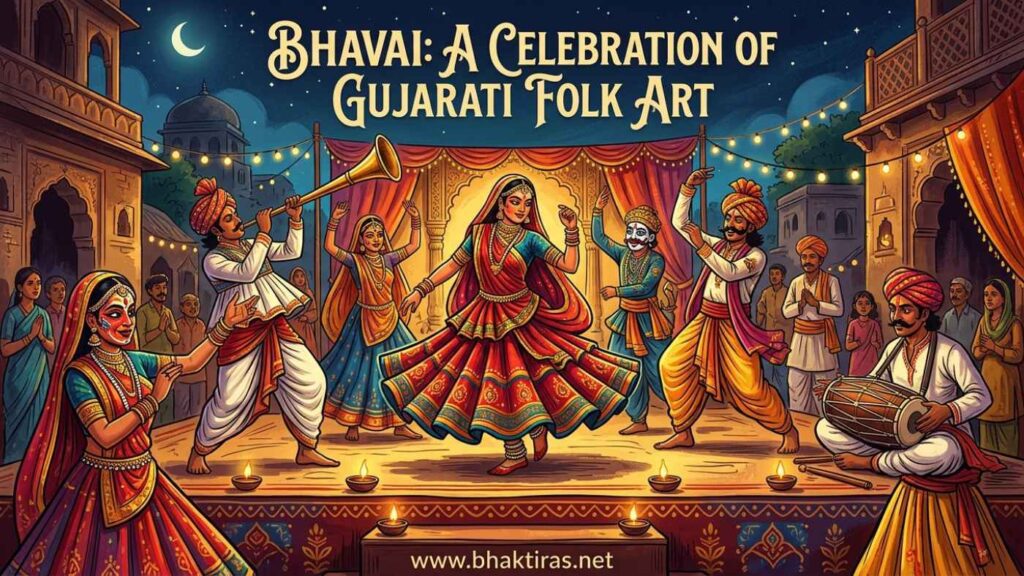
Bhavai is the old folk theatre of Gujarat and, along its northern edge, of parts of Rajasthan. It is played on open ground outside a temple or in a village square, not on a raised stage, and it doubles as devotion: the whole night is offered to the goddess Amba, mother of the universe. The word itself is often read as bhav (the cosmos) plus aai (mother). Troupes stage it through the year, but the busiest season is Navratri and the local temple fairs, when a lamp is lit for the Devi and the copper bhungal calls the audience in.
When Bhavai Is Performed
Bhavai is a performance tradition rather than a single dated festival, so there is no fixed annual date. It follows the ritual and fair calendar of Gujarat.
| Occasion | Typical time | Why Bhavai is performed |
|---|---|---|
| Sharadiya Navratri | 11-20 October 2026 | Nine nights offered to the Devi; the peak Bhavai season |
| Temple melas (fairs) | Through the year | Staged at fairs of Ambaji, Bahucharaji and local Devi shrines in north Gujarat |
| Vows and thanksgiving | As pledged | A troupe is invited to fulfil a family or village vow to the goddess |
The Navratri window shifts each year with the lunar month of Ashwin, so the October 2026 dates apply to that year only. Away from Navratri, a Bhavai night is arranged when a temple committee or a family sponsors it, most often at Devi fairs.
Why Bhavai Matters
Bhavai is part worship and part entertainment: a living offering to the goddess Amba that also carries centuries of village storytelling and gentle social criticism.
An offering to the Devi
Every performance is dedicated to Amba, and by extension to Bahuchara Mata, the guardian goddesses of the region. The opening lamp and invocation frame the whole night as devotion, which is why Bhavai clusters around Navratri and Devi temple fairs rather than secular events.
The legacy of Asaita Thakar
Tradition credits the 14th-century poet-saint Asaita Thakar with shaping Bhavai. A Brahmin from Unjha, he was outcast after sharing a meal with a girl he saved from abduction, and turned to composing and staging plays. He is said to have written hundreds of pieces, of which only a fraction survive.
A community's inheritance
Bhavai has long been the calling of the Targala community (also called Bhavaiya, and known regionally as Nayak, Bhojak or Vyas), who pass roles, texts and music down the generations. Keeping the tradition alive preserves an oral repertoire that exists nowhere in print.
Humour with a sharp edge
Under the devotional frame, Bhavai has always used comedy to comment on caste, greed and hypocrisy. The satire is pointed but affectionate, letting a village audience laugh at power while the night stays anchored in worship of the goddess.
Deities Honoured in Bhavai
Bhavai is offered chiefly to the Mother goddess, with Ganesha invoked first for an auspicious start.
Amba (Ambaji)
Amba, the Mother of the universe worshipped at Ambaji in north Gujarat, is the presiding deity of Bhavai. A lamp lit in her honour opens the night and the performance is dedicated to her.
Bahuchara Mata
Bahuchara Mata of Bahucharaji, another powerful goddess of the region, is closely tied to the tradition; many troupes and communities hold her as a family deity and stage Bhavai at her fairs.
Ganesha
As the remover of obstacles, Ganesha is called at the very start of a Bhavai night so the skits that follow proceed smoothly. Kali and other forms of the Devi may also appear before the main vesha begins.
A Night of Bhavai, Step by Step
A traditional Bhavai night follows a set order that moves from worship into the skits and back again.
- Marking the ground. The Nayak, the troupe leader, marks out the open performance circle and lights an oil lamp offered to goddess Amba, dedicating the night to her.
- Invocation to Ganesha. The night opens with a character or song honouring Ganesha, seeking an unobstructed, auspicious performance.
- Salute to the Devi. Amba, and often Kali, are invoked and greeted so the goddess presides over everything that follows.
- The bhungal calls. The long copper bhungal trumpet sounds, joined by pakhawaj drums, cymbals, sarangi and harmonium, to gather the audience and announce the entry of key characters.
- The vesha sequence. The troupe performs a chain of short skits, each called a vesha, some mythological and some sharply comic, with the Nayak and the jester staying on stage to link scenes and comment on the action.
- Song, dance and satire. Between and within veshas, dance and Hindustani-inflected folk songs carry the story, while the humour turns to caste, money and everyday village life.
- Closing. The night winds down through the small hours, ending as it began, with the performance returned to the goddess as an offering.
Fair Food Around a Bhavai Night
Bhavai is watched at temple fairs, where the eating is light Gujarati fair food rather than a feast, since the crowd grazes through a long evening.
Farsan
Assorted savoury snacks such as dhokla, khaman and fafda are the staple of any Gujarati mela, easy to buy from a stall and eat standing in the crowd.
Chevdo
A crisp, spiced mix of flattened rice, nuts and fried gram, chevdo is the classic dry snack passed around during a long night of performance.
Ganthiya
Thick, soft besan (gram flour) fried strips, often eaten with fried green chillies and chutney, are a north Gujarat fair favourite near Ambaji and Bahucharaji.
Tea and sweets
Glasses of hot masala chai keep the audience going into the early hours, alongside simple fair sweets like jalebi and boondi from the stalls.
Watching Bhavai: Do's and Don'ts
Bhavai is a devotional performance on temple ground, so a little care keeps the evening respectful.
Do
- Treat it as worship as well as theatre, since the night is offered to the goddess.
- Arrive early to find a place on the ground and settle before the invocation begins.
- Watch and appreciate the bhungal players and the Nayak, whose skill holds the night together.
- Support the troupe with the customary offering or contribution if one is invited.
- Stay for the full arc if you can, as the veshas build through the evening.
Avoid
- Do not treat the satire as mockery of faith; the comedy sits inside a devotional frame.
- Avoid loud talk or moving through the performance circle while a vesha is running.
- Do not photograph or film performers without asking, especially during ritual moments.
- Avoid pushing to the front or blocking the view of elders and children seated on the ground.
- Do not expect a fixed stage, set start time or a printed script; Bhavai is fluid and community-run.
Frequently Asked Questions
What is Bhavai?
Bhavai is the traditional folk theatre of Gujarat, and of parts of northern Rajasthan, performed on open ground as a devotional offering to the goddess Amba. It combines short satirical and mythological skits called vesha with dance, folk song and the sound of the copper bhungal trumpet.
When is Bhavai performed?
Bhavai has no single fixed date; it is a performance tradition, not a dated festival. Troupes stage it most often during Navratri (11 to 20 October in 2026) and at Devi temple fairs through the year across north Gujarat and parts of Rajasthan.
Which god is honoured in Bhavai?
Bhavai is offered chiefly to the goddess Amba (Ambaji), the Mother of the universe, and to Bahuchara Mata, the powerful goddess of the region. Ganesha is invoked at the very start of each night to remove obstacles before the skits begin.
What is a vesha in Bhavai?
A vesha is one short act or skit within a Bhavai night, and the whole tradition is sometimes simply called Vesha. Each vesha is a self-contained piece, some mythological and some pointedly comic, strung together across the evening by the Nayak and the jester.
What is the bhungal?
The bhungal is a copper trumpet about four feet long that is the signature instrument of Bhavai. It sounds a strong, carrying note to gather the audience and to mark the entry of important characters, alongside pakhawaj drums, cymbals, sarangi and harmonium.
Who started Bhavai?
Bhavai is traditionally credited to Asaita Thakar, a 14th-century poet-saint and Brahmin from Unjha in Gujarat. After being outcast for sharing a meal with a girl he had saved, he began composing and staging plays, which grew into the Bhavai form.
Who performs Bhavai?
Bhavai has traditionally been performed by the Targala community, also called Bhavaiya and known regionally as Nayak, Bhojak or Vyas. Roles, texts and music pass down through families, and female characters are played by men in the classic style.
Where can you see Bhavai today?
Bhavai is still staged at Devi temple fairs in north Gujarat, especially around Ambaji and Bahucharaji, and during Navratri, though cinema and television have shrunk its village audiences. Cultural festivals and folk-art programmes in Gujarat also help keep the tradition alive.
May the goddess Amba bless every troupe that keeps the lamp of Bhavai burning. Jai Ambe.