
Thaipusam 2027 – The Kavadi Festival of Lord Murugan
தைப்பூசம்
When is Thaipusam in 2027?
Thaipusam falls on Friday, 22 January 2027. It is a Tamil Hindu festival honouring Lord Murugan, observed on the full-moon day of the month of Thai when the Pusam (Pushya) star is ascendant. Devotees mark it by carrying the kavadi, a physical burden of penance, most famously up the Palani hill in Tamil Nadu and at Malaysia’s Batu Caves.
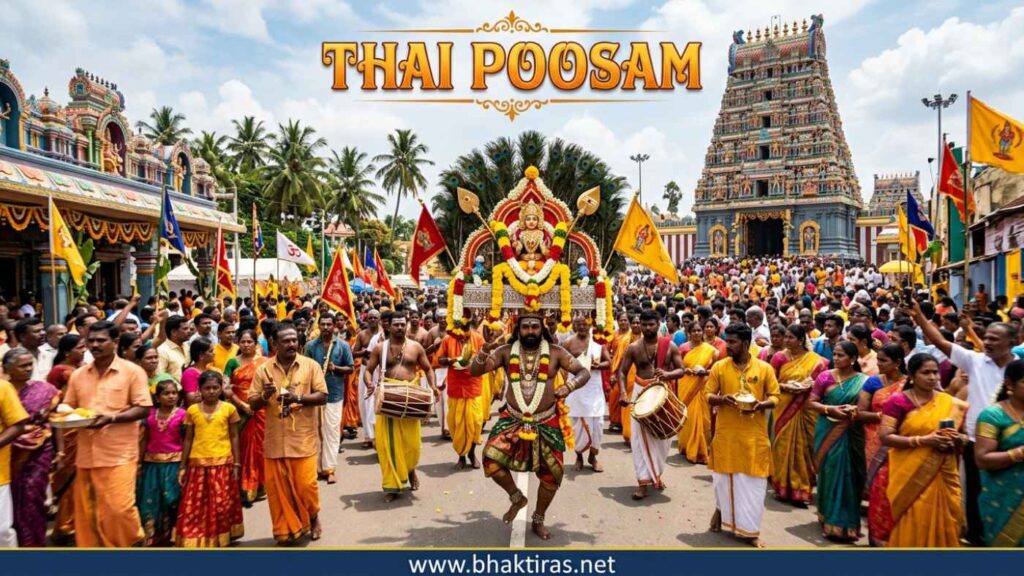
Thaipusam is the great Tamil festival of Lord Murugan, kept on the full-moon night of the month of Thai (January-February) when the Pusam star shines overhead. It remembers the moment the goddess Parvati placed the vel, a gleaming spear, in her son’s hand so he could defeat the demon Soorapadman. In 2027 it falls on Friday, 22 January. What sets the day apart is the kavadi: after weeks of fasting and prayer, devotees shoulder ornate frames and milk pots, some piercing the skin as a vow kept, and walk to the shrine chanting the name of Murugan.
Thaipusam 2026-2028: Dates & Calendar
The next Thaipusam is on Friday, 22 January 2027. The date shifts each year because it follows the Tamil solar-lunar calendar, landing on the Thai-month full moon paired with the Pusam nakshatra.
| Year | Date | Day | Notes |
|---|---|---|---|
| 2026 | 1 February | Sunday | Already passed this year |
| 2027 | 22 January | Friday | Next occurrence |
| 2028 | 9 February | Wednesday | Approximate; confirm nearer the date |
Because the festival tracks a star rather than a fixed Gregorian date, the 2028 date can vary slightly with the panchang and by location; the diaspora in Malaysia, Singapore and Mauritius usually keeps the same day as Tamil Nadu.
Why Thaipusam Is Celebrated
Thaipusam marks the day Parvati gave Lord Murugan the vel, the divine spear he used to destroy the demon Soorapadman, so the festival celebrates the triumph of good over pride and cruelty.
For devotees the deeper meaning sits in the kavadi itself. To take a vow, keep weeks of discipline, and then carry a real weight to the shrine is a way of turning a private prayer into something the body has to answer for. The heavier the burden accepted willingly, the more sincere the thanks or the plea it carries.
The gift of the vel
Tamil tradition holds that Parvati handed Murugan the vel on this day so he could lead the celestial army against Soorapadman. The spear stands for wisdom that cuts through ignorance, which is why chants of “Vel Vel” ring out along the route.
A vow made physical
Many devotees carry the kavadi to fulfil a promise made in a hard time, often for the health of a child or family. The penance is the point: it is thanks given in effort, not only in words.
Faith over pain
Piercing the cheeks, tongue or skin with vel-shaped skewers is undertaken as devotion, not display. Those who take it on prepare through fasting and prayer and describe entering a calm, trance-like state carried by the crowd’s chanting.
Deities & Figures Worshipped
Thaipusam centres entirely on Lord Murugan, the Tamil god of war and youth, with the goddess Parvati remembered as the one who armed him.
Lord Murugan
Also called Karthikeya, Subramanya or Skanda, Murugan is the second son of Shiva and Parvati and the commander of the divine army. Thaipusam honours him at his six great hill shrines in Tamil Nadu, above all Palani.
Goddess Parvati
Parvati is central to the day’s story as the mother who gave Murugan the vel to defeat Soorapadman. Her act frames the festival as the arming of the young god for a righteous fight.
Key Rituals, Step by Step
The vow begins weeks before the full moon and builds to the walk to the shrine on Thaipusam day.
- Take the vow. A devotee decides to carry a kavadi or milk pot, usually to fulfil a promise or seek a blessing from Murugan.
- Keep the fast. For weeks beforehand they eat simple vegetarian food, sleep on the floor, and abstain from indulgences to purify the body and mind.
- Prepare the kavadi. The frame is cleaned and decorated with peacock feathers, flowers and images of Murugan; milk pots (paal kudam) are readied for those making a simpler offering.
- Ritual bath and blessing. On the day, devotees bathe, dress in saffron or yellow, and receive sacred ash before the kavadi is lifted.
- Piercings for those who have vowed them. Under guidance, vel-shaped skewers and hooks are placed through the cheeks, tongue or skin as the promised penance, undertaken in a prayerful, focused state.
- Carry the kavadi. To drumming and chants of “Vel Vel”, devotees dance the Kavadi Attam and walk the route, at Palani climbing the hill to the shrine.
- Offer at the sanctum. The milk is poured over the deity (abhishekam) and the kavadi is set down before Murugan, completing the vow.
- Break the fast. After darshan the devotee takes prasadam, and the piercings are removed with prayers and sacred ash.
Special Foods of Thaipusam
Because devotees keep a strict vegetarian fast, the food of the day is simple, pure and shared freely as offering.
Milk (paal)
Pots of milk carried on the head are the classic Thaipusam offering, poured over Murugan as abhishekam. Milk stands for purity and an untainted heart.
Panchamirtham
A sweet made of banana, jaggery, honey, dates, ghee and cardamom, this is the famous prasadam of the Palani Murugan temple and closely tied to the festival.
Pongal
Sweet chakkarai pongal and savoury ven pongal are cooked as temple offerings, made from the new-season rice of the Thai month.
Vegetarian meals
Devotees on the vow eat only plain sattvic food, avoiding onion, garlic, meat and alcohol, and community kitchens serve free vegetarian meals to pilgrims along the route.
Where It's Celebrated
Thaipusam is a Tamil festival at heart, kept most intensely in Tamil Nadu and by the Tamil diaspora across Southeast Asia and the Indian Ocean.
Palani, Tamil Nadu
The hilltop Dhandayuthapani temple at Palani is the festival’s spiritual heart, drawing lakhs of devotees who climb the hill with kavadis and milk pots.
Kerala
Murugan temples across Kerala, including Palani-linked shrines, hold Thaipusam processions and kavadi offerings for the region’s Tamil and Malayali devotees.
Batu Caves, Malaysia
At the Batu Caves near Kuala Lumpur more than a million devotees gather, carrying kavadis up the long flight of steps in one of the largest Thaipusam gatherings anywhere.
Singapore & Mauritius
Tamil communities in Singapore and Mauritius keep the day with public kavadi processions, milk offerings and temple abhishekam, passing the tradition to a new generation abroad.
Thaipusam Do's and Don'ts
A few simple points help devotees and visitors honour the day well.
Do
- Keep the vegetarian fast and simple living if you have taken a vow
- Dress modestly, ideally in saffron, yellow or clean traditional wear
- Prepare piercings only under experienced guidance and in a prayerful frame of mind
- Support kavadi carriers with water, chanting and space along the route
- Treat the penance with respect as an act of devotion, not a spectacle
Avoid
- Do not eat meat, drink alcohol or use tobacco during the vow period
- Do not mock, film disrespectfully, or crowd devotees carrying the kavadi
- Do not attempt piercings casually or without proper preparation and guidance
- Do not break the fast before completing the offering at the shrine
- Do not treat the trance state of devotees as entertainment
Frequently Asked Questions
When is Thaipusam in 2027?
Thaipusam is on Friday, 22 January 2027. It falls on the full-moon day of the Tamil month of Thai when the Pusam (Pushya) star is ascendant, honouring Lord Murugan.
When was Thaipusam in 2026 and when is it in 2028?
Thaipusam fell on Sunday, 1 February 2026, and in 2028 it is expected on Wednesday, 9 February. The 2028 date is approximate and should be confirmed against a panchang nearer the time, as the festival tracks the Pusam star rather than a fixed Gregorian date.
Why is Thaipusam celebrated?
Thaipusam is celebrated to mark the day the goddess Parvati gave Lord Murugan the divine vel (spear) to defeat the demon Soorapadman. It honours the victory of good over evil and is a day for devotees to fulfil vows through penance and offerings.
Which god is worshipped on Thaipusam?
Lord Murugan, also known as Karthikeya, Subramanya or Skanda, is worshipped on Thaipusam. He is the Tamil god of war and youth, the son of Shiva and Parvati, and is honoured especially at his hill temple in Palani, Tamil Nadu.
What is the kavadi in Thaipusam?
The kavadi is a physical burden of devotion carried by devotees on Thaipusam to fulfil a vow. It ranges from a simple pot of milk to an ornate decorated frame, and some devotees also pierce the skin, cheeks or tongue with vel-shaped skewers as their promised penance.
Why do devotees pierce their bodies on Thaipusam?
Devotees pierce their cheeks, tongue or skin with vel-shaped skewers as an act of devotion and penance, usually to fulfil a vow made to Lord Murugan. It is undertaken after weeks of fasting and prayer, in a calm, focused state supported by chanting, and is regarded as faith made physical rather than a display.
Where is Thaipusam celebrated?
Thaipusam is celebrated most intensely in Tamil Nadu, above all at the Palani Murugan temple, and in Kerala. It is also a major festival for the Tamil diaspora, drawing over a million devotees to the Batu Caves in Malaysia and marked with public processions in Singapore and Mauritius.
What do devotees eat during Thaipusam?
Devotees on the Thaipusam vow keep a strict vegetarian fast, eating only plain sattvic food without onion, garlic, meat or alcohol. Milk is the key offering poured over Murugan, while panchamirtham at Palani and sweet pongal are shared as prasadam.
May Lord Murugan’s vel clear every obstacle from your path this Thaipusam. Vel Vel Muruga!