
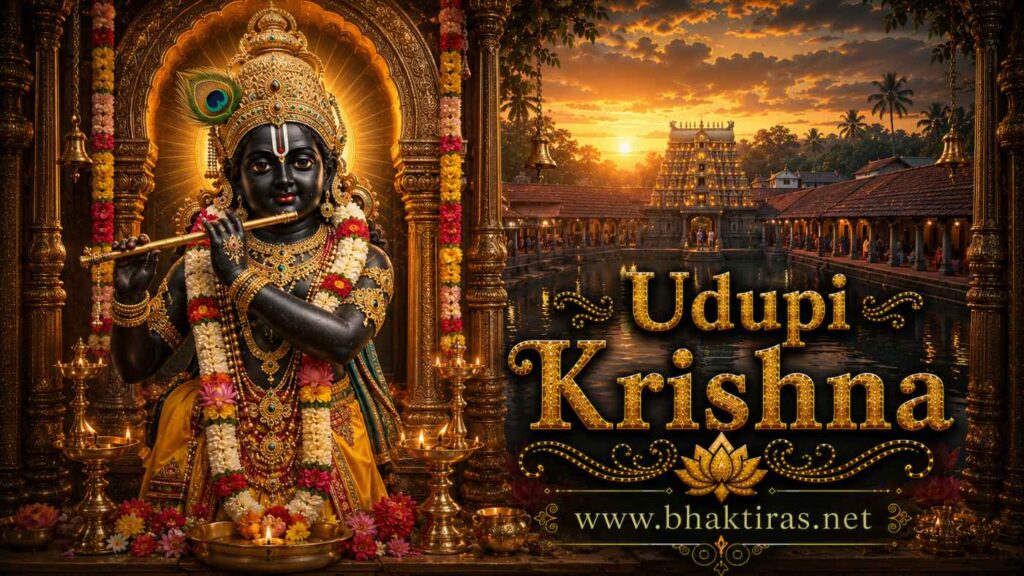
Udupi Krishna
उडुपी कृष्ण
Udupi Krishna is a beloved form of the child Lord Krishna worshipped at the Krishna Matha in Udupi, Karnataka. The small idol shows him as a boy holding a churning rod and a rope, the butter-thief. Installed in the 13th century by the saint Madhvacharya, he is uniquely worshipped facing west through a small window called the Kanakana Kindi.
Who Is Udupi Krishna?
In the coastal town of Udupi in Karnataka, the Lord takes on one of his most tender forms – a small boy, no taller than a child, caught in the middle of his mischief. This is Udupi Krishna, worshipped at the Krishna Matha, and the idol is not large or imposing. He is a little figure of grace, holding a churning rod in one hand and a rope in the other, the very picture of the butter-thief who slipped into the homes of Gokul to steal fresh butter.
What makes this form so loved is its intimacy. The child Krishna does not sit in royal splendour here. He plays, he churns, he holds the cord that once tied him to the grinding mortar. Devotees who come to Udupi often speak of feeling less like worshippers before a god and more like family members watching over a beloved child. The bhava, the mood of devotion, is one of affection rather than fear.
The idol was set in place in the 13th century by Sri Madhvacharya, the great teacher of the Dvaita school of Vedanta. For Madhva and the tradition he founded, the difference between the soul and the Supreme is real and eternal, and the path to grace lies in loving surrender to the Lord. Udupi Krishna became the living heart of that teaching – a form of Vishnu that a devotee could serve daily, feed, dress, and adore.
Perhaps the most astonishing thing about Udupi Krishna is the way he is worshipped. The main deity faces west, and the primary darshan is given not through a grand doorway but through a small silver-framed window with nine little openings. This window has a name and a story that every child in Karnataka knows, and it turned a barred outsider into one of the most cherished saints of the land.
How Madhvacharya Received the Idol
A ship in the storm
The tradition tells of a merchant ship sailing along the western coast, heavy with cargo, when a fierce storm rose over the sea. The waves tossed the vessel and the crew feared it would break apart. Sri Madhvacharya, who happened to be near the shore, saw the ship in distress. He is said to have raised his upper cloth and waved a signal, guiding the vessel safely past the danger to calmer water.
The gift of gopichandana
The grateful merchant offered Madhva anything from his cargo. The saint asked only for two lumps of gopichandana – the sacred clay used to mark the sacred tilaka on the forehead. These lumps had been used as ballast, weighing down the ship. When Madhva began to break one open, he found hidden inside it an idol of the child Krishna, complete with the churning rod and rope, exactly as the Lord had played in Gokula. The clay had travelled, the tradition says, all the way from Dwaraka.
Carried to Udupi
Madhvacharya carried the sacred image to Udupi and installed it with his own hands, consecrating the Krishna Matha around it. He composed the Dvadasha Stotra, twelve hymns of praise, and sang them as he set the Lord in his shrine. From that day the little idol became the beating heart of the town, and the care of the Lord passed to Madhva’s own disciples, whose lineages continue to serve him to this hour.
The Boy with the Churn
The idol of Udupi Krishna is small and finely carved, and every detail tells a story. In one hand the boy holds the mathu, the wooden churning rod used to turn milk into butter. In the other he grips a cord. Together they mark him as Navaneeta Krishna, the Krishna of fresh butter, the child who could never keep his fingers out of the butter pots of the cowherd women.
There is a well-loved episode behind this image. Little Krishna once broke a pot of curd and helped himself to the butter. His mother Yashoda, meaning to teach him a lesson, tried to tie him to a heavy grinding mortar with a rope. Yet no matter how much cord she brought, it always fell short by two fingers’ width – for the infinite cannot be bound by the finite. Only when she gave up her pride and surrendered in love did the rope reach around. Udupi Krishna, holding that very rope and churn, is a reminder that the Lord is bound not by force but by devotion.
Because he is a child, the daily worship at Udupi is full of tenderness. The Lord is woken gently, bathed, dressed in fine silks and jewels, offered a range of foods that a growing boy would love, and put to rest at night. Devotees do not merely pray before him; they mother him. This is the heart of the Udupi mood – the Supreme Being served with the warmth one gives to one’s own beloved child.
Kanakana Kindi – the Window of Grace
The saint who was turned away
Kanakadasa was a poet-saint of great devotion, but he was born into a community considered low in the social order of his day. When he came to Udupi longing for the darshan of Krishna, he was barred from entering the temple. Others might have grown bitter. Kanakadasa did not. He took his place behind the temple wall, on the western side, and there he sang. His songs were not complaints but pure outpourings of love, calling to Krishna as a child calls to its mother.
The Lord turns around
The tradition holds that the Lord could not bear to keep his devotee waiting. As Kanakadasa sang, the idol of Krishna – which had always faced east – is said to have turned around on its own to face west, toward the wall behind which the saint stood. At that very spot the wall cracked open, and a small window appeared, so that Krishna could look upon Kanakadasa and give him the darshan he was denied.
The window that remains
That window is the Kanakana Kindi, Kanaka’s window, and it has never been closed. To this day Udupi Krishna faces west and receives worship through this small nine-holed silver-framed opening. Every pilgrim who visits looks upon the Lord through the very window that love once opened. It is one of the most moving lessons in all of Hindu devotion – that the Lord answers the pure heart, and that no wall of birth or status can stand between a true devotee and the divine.
The Ashta Mathas and the Paryaya
Sri Madhvacharya did not leave the worship of Udupi Krishna to chance. He entrusted the care of the Lord to eight of his direct disciples, and from them arose the eight monasteries known as the Ashta Mathas – Pejawara, Palimaru, Adamaru, Puttige, Sodhe, Kaniyooru, Shirooru and Krishnapura. Each is headed by a swami of the Madhva lineage, and each carries its own centuries of tradition, teaching and service.
Rather than sharing the daily duties all at once, the eight mathas take turns. One matha serves the Lord for a fixed period, tending to every ritual, feeding thousands of pilgrims each day, and maintaining the temple. When the term ends, the responsibility passes to the next matha in a grand ceremony called the Paryaya.
The Paryaya festival happens once every two years, and it is one of the great events of Karnataka. The outgoing swami hands over the keys and the seva of Krishna to the incoming one, amid processions, scholarly gatherings and enormous public feasts. Through this rotating system the worship of Udupi Krishna has continued without a single break for over seven centuries – a living chain reaching back to Madhvacharya himself.
Iconography and Symbols
The churning rod (mathu)
The rod in the Lord’s hand is the everyday tool of a cowherd home, used to churn butter. It marks Udupi Krishna as the child of Gokula and reminds devotees that the divine delights in the simple, homely acts of love.
The rope (dora)
The cord recalls how Yashoda tried to tie the little Krishna to a grinding mortar, only for the rope to fall short. It teaches that the Lord cannot be bound by force, but yields willingly to a heart full of love.
The westward face
Alone among Krishna shrines, Udupi Krishna faces west. This is the trace of Kanakadasa’s darshan, a permanent sign that the Lord turns toward the sincere devotee, wherever they may stand.
The Kanakana Kindi
The nine-holed silver window through which the Lord is worshipped is itself an icon of grace. Looking upon Krishna through it, the pilgrim shares in the very vision granted to a barred outsider centuries ago.
The child form
Udupi Krishna is deliberately small and boyish. His childlike form invites affection over awe, and the daily rituals treat him as a living child who is fed, dressed and put to sleep.
Gopichandana clay
Born from a lump of sacred gopichandana, the idol links the daily tilaka mark on a devotee’s forehead to the very substance from which the Lord emerged – clay, devotion and grace made one.
How Udupi Krishna Is Worshipped
Worship at the Krishna Matha follows a full daily cycle, carried out by the serving matha with great care and warmth. The Lord is treated as a living child from the moment he is woken to the moment he is put to rest.
- Darshan through the window: pilgrims take their primary darshan of the Lord through the Kanakana Kindi on the western wall, gazing upon Krishna through the nine silver openings.
- Daily seva: the serving swami performs a fixed round of rituals – waking, bathing (abhisheka), dressing, adorning with ornaments, and offering lamps to the Lord several times a day.
- Naivedya and prasadam: a variety of food is offered to the child Krishna and then given out as prasadam; the Udupi kitchens feed thousands of pilgrims free of charge every day.
- Singing the Dvadasha Stotra: the twelve hymns composed by Madhvacharya are recited before the Lord, keeping the founder’s own words alive in the worship.
- Chanting the name: devotees repeat simple Krishna mantras and sing devotional kirtans, many in Kannada, including the compositions of Kanakadasa and Purandaradasa.
- Festivals: Krishna Janmashtami, the Paryaya changeover, and other Vaishnava festivals draw large crowds and are marked with special worship and processions.
Temples and Sacred Sites
The worship of Udupi Krishna is centred on one place above all, though the town of Udupi and its surroundings hold several linked shrines that pilgrims visit together.
- Krishna Matha, Udupi: the main shrine, home to the idol installed by Madhvacharya and worshipped through the Kanakana Kindi. This is the heart of the whole tradition.
- Chandramoulishwara and Anantheshwara temples: two ancient Shiva shrines beside the Krishna Matha, older than the matha itself, forming the sacred core of Udupi town.
- The Ashta Mathas: the eight monasteries of the Madhva order clustered around the temple, each with its own shrine, teaching hall and lineage of swamis.
- Pajaka Kshetra: the birthplace of Sri Madhvacharya, a short distance from Udupi, a pilgrimage site for followers of the Dvaita tradition.
- Malpe and the coast: the nearby shore linked in tradition to the ship whose gopichandana carried the idol, tying the story of Udupi Krishna to the sea itself.
Prayers and Mantras
Devotion to Udupi Krishna is expressed through simple, heartfelt chanting of the Lord’s name. The most common invocation is the basic Krishna mantra, repeated as a way of holding the child Lord in the heart throughout the day.
Devanagari: ॐ श्री कृष्णाय नमः
Transliteration: Om Shri Krishnaya Namah
Meaning: I bow to the revered Lord Krishna. This short mantra carries the whole mood of Udupi worship – not a demand or a bargain, but a loving salutation to the child who steals butter and hearts alike. Devotees also sing the Dvadasha Stotra of Madhvacharya and the Kannada devaranamas of Kanakadasa and Purandaradasa, whose songs still fill the temple air.
Frequently Asked Questions about Udupi Krishna
Who is Udupi Krishna?
Udupi Krishna is a beloved form of the child Lord Krishna enshrined at the Krishna Matha in Udupi, Karnataka. The small idol shows him as a boy holding a churning rod and a rope, the butter-thief of Gokula. He was installed by the saint Madhvacharya in the 13th century and is worshipped uniquely facing west.
What is the Kanakana Kindi?
The Kanakana Kindi is a small silver-framed window with nine openings on the western wall of the Krishna Matha. Tradition says the idol turned to face west and this window opened so that the saint Kanakadasa, barred from entering, could receive darshan. Today all pilgrims worship Udupi Krishna through this window.
Who installed the Udupi Krishna idol?
The idol was installed in the 13th century by Sri Madhvacharya, the founder of the Dvaita school of Vedanta. According to tradition, he recovered the image inside a lump of sacred gopichandana clay from a merchant ship he had saved from a storm, then carried it to Udupi and consecrated the Krishna Matha around it.
Why does Udupi Krishna face west?
Udupi Krishna faces west because of the devotee Kanakadasa. Barred from entering the temple, he sang to the Lord from behind the western wall with such love that the idol is said to have turned around to face him, and a window opened in the wall. The Lord has faced west ever since.
What are the Ashta Mathas and the Paryaya?
The Ashta Mathas are the eight monasteries founded by the disciples of Madhvacharya to care for Udupi Krishna. They take turns serving the Lord, and every two years the duty passes from one matha to the next in a grand festival called the Paryaya, marked by processions and vast public feasts.
Why does Udupi Krishna hold a churning rod?
The churning rod, or mathu, and the rope mark him as Navaneeta Krishna, the butter-thief of Gokula. They recall the child Krishna who stole fresh butter and whom Yashoda tried to bind with a cord that always fell short. The image celebrates a Lord bound only by love, not force.
Can anyone visit the Krishna Matha in Udupi?
Yes, the Krishna Matha welcomes pilgrims of all backgrounds today. The story of Kanakadasa itself teaches that the Lord's grace reaches every sincere heart regardless of birth. Visitors take darshan through the Kanakana Kindi and may share in the free prasadam served daily by the temple kitchens.
May the child Krishna of Udupi, who turned to face a devotee barred at the wall, turn his loving gaze upon you through the window of grace.