
Navpad Oli 2026 – The Nine-Day Jain Fast of the Siddhachakra
नवपद ओळी
When is Navpad Oli (Ayambil Oli) in 2026?
Navpad Oli falls twice in 2026: the spring (Chaitra) Oli ran from about 25 March to 2 April 2026, and the autumn (Ashwin) Oli runs for roughly nine days from about 17 October to Sharad Purnima on 25 October 2026. Both are exact-tithi observances, so local Jain calendars vary by a day. For all nine days devotees keep the ayambil vow – one bland, boiled, oil-free meal a day – while worshipping the nine holy positions of the Siddhachakra.
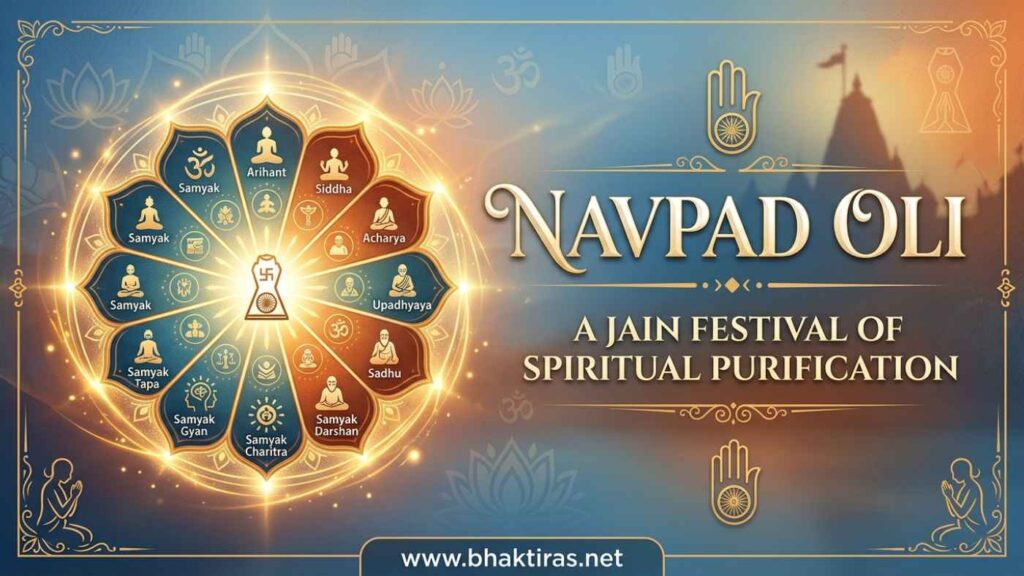
Navpad Oli, also called Ayambil Oli, is a nine-day Jain observance devoted to the Navpad – the nine holy positions arranged on the Siddhachakra. For each of the nine days a devotee keeps the ayambil vow: a single plain, boiled, tasteless meal with no oil, ghee, salt, sugar, milk or vegetables, taken once in daylight. It is kept twice a year, in the bright fortnights of Chaitra and Ashwin, and is less about the body than the palate – a deliberate loosening of the grip of taste and appetite while the mind rests on the nine ideals of Jain life.
Navpad Oli 2026-2027: Dates & Calendar
The next Navpad Oli is the autumn (Ashwin) Oli, running roughly 17 to 25 October 2026 and closing on Sharad Purnima. Because it is fixed to lunar tithis – the seventh day of the bright fortnight through the full moon – the exact start can shift a day between panchangs.
| Occasion | 2026 | 2027 (approx) | Basis |
|---|---|---|---|
| Chaitra Oli (spring) | 25 Mar – 2 Apr 2026 | mid-April 2027 | Chaitra Shukla 7 to Purnima |
| Ashwin Oli (autumn) | ~17-25 Oct 2026 | early October 2027 | Ashwin Shukla 7 to Purnima |
In practice the Ashwin Oli is the more widely kept of the two, ending on Sharad Purnima, when many families conclude the nine days of ayambil with the Siddhachakra puja. Confirm the precise start with your local sangh’s panchang, as the seventh-tithi date can fall on either 16 or 17 October depending on the reckoning.
Why Navpad Oli Is Observed
Navpad Oli is observed to venerate the Navpad, the nine supreme positions of the Siddhachakra, and to train the senses through nine days of ayambil – eating only to sustain the body, never to please the tongue.
The nine pads fall into two groups. Five are the Panch Parameshthi, the five revered beings every Jain honours in the Navkar Mantra: the Arihant (the enlightened teacher), the Siddha (the liberated soul), the Acharya (the head of the order), the Upadhyaya (the teacher of scripture) and the Sadhu (the ascetic). The remaining four are the qualities that carry a soul toward liberation: Darshan (right faith), Gyan (right knowledge), Charitra (right conduct) and Tapa (austerity).
The fasting is the point, not a side-effect of it. Ayambil strips food of everything that makes it enjoyable, so that for nine days the practitioner watches the mind’s reaction to a bland plate and, through that small daily discipline, learns to sit lightly with craving.
The Siddhachakra
The Siddhachakra is a lotus-shaped yantra with the nine pads set around and within it, the Arihant at the centre. Worshipping it is worshipping the whole map of the spiritual path at once – the beings who have walked it and the four inner qualities that make walking it possible.
Shripal and Mayanasundari
The Oli is bound to the story of King Shripal and his wife Mayanasundari. Shripal was afflicted with leprosy; on the counsel of a monk, Mayanasundari had him worship the Siddhachakra and bathe in water sanctified by its puja, and his body was cured. The tale is recited during the Oli as an example of devotion rewarded.
A fast of the palate
Where many fasts reduce quantity, ayambil removes pleasure. One meal, boiled, no oil or ghee, no salt or sugar, no milk or raw vegetables. The teaching is that mastering the tongue – the most restless of the senses – loosens the others, so the nine days become a rehearsal in detachment rather than a test of hunger.
How Navpad Oli Is Kept, Day by Day
Each of the nine days is given to one of the nine pads, with its own colour, its own count of Navkarvali beads and its own ayambil meal.
- Take the ayambil vow. On each of the nine days, eat only once, in daylight, a single boiled meal without oil, ghee, salt, sugar, milk, curd or vegetables – usually plain grains or lentils cooked in water. Drink only boiled water.
- Worship the pad of the day. Day by day the focus moves through the nine positions – Arihant, Siddha, Acharya, Upadhyaya, Sadhu, then Darshan, Gyan, Charitra and Tapa – each honoured before the Siddhachakra yantra.
- Keep the day’s colour. The pads carry set colours: white for Arihant, red for Siddha, yellow (golden) for Acharya, green (blue-green) for Upadhyaya, and black or dark for Sadhu, with the four qualities taking white. Many devotees wear or offer the colour of the day.
- Count the beads. The day’s mantra is repeated on the mala for its fixed number of rounds – traditionally twelve, eight, thirty-six, twenty-five and twenty-seven for the five beings, with sixty-seven, fifty-one, seventy and fifty for the four qualities – as a japa count varying by lineage.
- Attend the temple. Devotees gather for the daily Siddhachakra puja, the recitation of the Shripal Mayanasundari katha and community prayer, often at a derasar or ayambil shala where the meals are prepared.
- Close on Purnima. The ninth day falls on the full moon; the Oli concludes with a fuller Siddhachakra Mahapujan before the fast is formally broken (parna) the following day.
- Break the fast with parna. On the day after Purnima the vow is released and normal food resumed, often gently, honouring the discipline the body has kept for nine days.
What Ayambil Food Is
Ayambil food is defined by what it leaves out. It is deliberately bland – nourishing enough to sustain the body, plain enough to give the tongue nothing to enjoy.
Boiled grains and lentils
The everyday ayambil plate is plain rice, wheat, jowar or a simple dal, boiled in water with no oil, ghee, salt or spice. It fills without flavouring, which is exactly the intent.
Roasted flour dishes
Dry rotlis or bhakri made without oil, and roasted-flour preparations, are common because frying and fat are not allowed. Nothing is tempered or seasoned.
Boiled water only
Only pre-boiled (and cooled) water is taken, in keeping with Jain non-violence toward tiny water-borne life and the plainness of the vow. No juice, tea or milk.
What is left out
No oil or ghee, no salt or sugar, no milk, curd or buttermilk, no green or raw vegetables, no fruit. Only one meal, and only in daylight – the restrictions are the practice, not an inconvenience to it.
Who Keeps Navpad Oli
Navpad Oli is a pan-India Jain observance, kept most visibly by Shwetambar communities and their diaspora wherever ayambil shalas can serve the daily meal.
Gujarat & Rajasthan
The heartland of the observance, where temples and ayambil shalas run through both Olis and large sanghs organise the nine days of meals, daily Siddhachakra puja and the Shripal katha recitation.
Maharashtra
Jain communities across Mumbai, Pune and beyond keep the Ashwin Oli in strength, with derasars hosting the puja and community ayambil kitchens for those taking the vow.
Diaspora sanghs
Jain centres in the UK, USA, East Africa and Australia hold the Chaitra and Ashwin Olis on the same tithis, coordinating ayambil meals and streamed Siddhachakra pujan for members keeping the fast far from home.
Navpad Oli Do's and Don'ts
A few practical points for anyone keeping the ayambil vow through the nine days.
Do
- Eat once a day, in daylight, a plain boiled meal only.
- Drink boiled, cooled water and nothing else.
- Attend the daily Siddhachakra puja and the day’s pad worship.
- Keep the colour and bead-count of each day where your tradition prescribes them.
- Break the fast gently with parna the day after Purnima.
Avoid
- Do not use oil, ghee, salt, sugar, milk or curd in the meal.
- Do not eat green or raw vegetables, fruit, or anything fried.
- Do not eat after dark or take a second meal.
- Do not treat it as a diet – the aim is control of the palate, not the body.
- Do not fix your own start date – follow your sangh’s panchang for the exact tithi.
Frequently Asked Questions
When is Navpad Oli (Ayambil Oli) in 2026?
Navpad Oli is kept twice in 2026. The spring Chaitra Oli ran from about 25 March to 2 April 2026, and the autumn Ashwin Oli runs for nine days from roughly 17 October to Sharad Purnima on 25 October 2026. Both are tied to lunar tithis, so the exact start can differ by a day between Jain calendars.
What is the ayambil vow?
Ayambil is the vow that defines Navpad Oli: eating just one bland, boiled meal a day, in daylight, without oil, ghee, salt, sugar, milk, curd or vegetables, and drinking only boiled water. The point is to give the tongue nothing to enjoy, training the senses toward detachment for the nine days.
What are the nine Navpad?
The nine Navpad are the positions worshipped on the Siddhachakra. Five are the revered beings – Arihant, Siddha, Acharya, Upadhyaya and Sadhu – and four are the qualities that lead to liberation: Darshan (right faith), Gyan (right knowledge), Charitra (right conduct) and Tapa (austerity).
Why is Navpad Oli observed?
Navpad Oli is observed to venerate the nine holy positions of the Siddhachakra and to master the palate through nine days of ayambil. It is linked to the legend of King Shripal, whose leprosy was cured through devotion to the Siddhachakra, and is kept as an act of faith and self-discipline rather than for any worldly reward.
Which religion observes Navpad Oli?
Navpad Oli is a Jain observance, kept chiefly by Shwetambar Jain communities across India and the diaspora. It centres on the Siddhachakra yantra rather than on any single deity, honouring the five revered beings and the four right qualities of Jain teaching.
How many times a year is Ayambil Oli kept?
Ayambil Oli is kept twice a year, once in the bright fortnight of Chaitra (spring, around March-April) and once in the bright fortnight of Ashwin (autumn, around September-October). Each Oli lasts nine days, from the seventh tithi to the full moon, with the Ashwin Oli being the more widely observed.
What is the story of Shripal and Mayanasundari?
King Shripal was afflicted with leprosy, and on a monk’s advice his wife Mayanasundari had him worship the Siddhachakra and bathe in water sanctified by its puja, which cured him. The story is recited through the nine days of Navpad Oli as an example of devotion to the Siddhachakra bearing fruit.
What can you eat during Navpad Oli?
During Navpad Oli you eat only ayambil food: a single daytime meal of plain boiled grains or lentils, cooked in water with no oil, ghee, salt, sugar, milk, curd or vegetables. Only boiled and cooled water may be drunk, and nothing is taken after dark.
May your nine days of Navpad Oli deepen faith and steady the senses – जय जिनेन्द्र.