
Lord Jagannath
जगन्नाथ
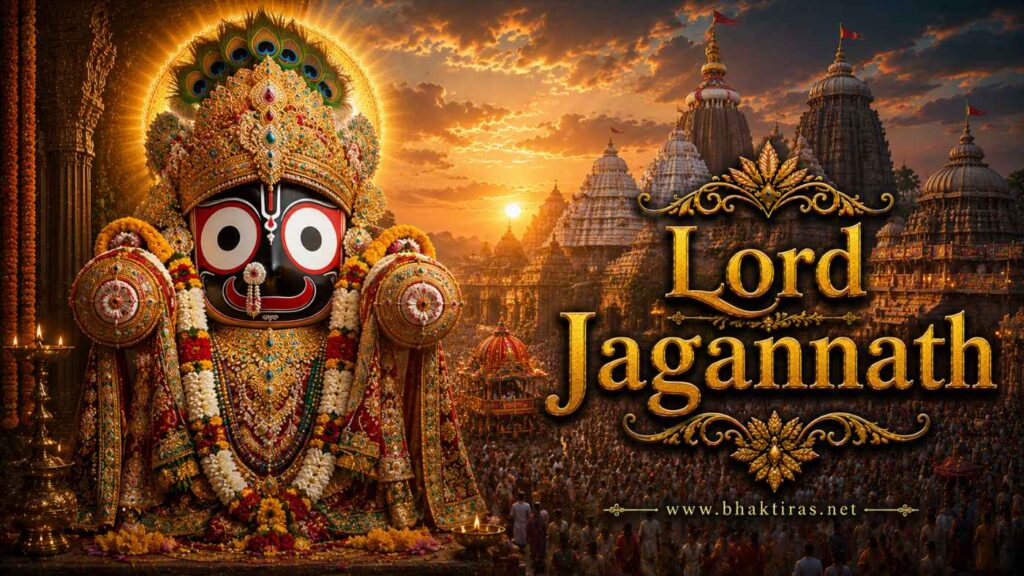
Lord Jagannath means the Lord of the Universe, a beloved form of Krishna and Vishnu. He is the presiding deity of the great temple at Puri in Odisha, one of the four Char Dham. He is worshipped in a trinity with his brother Balabhadra and sister Subhadra, in large-eyed wooden forms, and is famous for the Rath Yatra chariot festival.
Who Is Lord Jagannath?
Lord Jagannath is the great Lord of Puri, worshipped across Odisha and by devotees far beyond it as the very heart of God made approachable. His name joins two Sanskrit words, jagat, the world or universe, and natha, lord or protector – so Jagannath simply means the Lord of the Universe. Yet for the people of Odisha he is never a distant cosmic power. He is family. They call him affectionately, they scold him gently in their prayers, and they trust him as one would trust an elder who never turns anyone away.
In his form and story, Jagannath is understood as Krishna himself, and through Krishna, as Vishnu, the sustainer of all creation. He carries the dark complexion and the playful love of Vrindavan’s cowherd God, and the vast protecting reach of Vishnu. But the way he shows himself at Puri is unlike any other deity in India. Instead of a finely sculpted marble or bronze figure, he appears as a tall wooden form with a great round face, enormous circular eyes, and short arms – beautiful in its own bold, unmistakable way.
He does not stand alone. On the jewelled platform of the Puri temple, the Ratnavedi, he is worshipped together with his elder brother Balabhadra and his younger sister Subhadra. This divine trinity, of a brother, a brother, and a sister, is one of the tender wonders of Hindu worship, and it shapes almost everything about how Jagannath is loved and served.
Above all, Jagannath is the God of accessibility. He is called Patitapavana, the purifier of the fallen, the one who lifts up those whom the world has cast aside. His temple, his food, and his festivals carry a single message that has echoed for centuries: before Jagannath, all are equal, and all are welcome.
The Lord of the Universe
To call someone the Lord of the Universe is to say that nothing lies outside his care. This is the meaning devotees hold close when they utter Jagannath. He is not the deity of one temple or one region alone; his lordship reaches over every world, every being, and every heart. And yet the mystery of Puri is that this limitless Lord chose to sit in one small wooden form so that ordinary people could come, see him, and love him face to face.
As a form of Krishna, Jagannath carries the sweetness of the divine child of Gokul and the wisdom of the charioteer who spoke the Bhagavad Gita. As a form of Vishnu, he holds the responsibility of protecting dharma and sustaining the balance of the cosmos. The Odia tradition weaves these together beautifully. When the priests dress and decorate him through the day in the many vesha or costumes, they are recalling now his Krishna leelas, now his Vishnu majesty, now his own singular identity as the black-hued Lord of Nilachala, the blue hill of Puri.
There is an old and moving belief in Odisha that Jagannath is a living God, not a symbol. The daily rituals treat him as a person who wakes, bathes, dresses, eats, rests in the afternoon, and sleeps at night. He is offered fresh food many times a day. When he falls ill after his ceremonial bath, the temple closes for his recovery. This is the intimacy of Puri: the Lord of the Universe is looked after each day like a beloved member of the household.
The Divine Trinity of Puri
The most distinctive feature of Jagannath worship is that three deities share his sanctum. In the centre stands Lord Jagannath, dark like a rain cloud. To one side is his elder brother Balabhadra, radiant and white, who is the same as Balarama, the mighty plough-bearing brother of Krishna. On the other side, smaller between them, is their sister Subhadra, golden in colour, the beloved girl of the family. Alongside them is also the Sudarshana, the divine wheel, honoured as a pillar of light.
These forms are carved from sacred neem wood, and this is why they are called Daru Brahma – the Brahman, the supreme reality, present in wood. It is a remarkable idea. The formless, infinite God agrees to be held in a shaped tree, so that human hands may serve him and human eyes may behold him. The deities are deliberately abstract. Their bodies are simple columns, their arms are stumps that reach forward as if to embrace, and their eyes are wide, round, and open, as though God is gazing at every devotee at once and refusing to blink.
The tale of the unfinished forms
A well-loved Odia legend explains why the deities look the way they do. King Indradyumna longed to install the Lord in wood, and the divine architect Vishwakarma came in disguise to carve the images. He agreed on one condition – that he work behind closed doors, undisturbed, until he was finished. For days the sound of his tools rang out, then fell silent. The anxious king, or in some tellings the queen, opened the door too soon. The artist vanished, leaving the forms with their arms and features still incomplete. But a voice from the heavens reassured them: this is how the Lord wishes to appear. And so Jagannath’s beautifully unfinished shape is not a flaw at all, but his chosen face.
This trinity of two brothers and a sister gives Jagannath worship a warmth that ordinary devotees feel at once. It is a divine family, and the festivals of Puri are, in large part, the joyful and touching events of that family’s shared life.
The Rath Yatra – When the Lord Comes Out
Once every year, in the bright month of Ashadha, something extraordinary happens at Puri. The Lord of the Universe steps out of his own temple. For a single week, Jagannath, Balabhadra, and Subhadra leave the sanctum where they are otherwise worshipped, and come out into the open street to be with everyone. This is the Rath Yatra, the great chariot festival, and it is one of the most powerful expressions of devotion anywhere in the world.
Three colossal wooden chariots are built fresh each year, tall as small buildings, brightly painted, and fitted with enormous wheels. Jagannath rides the largest, Nandighosha; Balabhadra rides Taladhwaja; and Subhadra rides Darpadalana. When the deities are brought out and placed upon them, hundreds of thousands of devotees seize the thick ropes and pull the chariots by hand along the Grand Road of Puri, all the way to the Gundicha Temple, which is remembered as the home of the Lord’s aunt or his birthplace-away-from-home. There the family rests for several days before returning.
The reason this festival moves people so deeply is simple. Inside the temple, only some may approach the inner sanctum. But on the road, during Rath Yatra, there are no barriers at all. Anyone, of any background, can see the Lord, touch his chariot, and pull his rope. It is the one time each year when Jagannath comes down to the level of all his people and shows that his love has no walls.
The word that came from the chariots
The sheer scale of the Puri chariots, so heavy and unstoppable once they begin to roll, left such an impression on early European travellers that they carried the word home. From Jagannath came the English word juggernaut, meaning a massive, overwhelming force that moves forward and cannot be halted. It is a small echo, in a foreign tongue, of the awe that the Rath Yatra has always inspired.
The Navakalevara – Renewal of the Deities
Because the deities of Puri are carved from wood, they are not meant to last forever in a single body. Every so often – the interval varies from about eight to nineteen years, following the rhythm of the sacred calendar – the temple performs one of Hinduism’s most solemn and secret ceremonies: the Navakalevara, which means the New Body.
In this rite, the old wooden forms of Jagannath, Balabhadra, Subhadra, and Sudarshana are ceremonially retired, and new deities are carved to replace them. Special teams of servitors search the forests of Odisha for particular neem trees marked by sacred signs – a tree bearing certain natural symbols, near water, undisturbed, is chosen as the Daru, the divine wood, for each deity. The felling, transport, and carving are all wrapped in careful, hidden ritual.
The most sacred and mysterious moment is the transfer of the Brahma padartha, the divine essence, from the old body to the new. This is done at dead of night by blindfolded senior priests, whose hands are wrapped in cloth so that they neither see nor directly touch the holy substance. No one knows exactly what it is, and the priests are sworn never to reveal it. Through this renewal, the people of Odisha understand that God has taken a fresh body while remaining the very same Lord – a living picture of the soul that leaves an old form and enters a new one, exactly as the Gita teaches.
Mahaprasad and the Equality of All
To understand the spirit of Jagannath, one must sit before his food. The kitchen of the Puri temple, the Ananda Bazar, is one of the largest kitchens in the world. Hundreds of cooks, working over earthen pots stacked one above another on wood fires, prepare vast quantities of rice, dal, vegetables, and sweets offered fresh to the Lord each day. Once offered, this food becomes Mahaprasad – the great grace, believed to be sanctified by the touch of the Goddess Vimala herself before it is shared.
What makes Mahaprasad so beloved is not only its holiness but its message. Around the Ananda Bazar, people of every caste, class, and community sit together and eat the same food from the same source. Rich and poor, high and low as the old society reckoned them, all share Jagannath’s table as equals. The tradition is clear and radiant: before the Lord of Puri, there are no divisions. His prasad does not ask who you are; it only asks that you come with an open heart.
This inclusiveness runs through the whole personality of Jagannath. Great saints of many backgrounds have loved him. Odisha’s own poet-devotees sang of him in simple Odia so that farmers and fisherfolk could pray in their own words. He is the God who bends down to the ordinary and the overlooked, and this is perhaps the deepest reason he is adored.
Iconography & Symbols
The great round eyes
Jagannath’s most striking feature is his enormous circular eyes, wide and unblinking. Devotees say the Lord watches over everyone at once and never looks away. Gazing into those eyes, called darshan, is itself understood as the heart of a Puri pilgrimage.
The wooden, abstract form
Unlike the detailed idols of most temples, Jagannath appears as a bold, simple column of carved neem wood with a great smiling face and short, embracing arms. This is Daru Brahma, God present in wood, and its unfinished look is his own chosen form, not an imperfection.
The dark complexion
Jagannath is dark like a monsoon cloud, the same beautiful hue as Krishna. His brother Balabhadra beside him is white, and their sister Subhadra is golden – three colours that together mark the family of the Lord of Puri.
The divine trinity and the wheel
He is almost never shown alone. Balabhadra, Subhadra, and the luminous Sudarshana wheel share his platform, so his iconography is really that of a whole divine household worshipped as one.
How Lord Jagannath Is Worshipped
Devotion to Jagannath is joyful, personal, and deeply tied to seeing him and serving him. Here are some of the ways his devotees turn to him:
- Darshan at Puri: The heart of worship is simply standing before the Lord and gazing into his great eyes at the Jagannath Temple, one of the four Char Dham, a pilgrimage every Hindu hopes to make at least once.
- Joining the Rath Yatra: Pulling the ropes of the chariots during the annual festival is believed to bring immense blessing, and devotees travel from across the world to take part.
- Receiving Mahaprasad: Eating the Lord’s sanctified food, shared equally by all, is treasured as receiving his direct grace.
- Chanting ‘Jai Jagannath’: The simple cry of Jai Jagannath – victory to the Lord of the Universe – is on the lips of Odias in prayer, greeting, and celebration alike.
- Daily home worship: Many households keep a small image or picture of the trinity, offering a lamp, flowers, and the daily prayer that the Lord keep the family under his care.
- Singing bhajans and Odia devotional songs: Centuries of poets have written tender songs to Jagannath, and singing them is a loved way to feel near to him.
Prayers & Mantras
A single heartfelt call to Jagannath is enough, for he is known to answer the humble. His simplest and most beloved mantra is a direct salutation to the Lord of the Universe. Chant it softly, morning and evening, holding his round-eyed face in your mind:
ॐ श्री जगन्नाथाय नमः
Om Shri Jagannathaya Namah
This means, I bow to the revered Lord Jagannath, the Lord of the Universe. To offer it is to place yourself, exactly as you are, before the God who turns no one away. Devotees also love the plain cry Jai Jagannath, which needs no ritual and no permission – only love. Whether whispered in a crowded temple or a quiet room, these words carry the same trust: that the Lord of Nilachala is watching, smiling, and near.
Frequently Asked Questions about Lord Jagannath
Who is Lord Jagannath?
Lord Jagannath is the Lord of the Universe, worshipped as a form of Krishna and, through him, of Vishnu. He is the presiding deity of the famous Jagannath Temple at Puri in Odisha, one of the four Char Dham. He appears in a distinctive large-eyed wooden form and is loved as the God who welcomes all people equally.
Who are the three deities worshipped at Puri?
The sanctum at Puri holds a divine trinity. In the centre is Lord Jagannath, dark in colour; beside him is his elder brother Balabhadra, who is white and is the same as Balarama; and between them is their sister Subhadra, golden in colour. The radiant Sudarshana wheel is also honoured alongside them.
What is the Rath Yatra?
The Rath Yatra is Puri's great annual chariot festival. For one week, Jagannath, Balabhadra, and Subhadra leave the temple and ride three enormous wooden chariots pulled by hundreds of thousands of devotees to the Gundicha Temple. It is the only time each year the Lord comes out among all his people, without any barrier between them.
Why does Lord Jagannath have such a distinctive wooden form?
Jagannath is carved from sacred neem wood and is called Daru Brahma, the Brahman present in wood. His abstract shape, with a great round face, wide eyes, and short arms, is explained by the legend of the unfinished carving. Devotees believe this bold, simple form is exactly how the Lord wishes to appear.
What is Navakalevara?
Navakalevara means the New Body. Every eight to nineteen years, following the sacred calendar, the wooden deities of Puri are renewed. New images are carved from specially chosen neem trees, and the divine essence is secretly transferred from the old forms to the new ones by blindfolded priests. It shows God taking a fresh body while remaining the same Lord.
What is Mahaprasad and why is it special?
Mahaprasad is the sanctified food offered to Jagannath and cooked in one of the world's largest temple kitchens. It is treasured because people of every caste and community sit and share it together as equals. It carries Jagannath's central message that before the Lord of Puri, all are welcome and no one stands apart.
Is Lord Jagannath the same as Krishna?
Yes. Jagannath is worshipped as Krishna himself, carrying the same dark complexion and loving nature of the cowherd God of Vrindavan. Through Krishna he is also understood as Vishnu, the great sustainer. At Puri, however, he takes his own singular wooden form and is loved with a personality all his own.
Where is the Jagannath Temple located?
The Jagannath Temple stands in the coastal town of Puri in the state of Odisha in eastern India. It is one of the four Char Dham, the sacred pilgrimage sites that mark the four directions of the land, and it draws millions of devotees each year, especially during the Rath Yatra.
May the round-eyed Lord of Nilachala keep his gaze upon you always, and may you never be turned away from his door. Jai Jagannath.