
Lord Krishna
कृष्ण
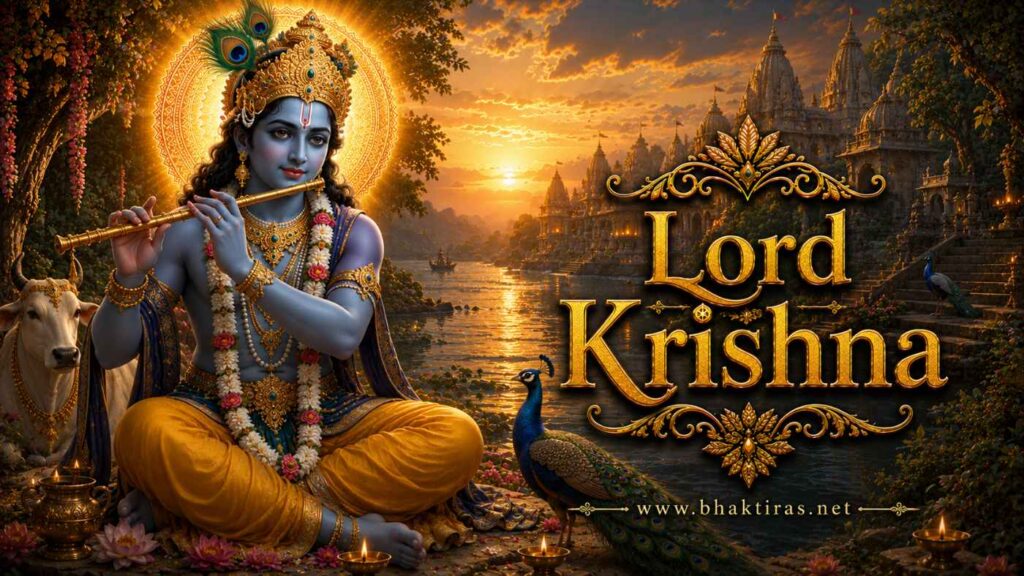
Lord Krishna is the eighth avatar of Vishnu, and in the Vaishnava traditions the complete avatar, God himself in human form. He is the butter-thieving child of Gokul, the flute-playing cowherd of Vrindavan beloved of Radha, the king of Dwarka, and the teacher who spoke the Bhagavad Gita to Arjuna at Kurukshetra.
Who Is Lord Krishna?
Ask ten devotees who Krishna is and you may hear ten different answers, all of them true. To a mother, he is the mischievous child who stole butter and cracked open the whole universe when she looked inside his open mouth. To a young heart, he is the cowherd whose flute drifts over the fields of Braj at dusk. To a warrior, he is the calm charioteer who explained the meaning of life on the edge of a battlefield. And to the philosopher, he is Svayam Bhagavan – God in his own person, not a partial descent but the source itself, come down to walk barefoot in the dust of Vrindavan.
Krishna is counted as the eighth avatar of Vishnu, the great preserver who descends whenever dharma weakens and unrighteousness rises. But in the Vaishnava traditions he is set apart from the other avatars. Where Rama shows how a man of perfect duty should live, Krishna shows the full sweetness and the full power of the Divine at once. He is the Purna avatar, the complete descent, in whom every quality of God is present without limit.
What makes him so loved is that he refuses to stay distant. He is a friend you can argue with, a child you can scold, a lover you can long for, a teacher who answers your hardest questions. His life runs from the cradle in a prison cell to a throne in golden Dwarka, and every stage of it has become a doorway for devotion. The child-god of Braj and the grave teacher of the Gita are the same person, and holding both together is the heart of loving Krishna.
To know Krishna is not to master a doctrine but to fall, slowly and gladly, into a friendship that has no end.
Birth in Mathura and the Fall of Kamsa
A prophecy and a prison cell
Mathura groaned under the cruelty of King Kamsa, who had thrown his own father from the throne. On the day his beloved sister Devaki married the noble Vasudeva, a voice from the sky warned Kamsa that Devaki’s eighth son would be his death. Terrified, the tyrant almost killed her on the spot, then instead locked the newlyweds in a dungeon, murdering each child of theirs as it was born. Seven times a small life was snuffed out. Then came the eighth.
The night the chains fell open
On the eighth night of the dark fortnight of Bhadrapada, at the stroke of midnight, Krishna was born. The dungeon filled with light, and Vishnu himself appeared to Devaki and Vasudeva before folding back into the form of a newborn. Then a wonder: the guards fell into deep sleep, the iron chains slipped from Vasudeva’s wrists, and the prison doors swung open. He gathered the infant in a basket and stepped out into a storm.
The crossing of the Yamuna
Rain fell in sheets as Vasudeva carried the baby toward Gokul across the river. The Yamuna rose in flood, then parted, or lowered herself to touch the child’s feet and calm again, so a father could wade across. The great serpent Shesha spread his hoods overhead to shield the infant from the downpour. In Gokul, Vasudeva laid Krishna beside the sleeping Yashoda, took her newborn daughter, and returned to the prison. When Kamsa seized that child to dash her against the stones, she rose into the sky as the goddess, laughing, telling him his slayer was already born and safe. The wheel of his fall had begun to turn.
The Divine Child of Gokul and Vrindavan
Raised as the son of Yashoda and Nanda the cowherd chief, Krishna grew up among the cows, the milkmaids and the dust of Braj, hiding his godhood behind a child’s laughter. These years are the sweetest in all of Hindu memory, remembered in the Bhagavata Purana with a tenderness that still makes grown devotees weep.
Makhan Chor, the butter thief
He could not be kept away from fresh butter. He raided the pots hung high from the rafters, shared the loot with his friends and the monkeys, and blamed everyone but himself when caught with cream on his lips. Once, tired of his mischief, Yashoda peered into his mouth to check for stolen butter and saw whirling inside it the entire cosmos – the sun, the stars, herself looking in. Then Krishna let the memory dissolve, and she scolded a naughty little boy again.
Lifting Govardhan hill
When the cowherds prepared their yearly offering to Indra, god of rain, Krishna urged them instead to honour the hill Govardhan that fed their cattle. Furious, Indra loosed a deluge to drown Braj. Krishna lifted the whole mountain on the little finger of his left hand and held it like an umbrella for seven days and nights, while every villager and cow sheltered beneath. Indra bowed. From then he was called Govardhandhari, the hill-lifter.
Dancing on Kaliya's hoods
A monstrous serpent named Kaliya had poisoned a deep pool of the Yamuna, killing whatever drank from it. Krishna leapt into the water, was coiled and crushed, then swelled beyond the serpent’s grip and rose to dance upon its many hoods, beating time until Kaliya, half-dead, surrendered. Sparing him at his wives’ plea, Krishna banished the serpent and gave the river back to the people, clean and sweet.
The flute and the gopis
As he grew, Krishna the cowherd, Gopala, would play his flute at evening, and the milkmaids of Braj, the gopis, would leave their homes and chores and follow the sound helplessly into the forest. On the full-moon night of autumn he danced the raas-lila with them, multiplying himself so that each gopi felt he danced only with her. This is read not as mere romance but as the soul’s irresistible pull toward God, love so complete it forgets everything else.
Radha and the Love of Braj
Among all the gopis, one name is spoken in the same breath as Krishna’s own: Radha. She is the supreme beloved, the girl of Barsana whose love for Krishna became the very definition of devotion.
The love that names the God
Radha and Krishna’s love is longing itself made holy. Their meetings by the Yamuna, their partings, her jealousy and her surrender, her waiting through the long night – the poets of Braj sang all of it as the play between the soul and God. Radha is understood not as separate from Krishna but as his own heart of love, his hladini shakti, the power of divine bliss taken form. This is why devotees say her name first: Radhe Krishna, Radhe Shyam.
A love beyond the ending
When Krishna left Braj for Mathura and never came back to live there, Radha and the gopis were left in viraha, the ache of separation. In the Vaishnava heart this ache is treasured above even union, because it is love that asks nothing in return and never lets go. Radha never marries Krishna in the stories, and that is the point: theirs is love unbounded by any worldly tie. To love Krishna as Radha loved him is held up as the highest devotion a soul can reach.
The Prince of Dwarka and Friend of the Pandavas
The barefoot cowherd of Braj grew into one of the great figures of the age. Returning to Mathura, Krishna finally faced Kamsa, dragged the tyrant from his throne and killed him, freeing his true parents from years of imprisonment and setting his grandfather back on the seat.
The king who built a city in the sea
Harried by Kamsa’s vengeful father-in-law Jarasandha, Krishna led his people west and raised the shining city of Dwarka on the shore of Gujarat. There he ruled as a wise and generous king, married Rukmini, who wrote to him begging to be carried away from an unwanted match, and Satyabhama, and gathered a great household. The playful cowherd had become a statesman whose word steadied kingdoms.
The friend in the great war
Krishna’s deepest bond was with the five Pandava brothers, and above all with Arjuna. When the feud with their cousins the Kauravas grew into the war of the Mahabharata, Krishna offered each side a choice: his mighty army, or himself alone, and unarmed. Arjuna chose Krishna, and Krishna chose to serve as his charioteer rather than to fight. As guide, envoy and strategist he shaped the whole course of the war – the master statesman who bent every event toward the restoring of dharma.
The Bhagavad Gita – Krishna's Teaching
The single moment for which Krishna is honoured above all others came not in Braj but on a battlefield. As the two armies faced each other at Kurukshetra, Arjuna looked across at his teachers, cousins and elders and let his bow fall. He could not bring himself to fight. Between the drawn-up armies, Krishna the charioteer turned to speak, and what he said became the Bhagavad Gita, the Song of the Lord.
The eternal Self
Krishna begins by lifting Arjuna’s grief. The Self, the atman, is never born and never dies, he says; it only changes bodies as a person changes worn clothes. Weapons cannot cut it, fire cannot burn it. To grieve for what is deathless is confusion. This teaching on the imperishable soul is the ground on which everything else in the Gita stands.
Karma yoga – action without grasping
You have a right to your action, Krishna teaches, but never to its fruits. Do your duty fully, offer the results to God, and act without craving reward or fearing loss. This is karma yoga, the path of selfless action, by which even a life of work in the world becomes a road to freedom. Do your own duty imperfectly, he adds, rather than another’s duty well.
Bhakti – the way of love
Highest of all the paths Krishna offers is bhakti, loving devotion. Fix your mind on me, love me, surrender your whole self to me, he tells Arjuna, and I will carry you across every difficulty. In the great vision of the eleventh chapter he shows his cosmic form, blazing with countless suns, and then returns to the gentle friend at Arjuna’s side. Set aside all lesser duties, he says at the last, and simply take refuge in me. Reassured, Arjuna takes up his bow.
The Many Names and Forms of Krishna
No deity is called by so many names, because no deity plays so many parts. Each name catches a different face of the same beloved God.
- Govinda / Gopala – protector of cows and cowherds, the pastoral lord of Braj.
- Murlidhar / Bansidhar – the one who holds the flute, whose music calls every soul.
- Makhan Chor – the butter thief, the darling child of Gokul.
- Giridhari / Govardhandhari – the lifter of Govardhan hill.
- Vasudeva – the son of Vasudeva, and the indwelling divine in all beings.
- Madhava / Keshava – names of Vishnu carried by his complete avatar.
- Yogeshwara – the lord of yoga, teacher of the Gita.
- Dwarkadhish – the king who rules from golden Dwarka.
- Shyam / Ghanshyam – the dark one, dark as a rain-cloud, tender and cool.
The Festivals of Krishna
Janmashtami
The greatest of Krishna’s festivals marks his birth on the eighth night of dark-fortnight Bhadrapada, in August or September. Devotees fast through the day, keep vigil in temples that ring with bhajans, and welcome him at the stroke of midnight, the very hour he was born, rocking his cradle and offering butter and sweets. In Maharashtra the young men of the towns build human pyramids to break the high-hung dahi handi, replaying his butter raids.
Holi
The festival of colours belongs to Krishna in a special way, for the play of coloured powders began, the poets say, with Krishna and Radha and the gopis of Braj. Nowhere is Holi kept with such joy as in Barsana and Vrindavan, where the celebration stretches over days. It carries his spirit of laughter, mischief and love that dissolves every barrier between people.
Radhashtami and Gita Jayanti
Radhashtami, a fortnight after Janmashtami, honours the birth of Radha and is kept with special devotion across Braj. Gita Jayanti, on the eleventh day of bright-fortnight Margashirsha, marks the day Krishna spoke the Bhagavad Gita at Kurukshetra, when devotees read and recite the whole Song in gratitude for the teaching that has guided countless lives.
How Lord Krishna Is Worshipped
Krishna is worshipped in almost every corner of India, from the great temples of Dwarka, Jagannath Puri, Nathdwara, Guruvayur and Udupi to the small household shrine where a family dresses a little brass image of the baby Krishna and puts him to sleep at night. His worship is unusually intimate; devotees relate to him as parent, friend or beloved, not only as distant lord.
- Chanting the Hare Krishna maha-mantra and the names Radhe Krishna, Radhe Shyam and Jai Shri Krishna.
- Singing bhajans and kirtans, especially the songs of Meera, Surdas and the Braj poets, often with dancing.
- Offering butter, milk sweets, makhan-mishri and tulsi leaves, foods dear to him from his cowherd days.
- Keeping the tulsi plant, sacred to Vishnu and Krishna, in the home and courtyard and honouring it daily.
- Dressing and adorning the deity through the day – the shringar of Nathdwara and Vrindavan is famous for its love and detail.
- Reading the Bhagavata Purana and reciting the Bhagavad Gita, especially the small chapter offered at the family shrine.
- Keeping Janmashtami with midnight vigil, fasting, and the rocking of Krishna’s cradle.
Prayers & Mantras
Krishna’s names are among the most joyfully chanted in the world. His mantras carry both his sweetness and his power, and even a single sincere calling of his name is held to be a shelter.
The Krishna mool mantra
ॐ नमो भगवते वासुदेवाय
Om Namo Bhagavate Vasudevaya
‘I bow to the Lord Vasudeva, the Divine that dwells in all.’ This twelve-syllabled mantra, praised in the Bhagavata Purana, is a complete prayer of surrender to Krishna as the God present within every heart.
The Hare Krishna maha-mantra
हरे कृष्ण हरे कृष्ण कृष्ण कृष्ण हरे हरे
हरे राम हरे राम राम राम हरे हरे
Hare Krishna Hare Krishna Krishna Krishna Hare Hare, Hare Rama Hare Rama Rama Rama Hare Hare.
This great sixteen-name chant calls on the divine energy (Hare), on Krishna, and on Rama together. Sung and danced by millions, it is a simple, joyful prayer for love and remembrance of God in this age.
Frequently Asked Questions about Lord Krishna
Who is Lord Krishna?
Krishna is the eighth avatar of Vishnu and, in the Vaishnava traditions, the complete avatar – God himself in human form. He is the child-god of Gokul, the flute-playing cowherd of Vrindavan beloved of Radha, the king of Dwarka, and the teacher who spoke the Bhagavad Gita to Arjuna at Kurukshetra.
What is the Bhagavad Gita?
The Bhagavad Gita, the Song of the Lord, is the teaching Krishna gave Arjuna on the battlefield of Kurukshetra, set within the Mahabharata. In seven hundred verses it explains the eternal Self, selfless action or karma yoga, and loving devotion or bhakti, and it remains one of the most cherished spiritual texts in the world.
Who is Radha to Krishna?
Radha is Krishna's supreme beloved, the gopi of Barsana whose love for him became the very model of devotion. She is understood not as separate from Krishna but as his own power of divine bliss taken form, which is why devotees join their names together as Radha-Krishna and greet each other with Radhe Radhe.
When is Janmashtami?
Janmashtami, Krishna's birthday, falls on the eighth night of the dark fortnight of the month of Bhadrapada, usually in August or September. Devotees fast and keep vigil, welcoming him at midnight, the hour of his birth, with cradle-rocking, bhajans and offerings of butter and sweets.
Why is Krishna shown with blue skin?
Krishna is pictured dark or blue as a rain-bearing cloud, which is why he is called Shyam and Ghanshyam. The colour signals that he is infinite and unfathomable, like the boundless sky and sea, and reflects his descent from Vishnu, who is also shown blue as the all-pervading, limitless Divine.
What is the Hare Krishna mantra?
The Hare Krishna maha-mantra – Hare Krishna Hare Krishna Krishna Krishna Hare Hare, Hare Rama Hare Rama Rama Rama Hare Hare – is a sixteen-name chant calling on the divine energy, on Krishna and on Rama. Sung joyfully around the world, it is regarded as a simple and powerful way to remember God in this age.
What is the difference between Krishna and Vishnu?
Vishnu is the great preserver of the cosmos, and Krishna is his eighth avatar, a descent into human form. In the Vaishnava traditions, however, Krishna is honoured as the Purna avatar or Svayam Bhagavan, the complete and original form of God, so many devotees worship Krishna not merely as an aspect of Vishnu but as the supreme source itself.
What are the main texts about Krishna?
Krishna's life and teaching are drawn mainly from three texts: the Bhagavata Purana, which lovingly tells of his birth and the play of his Braj childhood; the Mahabharata, which shows him as prince, friend and statesman; and the Bhagavad Gita, part of the Mahabharata, which preserves his supreme teaching to Arjuna.
May the flute of Vrindavan sound softly in your heart, and may Shri Krishna keep you in his endless play of love. Jai Shri Krishna.