
Janjatiya Gaurav Divas 2026 – India's Tribal Pride Day
जनजातीय गौरव दिवस
When is Janjatiya Gaurav Divas in 2026?
Janjatiya Gaurav Divas falls on Sunday, 15 November 2026. It is India’s national day honouring the country’s tribal (Adivasi) communities, held every year on the birth anniversary of Bhagwan Birsa Munda. The Government of India declared it in 2021, and it is marked with tributes, cultural programmes and exhibitions, especially across Jharkhand and central India.
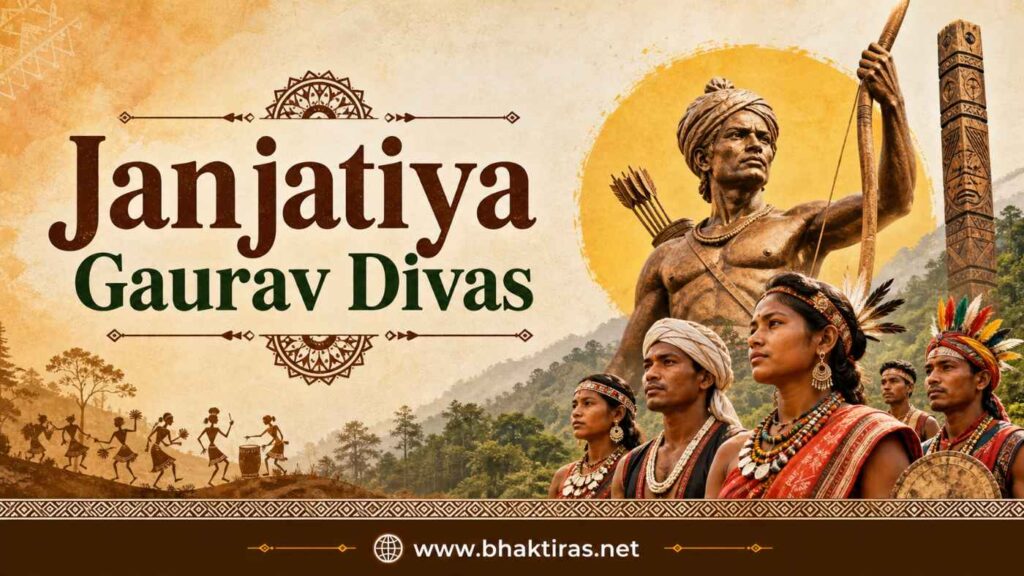
Janjatiya Gaurav Divas, or Tribal Pride Day, is a national observance the Government of India began in 2021 to honour the country’s tribal communities and the men and women who fought and died for their land and freedom. It is held on 15 November, the birthday of Bhagwan Birsa Munda, the young Munda leader of Jharkhand who rose against British rule and is remembered as Dharti Aaba, the Father of the Earth. Across the country the day brings exhibitions, folk performances and quiet tributes to a history that school textbooks long left in the margins.
Janjatiya Gaurav Divas 2026-2028: Dates & Calendar
Janjatiya Gaurav Divas is fixed to a solar calendar date, so it lands on 15 November every year regardless of the moon or the Hindu tithi. Only the weekday changes.
| Year | Date | Day | Notes |
|---|---|---|---|
| 2025 | 15 November | Saturday | Fifth national observance |
| 2026 | 15 November | Sunday | Next occurrence |
| 2027 | 15 November | Monday | Fixed solar date |
| 2028 | 15 November | Wednesday | Fixed solar date |
Because the date is tied to a Gregorian anniversary rather than a lunar tithi, there is no shifting muhurat to track. The main national commemoration is usually anchored in Jharkhand, Birsa Munda’s home state, with parallel events organised by the Ministry of Tribal Affairs elsewhere.
Why Janjatiya Gaurav Divas Is Celebrated
Janjatiya Gaurav Divas is celebrated to remember the sacrifices of India’s tribal freedom fighters and to give the country’s Adivasi heritage the recognition it was long denied. The date honours Birsa Munda, born on 15 November 1875.
For generations the tribal contribution to India’s freedom struggle sat outside the mainstream retelling of that story. Naming a national day after Birsa Munda’s birthday was a deliberate correction, placing figures like him alongside the more familiar names of the independence movement and inviting a wider audience to learn who they were.
Bhagwan Birsa Munda
Born in 1875 in the Chotanagpur plateau, Birsa Munda led the Ulgulan, the Great Tumult, a Munda uprising against British land laws and the exploitation that came with them. He died in Ranchi jail in 1900, aged only twenty-five, yet his people came to revere him as Dharti Aaba, the Father of the Earth. His birthday anchors the whole observance.
Tribal freedom fighters
The day widens beyond one hero to remember many. Leaders such as Tilka Manjhi, the Santhal brothers Sidhu and Kanhu Murmu, Rani Gaidinliu of the Naga hills and Tantya Bhil all resisted colonial rule in their own regions. Janjatiya Gaurav Divas gathers these scattered struggles into a single day of national memory.
Tribal heritage and identity
Alongside the history of resistance, the observance celebrates living Adivasi culture – the languages, crafts, farming knowledge, music and dance carried by around a hundred million tribal people across India. It is meant as much to look forward, at dignity and belonging today, as to look back.
How Janjatiya Gaurav Divas Is Observed
Janjatiya Gaurav Divas is a civic and cultural observance rather than a religious rite, so the day is marked by gatherings, tributes and public programmes rather than temple ritual. Here is how it typically unfolds.
- Floral tributes to Birsa Munda. The day opens with garlands and flowers laid at statues and memorials of Birsa Munda, most prominently in Ranchi and across Jharkhand, often with a moment of silence for the tribal martyrs.
- Official addresses and messages. The President, Prime Minister and state leaders issue tributes, and the Ministry of Tribal Affairs anchors a central commemoration, sometimes launching welfare schemes or projects for tribal areas on the day.
- Cultural performances. Folk troupes present tribal dance, drumming and song – forms like Chhau, Santhali and Gond traditions – in schools, colleges and public grounds, keeping the art in front of new audiences.
- Exhibitions and craft fairs. Museums and tribal-affairs bodies mount displays of Adivasi weaving, painting, metalwork and daily objects, often paired with stalls where artisans sell their work directly.
- Talks and school programmes. Lectures, seminars and classroom sessions retell the lives of Birsa Munda and other tribal leaders, so the history reaches students who rarely meet it in standard syllabi.
- Community gatherings in villages. In tribal-majority districts the day is kept close to home, with village meetings, shared meals and elders passing on stories and songs to the young.
How It's Marked Across India
Though it is a single national day, the character of Janjatiya Gaurav Divas shifts from region to region, shaped by which tribal communities live there.
Jharkhand
As Birsa Munda’s home state and the seat of the Ulgulan, Jharkhand holds the largest observances. Ranchi becomes the focal point, with tributes at the Birsa Munda memorial and cultural events drawing Munda, Ho, Santhal and Oraon communities.
Central India
Madhya Pradesh, Chhattisgarh and Odisha, home to large Gond, Bhil, Baiga and other populations, hold their own commemorations honouring regional heroes such as Tantya Bhil and Rani Durgavati alongside Birsa Munda.
Northeast India
In the hill states the day recalls figures like Rani Gaidinliu of the Nagas and the many communities who resisted colonial control, with local dance and song traditions taking the lead.
Across the country
Government offices, tribal research institutes, universities and cultural bodies elsewhere in India mark the day with talks, exhibitions and screenings, extending the memory well beyond the tribal heartlands.
Janjatiya Gaurav Divas Do's and Don'ts
A short guide to marking the day with respect and understanding.
Do
- Learn the real story of Birsa Munda and the Ulgulan uprising
- Attend a local exhibition, talk or cultural programme if one is held
- Support tribal artisans by buying their crafts directly
- Share accurate history about tribal freedom fighters
- Listen to Adivasi voices telling their own stories
Avoid
- Don’t treat tribal culture as a costume or a photo prop
- Don’t reduce the day to a single slogan and skip the history
- Don’t confuse it with World Tribal Day (9 August), which is a UN observance
- Don’t spread invented dates or fabricated quotes about Birsa Munda
- Don’t flatten India’s many distinct tribes into one generic image
Frequently Asked Questions
When is Janjatiya Gaurav Divas in 2026?
Janjatiya Gaurav Divas is on Sunday, 15 November 2026. The date is fixed every year to 15 November, the birth anniversary of Bhagwan Birsa Munda. It has been observed nationally since the Government of India declared it in 2021.
When is Janjatiya Gaurav Divas in 2027 and 2028?
Janjatiya Gaurav Divas falls on Monday, 15 November 2027 and Wednesday, 15 November 2028. Because it is tied to a fixed Gregorian date rather than a lunar calendar, it always lands on 15 November and only the weekday changes from year to year.
Why is Janjatiya Gaurav Divas celebrated?
Janjatiya Gaurav Divas is celebrated to honour India’s tribal communities and remember the tribal freedom fighters who resisted British rule. It was chosen for 15 November, Birsa Munda’s birthday, and aims to give Adivasi heritage and history the national recognition it was long denied.
Who was Birsa Munda?
Birsa Munda was a young tribal leader and folk hero from the Chotanagpur region of present-day Jharkhand, born on 15 November 1875. He led the Ulgulan, or Great Tumult, an uprising against British land laws, and died in 1900 aged twenty-five. His people revere him as Dharti Aaba, the Father of the Earth.
Is Janjatiya Gaurav Divas a religious festival?
No, Janjatiya Gaurav Divas is a national civic and cultural observance, not a religious festival. It commemorates the history and heritage of India’s tribal communities through tributes, exhibitions and cultural programmes rather than temple worship.
When was Janjatiya Gaurav Divas started?
Janjatiya Gaurav Divas was declared by the Government of India in 2021, with the first observance held on 15 November that year. The date coincides with the 146th birth anniversary of Birsa Munda in 2021 and is repeated every 15 November.
What is the difference between Janjatiya Gaurav Divas and World Tribal Day?
Janjatiya Gaurav Divas is India’s own national Tribal Pride Day on 15 November, marking Birsa Munda’s birth. World Tribal Day, or the International Day of the World’s Indigenous Peoples, is a United Nations observance held on 9 August. They are separate days with different origins.
How is Janjatiya Gaurav Divas observed?
Janjatiya Gaurav Divas is observed with floral tributes at Birsa Munda memorials, official addresses, folk dance and music performances, craft exhibitions and school programmes on tribal history. Jharkhand and central India hold the largest events, while offices and institutions elsewhere mark it with talks and displays.
This Janjatiya Gaurav Divas, may the courage of Birsa Munda and every tribal hero be remembered, and their living heritage honoured. Johar.