
Sohrai 2026 – The Great Cattle and Harvest Festival of the Adivasis
सोहराय
When is Sohrai in 2027?
Sohrai falls around 30 October 2027, close to the new moon of Kartik and the day after Diwali. It is the great cattle-and-harvest festival of the Santhal and other Adivasi communities of Jharkhand and its neighbouring states, held once the paddy is safely gathered in. The date shifts each year because it follows the lunar calendar, so it lands in late October or November.
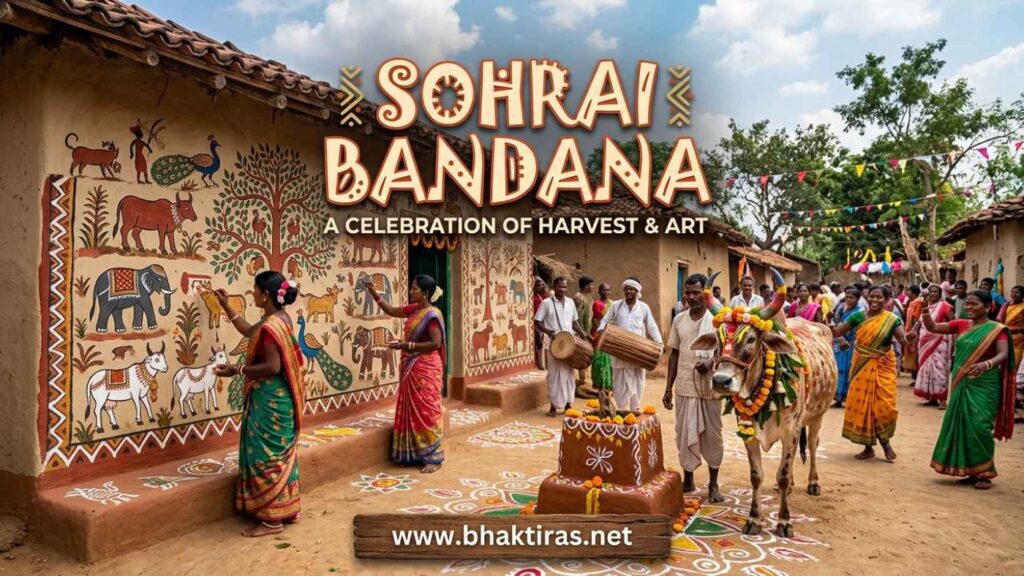
Sohrai is the harvest thanksgiving of the Santhal and many other Adivasi peoples of Jharkhand, West Bengal, Odisha and Bihar, kept around the new moon of Kartik, just after Diwali. Once the paddy is cut and stored, families turn to the animals that made the harvest possible. Cattle are washed at the pond, their horns rubbed with oil and colour, hung with garlands and honoured with worship. Women repaint the mud walls of their homes with natural pigments, and the villages fill with drumming, rice beer and dancing that runs through the night.
Sohrai 2026-2028: Dates & Calendar
The next Sohrai falls around 30 October 2027. The festival tracks Kartik Amavasya and the days just after Diwali, so its Gregorian date moves earlier by roughly eleven days each year before a calendar correction pulls it back.
| Year | Date (approx.) | Day | Notes |
|---|---|---|---|
| 2026 | ~9 November | Monday | Day after Diwali, near Kartik Amavasya |
| 2027 | ~30 October | Saturday | Next occurrence |
| 2028 | ~18 October | Wednesday | Follows Diwali as usual |
In much of Jharkhand and the neighbouring hills Sohrai is kept over three to five days beginning around Kartik Amavasya. In parts of the Santhal Parganas the main Santhal Sohrai is observed later, closer to January, so a village near Dumka may celebrate weeks after one in Hazaribagh. Ask locally rather than assuming a single national date.
Why Sohrai Is Celebrated
Sohrai is celebrated to thank cattle for a full year of ploughing, carting and companionship, and to mark the safe gathering of the harvest. For farming Adivasi families the bullock and the cow are working partners, and this is the one festival that puts them at the centre.
The timing is deliberate. Sohrai comes only after the paddy is reaped and the granary is full, so it reads as a settling of accounts with the land and the herd before the quieter winter months. Gratitude, rest and plenty all meet in the same few days.
Honouring the herd
The animals that pulled the plough through the wet season are bathed, fed well and worshipped. Oiling and painting the horns is both decoration and a public thank-you to a working animal that a family depends on for its living.
A harvest settled
With the rice cut and stored, Sohrai closes the agricultural year on a note of abundance. Fresh grain, new rice beer and shared meals are all ways of saying the season provided.
Renewing the home
Repainting the house walls is not only art. It cleans and reseals the mud surfaces before winter and, in belief, invites well-being into the home for the year ahead.
Community and continuity
The all-night dancing, the drums and the group songs pull the whole village together and pass the festival’s music, patterns and stories from older women to younger ones.
Whom Sohrai Honours
Sohrai is a tribal harvest festival rather than a temple festival, so it centres on cattle, ancestors and nature spirits rather than a single named god. Different Adivasi groups frame the worship in their own ways.
Cattle and the herd
The cattle themselves are the honoured beings of Sohrai. Cows and bullocks are washed, garlanded, marked and offered food and worship in gratitude for their year of labour.
Marang Buru & the bongas
Many Santhal households remember Marang Buru, the great mountain spirit, and the bongas, the guardian and ancestral spirits of home and field. Offerings and rice beer are shared in their name during the festival.
Pashupati / Govardhan link
Because Sohrai sits beside Diwali and Govardhan Puja, some communities and nearby Hindu neighbours connect the cattle worship with the wider tradition of honouring cows and the lord of animals at this season.
Key Rituals, Step by Step
The order varies from village to village, but a typical Sohrai unfolds roughly like this across its opening days.
- Clean and repaint the home. In the days before, women scrub the mud walls and courtyard and repaint them with the natural-pigment Sohrai designs, readying the house for the festival.
- Bathe the cattle. On the main morning the cows and bullocks are taken to the pond or river, washed thoroughly and brought back gleaming.
- Oil and colour the horns. Horns are rubbed with oil and painted, and the animals are hung with garlands, marked with vermilion and sometimes given new ropes.
- Worship the herd. The family offers rice, grain, oil lamps and prayers to the cattle at the cowshed threshold, thanking them for the year’s work.
- The trampling or symbolic test. In some places cattle are made to walk over spread paddy or are brought before a tethered symbolic threat, read as a test and a blessing of the herd’s strength and protection.
- Feasting and handia. Fresh-grain dishes and home-brewed rice beer, handia, are shared among family and neighbours.
- All-night dance and song. To the beat of the tamak and tumdak drums the village dances in long lines through the night, the music carrying the festival forward until dawn.
Special Foods of Sohrai
Sohrai food leans on the new harvest and on the rice beer that is central to Adivasi celebration. Sweets are simple and grain-based.
Handia
Home-brewed rice beer, mildly fermented and slightly sweet-sour, offered to spirits and shared freely among guests. For most Sohrai households it is the drink of the festival.
Pitha
Steamed or fried rice-flour cakes, sometimes filled with jaggery or grated coconut, made from the fresh harvest and eaten across the eastern Adivasi belt.
New-rice dishes
Meals built around the just-harvested paddy, from plain steamed rice to simple grain preparations, celebrating the very crop the festival gives thanks for.
Meat and community meals
Many families cook chicken, goat or, in some communities, other meats for a shared feast, turning the day into a large communal meal rather than a private one.
Regional Names & Variations
Sohrai and its close cousins are kept across the eastern Adivasi belt, and neighbouring communities mark the same cattle-honouring season under their own names.
Jharkhand
The heartland of Sohrai, and home of the famous Sohrai wall painting of Hazaribagh. Celebrations here are strongest around Kartik Amavasya, with the Santhal Parganas keeping a later, January-timed observance.
West Bengal
In the western districts, Santhal, Kurmi and other communities keep Sohrai and the closely related Bandana cattle festival with wall art, cattle worship and group dancing.
Odisha
Adivasi communities in the northern belt observe the harvest cattle festival in the same season, sharing the core of animal worship, feasting and rice beer.
Bihar
In the tribal-populated areas bordering Jharkhand, families keep Sohrai alongside the wider Diwali-Govardhan season, again focused on honouring cattle after the harvest.
Sohrai Do's and Don'ts
A few pointers if you are joining or visiting a Sohrai celebration.
Do
- Treat the cattle gently and respectfully – they are the guests of honour
- Accept food and handia graciously if a host offers, as a mark of welcome
- Ask before photographing the wall paintings, homes or dancers
- Learn the local names, since a Santhal Sohrai differs from a Kurmi Bandana
- Support Adivasi artists directly if you buy Sohrai art or crafts
Avoid
- Do not treat it as merely a variant of Diwali – it has its own meaning
- Do not startle, prod or overwork the decorated animals during the festival
- Do not copy or mass-produce Sohrai wall art without crediting its makers
- Do not assume one fixed national date – it varies by village and sub-group
- Do not photograph rituals or people without consent
Frequently Asked Questions
When is Sohrai in 2027?
Sohrai in 2027 falls around 30 October, near Kartik Amavasya and just after Diwali. As a community harvest festival it has no single fixed national date, so the exact day varies by village and by Adivasi sub-group, but late October is the window for most of Jharkhand.
When is Sohrai in 2026 and 2028?
Sohrai is celebrated around 9 November in 2026 and around 18 October in 2028. Both dates sit just after Diwali, near the new moon of Kartik. The festival moves each year because it follows the lunar calendar, and local observance can differ by a day or two.
Why is Sohrai celebrated?
Sohrai is celebrated to thank cattle for a full year of ploughing and carting, and to mark the safe gathering of the paddy harvest. Coming just after the crop is stored, it is the Adivasi farming year’s thanksgiving to both the herd and the land, kept with cattle worship, feasting and dancing.
Which communities celebrate Sohrai?
Sohrai is celebrated mainly by the Santhal and other Adivasi communities such as the Kurmi, Munda, Ho and Oraon across Jharkhand, West Bengal, Odisha and Bihar. It is one of the biggest festivals of the Santhal calendar and centres on cattle and the harvest.
What is Sohrai wall painting?
Sohrai wall painting is a traditional folk art in which women decorate the mud walls of their homes with natural-pigment designs of animals, plants and geometric forms during the festival. The style of Hazaribagh in Jharkhand is especially famous and carries a Geographical Indication (GI) tag.
How is Sohrai related to Diwali?
Sohrai falls in the same season as Diwali, around Kartik Amavasya, and often on the day after it, close to Govardhan Puja when cows are also honoured. The two are neighbours in the calendar and share a cattle-honouring theme, but Sohrai is a distinct Adivasi harvest festival with its own rituals.
What foods are eaten during Sohrai?
Sohrai food centres on the fresh harvest and on handia, the home-brewed rice beer shared with guests and offered to spirits. Families also make rice-flour pitha cakes, new-rice dishes and, for the village feast, meat preparations such as chicken or goat.
How long does Sohrai last?
Sohrai usually lasts three to five days, beginning around Kartik Amavasya. The main day is given to bathing and worshipping the cattle, while the surrounding days carry the wall painting, feasting, rice beer and all-night dancing that complete the festival.
May your granary stay full and your cattle stay strong – a happy Sohrai to you and your village.