
Karam Parab 2026 – The Adivasi Festival of Youth, Harvest and the Sacred Karam Tree
करम परब
When is Karam Parab in 2026?
Karam Parab (Karma Puja) falls on approximately 26 September 2026, on Bhadrapada Shukla Ekadashi. It is the harvest and youth festival of the Oraon, Munda, Ho, Santhal and Kudmi tribes of Jharkhand, West Bengal, Odisha, Chhattisgarh and Assam, who worship Karam Devta – the god of power, youth and fertility – in the form of a branch of the sacred Karam tree.
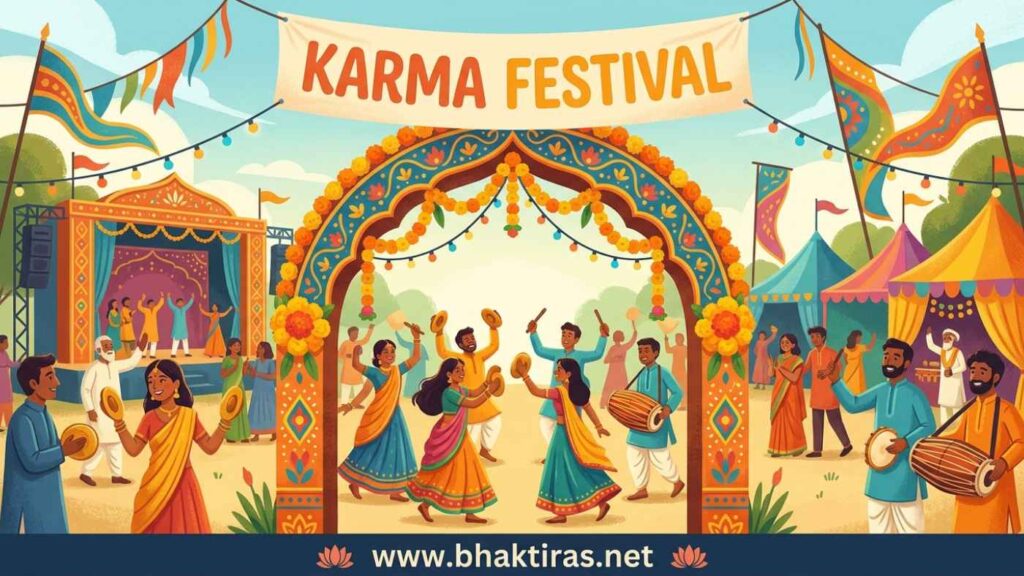
Karam Parab, also called Karma Puja, is one of the great festivals of the Adivasi communities of central and eastern India – the Oraon, Munda, Ho, Santhal and Kudmi. Held on Bhadra Shukla Ekadashi in September, it honours Karam Devta, the deity of youth, strength and fertility, who is believed to live inside a branch of the sacred Karam (kadamba) tree. Young people fast through the day; at evening a Karam branch is cut and planted in the village dancing ground, and the whole community dances around it until dawn, praying for full granaries, healthy children and good fortune.
Karam Parab 2026-2028: Dates & Calendar
Karam Parab is set by the Hindu lunar calendar, falling on Bhadrapada Shukla Ekadashi – the eleventh day of the waxing moon in the month of Bhadra. Because it tracks the moon, the Gregorian date shifts each year between mid-September and early October.
| Year | Date (approx.) | Day | Tithi |
|---|---|---|---|
| 2026 | 26 September | Saturday | Bhadra Shukla Ekadashi |
| 2027 | 15 September | Wednesday | Bhadra Shukla Ekadashi |
| 2028 | 3 October | Tuesday | Bhadra Shukla Ekadashi |
The festival really begins a week or more earlier, when unmarried girls sow the jawa – grains of barley, wheat and pulses – in small baskets of sand and tend the young yellow shoots that they will offer to the Karam branch on the main night.
Why Karam Parab Is Celebrated
Karam Parab is celebrated to thank Karam Devta for the standing crop and to ask his blessing on the coming harvest, on the youth of the village and on fertility of land, cattle and people.
For farming communities the timing is everything. By Bhadra the paddy is green in the fields but not yet safe; the rains could still fail or floods could still come. Karam Parab sits at exactly this anxious, hopeful moment – the crop is promised but not yet gathered – and the festival is a village-wide prayer that the promise will be kept.
The legend of Karma and Dharma
The pahan (village priest) tells the story of two brothers, Karma and Dharma. In most tellings the elder brother Karma neglects or insults the Karam tree and is struck by misfortune and poverty; only when he seeks out the tree, honours it and brings it home does his fortune return. The tale teaches that respect for nature and right conduct – karma – decide whether a household thrives.
A festival of the young
Karam Parab belongs above all to unmarried youth. Girls raise the jawa shoots and fast for the wellbeing of their brothers; young men cut and carry the branch. The all-night dance is where the community’s young people meet, and it carries an open theme of fertility and the continuation of the village.
Living worship of a tree
Unlike temple festivals, Karam Parab has no idol. The deity is present in a fresh green branch of the Karam tree itself, planted in the earth of the akhra. This is nature worship in its plainest form – the sacred is the living tree, the soil and the harvest, not a carved image.
Deities & Figures Worshipped
The central figure of Karam Parab is Karam Devta, worshipped through the sacred Karam branch. Several supporting figures appear in the ritual and the legend.
Karam Devta / Karam-Dharam
The god of power, youth and fertility, embodied in the branch of the sacred Karam (kadamba) tree. He is often paired as Karam-Dharam, twinning the ideas of action and righteousness. It is to him the jawa shoots, flowers and the night of dance are offered.
The Karam tree
A branch of the Karam or kadamba tree (Neolamarckia cadamba) is the living seat of the deity. Cut with ceremony, carried to the akhra and planted upright, the branch is the focus of every prayer and every circling dance through the night.
Karma and Dharma
The two brothers of the Karam story, whose fortunes turn on how they treat the sacred tree. Their tale, recited by the pahan on the main night, gives the festival its moral heart and its name.
Key Rituals, Step by Step
The observance runs over several days but climaxes on Ekadashi night, moving from fasting and preparation to the planting of the branch and the immersion the following day.
- Sowing the jawa. Days before the festival, unmarried girls fill baskets with sand and sow barley, wheat and pulses, keeping the sprouting shoots in a dark room and tending them so they grow a pale, tender yellow.
- The day-long fast. On Ekadashi the young people, especially the girls, fast for the wellbeing of their brothers and the household, eating nothing until the branch has been worshipped.
- Cutting the Karam branch. A group of young men goes to the forest and, after asking the tree’s pardon, cuts a healthy branch of the Karam tree, carrying it back to the village with drumming and song.
- Planting in the akhra. The branch is set upright in the akhra, the village dancing ground, and decorated. The pahan performs the puja, offering the jawa shoots, flowers, vermilion, rice and country liquor.
- The Karam legend. The pahan recites the story of the brothers Karma and Dharma, reminding the gathering why the tree is honoured and how conduct shapes fortune.
- The all-night dance. To the deep beat of the mandar drum and the flute, the village – youth foremost – joins hands in long swaying rows and dances around the branch through the whole night, singing Karam songs.
- Immersion. At dawn or the next day the branch is carried in procession and immersed in a river or pond, and the jawa shoots are distributed and worn, closing the festival with the deity returned to the waters.
Special Foods of Karam Parab
Karam Parab food is village food – made from the year’s own grain and shared across the akhra. Handia, the fermented rice drink, is offered to the deity and passed among the celebrants.
Handia
A mild fermented rice beer brewed at home with ranu tablets, central to Adivasi ritual. A little is offered to Karam Devta and the rest is shared through the night of dancing.
Pitha
Steamed or fried rice-flour cakes, plain or filled with jaggery and coconut, prepared in most households for the festival and offered along with the new grain.
Dhuska and rice dishes
Deep-fried rice-and-lentil dhuska and simple rice meals feed the gathering, marking the arrival of the season’s plenty even before the paddy is cut.
Regional Names & Variations
The festival is kept across the Chotanagpur plateau and eastern India, with each community giving it its own colour and name.
Jharkhand
The heartland of Karam Parab, kept by Oraon, Munda, Ho and Kudmi communities across the Chotanagpur plateau. It is a recognised state festival, and akhra grounds in villages around Ranchi and the southern districts fill with night-long Karam dancing.
West Bengal
Observed as Karam Puja in the Jangalmahal districts – Purulia, Bankura and West Medinipur – and among Kudmi and Adivasi communities, with the same branch, jawa and mandar-led dance.
Odisha
Celebrated as Karama or Karam in the western and northern districts such as Sundargarh, Mayurbhanj and Sambalpur, where the Karam dance and song are a strong part of the tribal calendar.
Chhattisgarh & Assam
Kept by tribal and tea-garden communities – in Chhattisgarh across the north and among the descendants of Adivasi labourers carried to the Assam tea estates, who preserve Karam songs and dances far from the original homeland.
Karam Parab Do's and Don'ts
A few simple courtesies help you take part respectfully if you are a guest at a village celebration.
Do
- Ask the pahan’s or a host family’s leave before joining the dance or photographing the puja.
- Treat the planted branch and the jawa shoots as sacred – they carry the deity.
- Learn the basic step and join the joined-hand row if invited; the dance is meant to be shared.
- Accept prasad, jawa and hospitality with your right hand and with thanks.
- Respect the fasting girls and the quiet moments of the puja before the dancing begins.
Avoid
- Do not touch or break the Karam branch, or step over the offerings.
- Do not treat the ritual as a mere tourist show or interrupt the pahan’s recitation.
- Do not press alcohol on anyone or overdo the handia; it is offered in a ritual spirit.
- Do not photograph people, especially the young women, without asking first.
- Do not litter or damage the akhra, the sacred ground of the dance.
Frequently Asked Questions
When is Karam Parab in 2026?
Karam Parab (Karma Puja) falls on approximately 26 September 2026, a Saturday, on Bhadra Shukla Ekadashi. The date is set by the lunar calendar, so confirm with a local panchang; some communities may keep it a day either side.
When is Karam Parab in 2027 and 2028?
Karam Parab is expected around 15 September 2027 and 3 October 2028, both on Bhadrapada Shukla Ekadashi. These dates are approximate because the festival follows the lunar tithi rather than a fixed calendar date.
Why is Karam Parab celebrated?
Karam Parab is celebrated to worship Karam Devta, the Adivasi deity of youth, power and fertility, and to pray for a good harvest, wealth and healthy children. It falls when the paddy is green but not yet gathered, making it a village-wide prayer for the crop to come safely to harvest.
Which god is worshipped in Karam Parab?
Karam Devta, also called Karam-Dharam, is the deity of Karam Parab. He is worshipped not as an idol but in the form of a fresh branch of the sacred Karam (kadamba) tree, which is planted in the village dancing ground and honoured through the night.
Who celebrates Karam Parab?
Karam Parab is celebrated mainly by the Adivasi communities of central and eastern India – the Oraon, Munda, Ho, Santhal and Kudmi peoples – across Jharkhand, West Bengal, Odisha, Chhattisgarh and Assam. It is above all a festival of the young, led by unmarried boys and girls.
What is the story of Karam Parab?
The legend of Karam Parab tells of two brothers, Karma and Dharma. When Karma neglects or dishonours the sacred Karam tree, misfortune falls on him, and his fortune returns only when he honours the tree and brings it home. Recited by the pahan on the main night, the tale teaches that respect for nature and right conduct decide a household’s fate.
What is the jawa in Karam Parab?
The jawa are young seedlings – barley, wheat and pulses – that unmarried girls sow in baskets of sand days before the festival and tend in the dark until they grow pale yellow. On the main night the shoots are offered to the Karam branch and later distributed as a blessing for the harvest.
How is Karam Parab celebrated?
On Bhadra Shukla Ekadashi the youth fast, a Karam branch is cut from the forest and planted in the akhra, and the pahan performs the puja and tells the Karam legend. The whole village then dances in joined-hand rows around the branch all night to the mandar drum, and the branch is immersed in water the next day.
May Karam Devta bless your fields and your family with plenty and joy – Karam Parab ki shubhkamnayein.