
Tusu Parab 2027 – The Winter Song Festival of the Rarh Girls
টুসু পরব
When is Tusu Parab in 2027?
Tusu Parab climaxes on Makar Sankranti, which falls on Thursday, 14 January 2027. The songs and evening worship of the folk goddess Tusu run through the winter month of Poush before this; the decorated Tusu is carried in procession and immersed in a river on Sankranti morning. It is a harvest folk festival of the Rarh region, kept mainly by unmarried girls, with no priest or scripture.
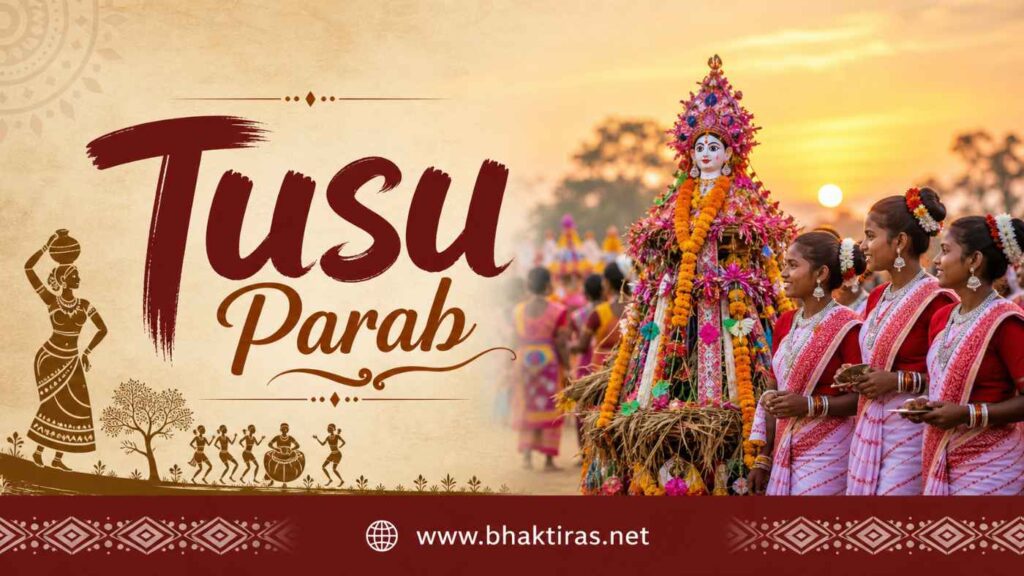
Tusu Parab is a harvest festival of the Rarh countryside – the red-soil belt of Purulia and Bankura in West Bengal, along with neighbouring parts of Jharkhand and Odisha. Through the cold month of Poush the unmarried girls of a household keep a small, brightly decorated Tusu at home and sing to her every evening, treating this folk goddess as a beloved daughter of the family. The month of song ends on Makar Sankranti, 14 January 2027, when the Tusu is carried out in a joyful procession, floated on a river, and the harvest is thanked with fairs, feasting and Poush pithas. There is no priest and no scripture here, only the voices of the girls.
Tusu Parab 2026-2028: Dates & Calendar
The songs of Tusu run through the whole of Poush, but the festival reaches its close on Makar Sankranti, the day the sun turns north. Because Sankranti is a solar reckoning, the closing date stays near 14 January every year.
| Year | Immersion (Makar Sankranti) | Day | Notes |
|---|---|---|---|
| 2026 | 14 January | Wednesday | Songs through Poush 2025-26 |
| 2027 | 14 January | Thursday | Next occurrence – immersion & fairs |
| 2028 | 15 January | Saturday | Falls a day later (leap year) |
In most villages the evening singing begins around the first day of Poush (mid-December) and builds night by night, so the festival is really a month long. Only the immersion, the fairs and the biggest gatherings are fixed to Makar Sankranti itself.
Why Tusu Parab Is Celebrated
Tusu Parab is celebrated to honour Tusu, a folk goddess of the harvest whom the Rarh region imagines as a young unmarried daughter of the house. It marks the end of the aman rice harvest and the turning of the sun at Makar Sankranti.
A goddess who is a daughter
Tusu has no temple, no idol carved by a priest and no fixed myth binding her to the great gods. Villagers picture her as a girl of their own home, and the affection in the songs – part lullaby, part farewell – is what makes the festival unusual. When she is immersed, the mood is that of seeing a daughter off after her stay.
A thanksgiving for the harvest
The festival sits at the close of Poush, when the winter rice is in and the granaries are full. Singing to Tusu is a way of marking that abundance and asking for it again, tying the goddess to the fields, the new grain and the fresh crop of dates and jaggery.
A festival owned by women
Tusu Parab belongs to the girls and women of the household. They compose the songs, keep the Tusu, lead the evening worship and carry her to the water. In a rural world where much public ritual is led by men, this month of the year is theirs, and the songs often carry their own joys, complaints and hopes.
Deities & Figures Worshipped
The one figure worshipped is Tusu herself, a folk goddess of the harvest with no Sanskrit scripture behind her. She is represented not by a carved idol but by a simple decorated image or a colourful bamboo-and-paper frame.
Tusu
Tusu is a village deity of the Rarh region, honoured as a symbol of the harvest and of unmarried girlhood. She has no established mythology linking her to the mainstream pantheon; her worship survives entirely through the songs and the yearly ritual, passed from mother to daughter.
The chaudal
In many homes Tusu takes the form of a chaudal, a small brightly coloured frame of bamboo, coloured paper and tinsel built for the festival. Elsewhere she is a modest clay or paper image kept on a decorated platform. It is this chaudal or image that is worshipped through Poush and finally floated on the river.
Key Rituals, Step by Step
Tusu Parab has no formal liturgy; the ritual is the daily keeping of the goddess and the singing to her, ending in her immersion. Here is how a typical observance runs.
- Setting up Tusu. On or around the first day of Poush the girls install a small Tusu – an image or a decorated chaudal frame – on a clean, adorned spot in the home or courtyard.
- Evening worship. Each evening through Poush the goddess is offered flowers, sweets, sindoor and a lamp, and the household gathers around her.
- Singing the Tusu songs. The girls sing specially composed Tusu songs to her night after night. Hundreds of these exist, many made up locally, ranging from tender to playful to mildly satirical.
- Building towards Sankranti. As Makar Sankranti nears, the singing grows longer and more festive and neighbouring households visit one another to share songs.
- Preparing the pithas. On the eve and morning of Sankranti families make Poush pithas – rice-flour cakes with jaggery and coconut – both to offer and to feast on.
- The procession. On Makar Sankranti morning the decorated Tusu is lifted up and carried out in a lively procession, often to the beat of dhak and to the sound of the same songs.
- Immersion. The Tusu or chaudal is floated on a river or pond, sending the goddess off much as a family would see off a daughter, and the fairs and feasting continue through the day.
Special Foods of Tusu Parab
The food of Tusu Parab is the food of a Bengal-Jharkhand winter harvest: new rice, fresh date jaggery and coconut, worked into the pithas that define Poush.
Poush pithas
Rice-flour cakes are the heart of the feast. Cooks make several kinds – steamed, fried and folded – filled with grated coconut and nolen gur (fresh date-palm jaggery), the season’s prize sweetener.
Puli & bhapa pitha
Puli pithas are little rice-flour dumplings stuffed with coconut and jaggery, while bhapa pithas are gently steamed cakes. Both are made in quantity during Poush and shared with visiting singers and neighbours.
Nolen gur & patali
The fresh sap of date palms, boiled down to liquid nolen gur or set into cakes called patali, flavours nearly every sweet of the season. Its smoky sweetness is closely tied to Poush in this region.
Fair sweets & snacks
At the Sankranti fairs that spring up along the rivers, stalls sell jilipi, muri, batasha and other simple treats, so the day of immersion doubles as a day of eating out for whole villages.
Regional Names & Variations
Tusu Parab is a shared festival of the Rarh belt, but its scale, its name and the size of its fairs change from district to district.
Purulia & Bankura (West Bengal)
This is the heartland of Tusu. Purulia in particular is known for enormous Sankranti-day Tusu melas along the rivers, where thousands of chaudals are brought for immersion and Tusu-song competitions draw crowds.
Jharkhand
Across the Jharkhand plateau, among both tribal and rural Hindu communities, Tusu is kept as a Makar or Poush festival with the same month of song and the same river immersion, closely tied to the local harvest.
Purulia-Odisha border
In the western fringes reaching into Odisha, Tusu blends with the wider Makar Sankranti and Tusu-mela tradition, sharing songs, fairs and the same close on the day the sun turns north.
The song tradition
Everywhere the festival is really carried by its songs. New Tusu songs are composed each year on everything from love and family to the events of the day, which is why the tradition stays alive and local rather than fixed.
Tusu Parab Do's and Don'ts
A few gentle customs help you take part in the spirit of the festival.
Do
- Keep the Tusu clean and freshly decorated through Poush
- Join the evening singing – the songs are the festival
- Learn or compose a Tusu song of your own if you can
- Share pithas and sweets with neighbours and visiting singers
- Treat the immersion with the warmth of a family farewell
Avoid
- Do not treat it as a grand temple ritual – it is a homely, folk observance
- Do not look down on the songs as simple; they carry real feeling and craft
- Do not litter the riverbanks during the melas and immersion
- Do not force a fixed date on the month of song – it varies by village
- Do not confuse Tusu with Bhadu, her sister folk goddess of the monsoon
Frequently Asked Questions
When is Tusu Parab in 2027?
Tusu Parab closes on Makar Sankranti, which falls on Thursday, 14 January 2027. The month of Tusu songs and evening worship runs through Poush before this, and the Tusu is carried in procession and immersed in a river on Sankranti morning.
When is Tusu Parab in 2026 and 2028?
The Makar Sankranti climax of Tusu Parab falls on Wednesday, 14 January 2026 and on Saturday, 15 January 2028. The 2028 date is a day later because it is a leap year. In each case the singing through Poush leads up to that day.
Why is Tusu Parab celebrated?
Tusu Parab is celebrated to honour Tusu, a folk goddess of the harvest whom the Rarh region imagines as a beloved unmarried daughter. It marks the end of the winter rice harvest and the turning of the sun at Makar Sankranti, and it is kept mainly through song by the girls of each household.
Who is the goddess Tusu?
Tusu is a village folk goddess of West Bengal’s Rarh region and neighbouring Jharkhand, worshipped as a symbol of the harvest and of girlhood. She has no Sanskrit scripture or fixed myth and no priest; she is kept as a small decorated image or a colourful frame called a chaudal, and honoured through hundreds of folk songs.
Where is Tusu Parab celebrated?
Tusu Parab is celebrated across the Rarh belt – chiefly Purulia and Bankura in West Bengal, along with parts of Jharkhand and the Odisha border. Purulia is especially known for its large Sankranti-day Tusu fairs held along the rivers.
What are Tusu songs?
Tusu songs are specially composed folk songs sung to the goddess Tusu each evening through Poush. There are hundreds of them, many made up locally and freshly each year, ranging from tender and devotional to playful and satirical. They are the living heart of the festival and are sung mostly by girls and women.
What foods are made during Tusu Parab?
The festival food is Poush pithas – rice-flour cakes filled with coconut and fresh date-palm jaggery (nolen gur), made in many forms such as puli and bhapa pitha. Simple fair sweets like jilipi and batasha are also enjoyed at the Sankranti melas.
How is the Tusu immersed?
On Makar Sankranti morning the decorated Tusu or chaudal is carried out in a joyful procession and floated on a river or pond. The mood is that of a family fondly seeing off a daughter, and fairs, songs and feasting continue along the water through the day.
May the songs of Poush fill your home and the new harvest bring you plenty – a happy Tusu Parab to all the daughters of the Rarh.