
Rishi Vishwamitra
विश्वामित्र
Rishi Vishwamitra was a warrior-king named Kaushika who gave up his throne to pursue penance and rose, by sheer force of will, from Kshatriya ruler to Brahmarishi. He is the seer of the Gayatri Mantra, author of the third book of the Rigveda, and the guru who armed the young Rama with celestial weapons.
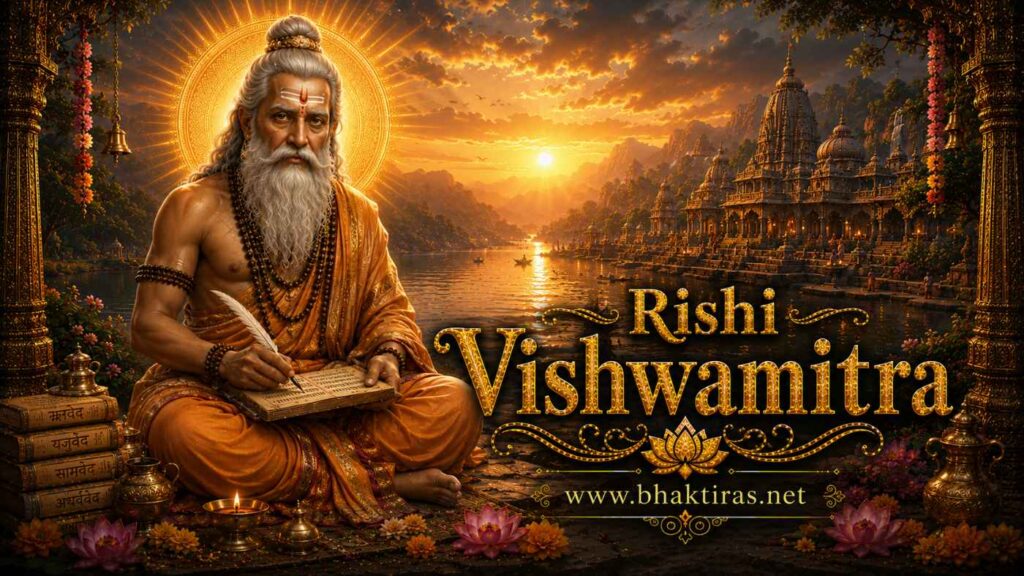
Who Is Rishi Vishwamitra
Among the great seers of Hindu tradition, few carry a story as fierce as that of Vishwamitra. He was not born a sage. He began his life as Kaushika, a king of the Kushika dynasty, commander of armies and master of the arts of war. Yet the name history remembers him by, Vishwamitra, means ‘friend of all the world’ – a title earned not on the battlefield but through decades of relentless inner struggle.
His life is the record of a single, staggering ascent. He climbed from a Kshatriya throne to the rank of Rajarishi, then Maharishi, and at last to the highest station a human can reach through effort: Brahmarishi. No one was born into that rank; it had to be won. Vishwamitra won it against every obstacle the world and his own nature could throw at him.
He is bound tightly to two of the tradition’s most sacred threads. He is the seer to whom the Gayatri Mantra was revealed, and the rishi credited with the third mandala of the Rigveda, one of the oldest layers of Hindu scripture. He is also the guru who walked into Ayodhya, asked King Dasharatha for his son, and led the boy Rama toward the destiny that the Ramayana would immortalise.
Vishwamitra’s story is loved because it is honest about the cost of change. He falls, he burns with pride, he loses his temper, he spends the fruit of years of penance in single fits of rage – and still he keeps climbing. That is why he endures: he is proof that a person can remake themselves entirely, and that the greatness of the spirit can outrun the greatness of birth.
From King to Sage – the Great Transformation
The King and the Cow
The turning point came during an ordinary royal hunt. King Kaushika, riding through the forest with his troops, arrived tired and hungry at the hermitage of the sage Vashishtha. The sage received the whole army as honoured guests and, to everyone’s astonishment, fed them a feast fit for a palace. Kaushika asked how a forest hermit could provide so much. The secret was Nandini, Vashishtha’s divine cow, who granted whatever was wished of her.
What No Army Could Take
The king wanted the cow. He offered gold, herds, a fortune in exchange, and Vashishtha refused; the cow was the ashram’s soul, not for sale. So Kaushika ordered his soldiers to seize her by force. Here the story turns. The gentle cow, at Vashishtha’s word, brought forth armies of her own and scattered the king’s men like leaves. A ruler who commanded thousands stood helpless before one sage and one cow.
The Humbling
Kaushika had learned something that shook him to the core. All his weapons, all his soldiers, all his royal power counted for nothing against the strength Vashishtha had earned through tapas. The might of arms was hollow; the might of the spirit was real. In that moment of defeat the king made a decision that would define ages. He set down his crown, turned his back on his kingdom, and walked into the forest to earn that inner power for himself, whatever it took.
The Long Climb to Brahmarishi
What followed was not a single retreat but a war of the will that stretched across enormous spans of time. Vishwamitra sat in penance so severe that the heavens themselves took notice, and step by step his effort was recognised. First he earned the title of Rajarishi, the royal sage – proof that a king could turn seer. But the gods offered him only that lesser rank, and Vishwamitra, hungry for the full ascent, refused to be satisfied.
The path was strewn with tests, and many of them he failed before he passed. When the celestial nymph Menaka was sent to break his concentration, she succeeded; years of accumulated penance drained away in her company. When King Trishanku’s cause provoked him, his temper flared and he poured out hard-won spiritual power in anger. Again and again he had to begin from the ashes of his own pride, and again and again he began.
Through it all a single figure stood as both rival and measure: Vashishtha, the Brahmarishi whose cow had first humbled him. Vishwamitra could not rest while the man who had defeated him held the rank he craved. Their long contest, at times bitter, at times touched by grief, drove him onward. Only when Vishwamitra had mastered his rage, his desire, and his pride did the true recognition come.
At last Vashishtha himself – the very seer he had spent lifetimes trying to surpass – acknowledged him as an equal and greeted him as Brahmarishi. That acknowledgement mattered more than any boon from the gods, because it came from the one voice Vishwamitra had needed to hear. He had reached the summit not by birth, not by conquest, but by refusing, across ages, to give up.
The Seer of the Gayatri Mantra
Of all Vishwamitra’s gifts to the world, the greatest is the Gayatri Mantra. In the tradition of the Rigveda, a mantra is not composed like a poem; it is seen, received by a seer whose inner sight has been purified enough to perceive it. Vishwamitra was that seer for the Gayatri, and this places him at the heart of Vedic spiritual life.
The verse is a prayer to Savitr, the radiant power behind the sun, asking that the light of the divine awaken and guide the human mind. Recited at dawn and dusk for countless generations, it remains one of the most cherished of all Hindu prayers, taught to the young at the sacred-thread ceremony and carried through a lifetime of practice. That such a luminous line of scripture came through Vishwamitra says a great deal about the height he reached.
He is also honoured as the rishi of the third mandala of the Rigveda, one of the ten great books that form the oldest layer of the Veda. To be the seer of an entire mandala is to have shaped a foundation stone of Hindu revelation. The former warrior-king, who once measured strength in soldiers, ended by giving the world verses that still open the day for millions.
Guru of the Young Rama
Vishwamitra’s most famous appearance in story comes at the start of the Ramayana. His forest sacrifices were under constant assault by demons who fouled his rituals with blood and filth, and the sage needed protection that only a hero could give. So he journeyed to Ayodhya and asked King Dasharatha for something no father wants to hear: give me your son, the boy Rama, to guard my yajna.
Dasharatha hesitated to send so young a prince into danger, but Vashishtha counselled him to trust the sage, and Rama, with his brother Lakshmana at his side, set out. Along the road Vishwamitra taught the two princes sacred knowledge and placed in their hands a store of celestial weapons, the astras, along with the mantras to summon and to withdraw them. It was under his guidance that Rama first became the warrior the world would need.
When the demons Maricha and Subahu attacked the completed sacrifice, Rama drove them off, and the yajna was saved. But the sage’s guidance did not end there. Vishwamitra led the brothers onward to Mithila, to the court of King Janaka, where the mighty bow of Shiva waited. No one had been able so much as to lift it. Rama, brought to that hall by Vishwamitra, raised the bow and drew it until it broke – and by that feat won the hand of Sita. The seer had set the young prince on the road to everything that would follow.
Menaka, Trishanku and the Tests of Tapas
The road to Brahmarishi was lined with famous trials, and the tradition remembers several of them vividly. They show a man of enormous power who was still, at every stage, a man – capable of falling, of anger, and of extraordinary compassion in the same breath.
- Menaka and Shakuntala: When Vishwamitra’s penance grew so intense that it threatened the balance of the heavens, the celestial dancer Menaka was sent to distract him. She succeeded, and for a time the sage set aside his austerities to live with her. From their union was born a daughter, Shakuntala, who would later become the mother of Bharata, the emperor after whom the land itself is named. When Vishwamitra realised how much penance he had spent, he parted from Menaka and returned, chastened, to his tapas.
- The tale of Trishanku: King Trishanku wished to ascend to heaven in his own mortal body, a thing the gods forbade and even Vashishtha’s sons refused to attempt. Vishwamitra took up the cause. When Indra cast the rising king back down toward earth, the sage’s power blazed out and he began to build an entire second heaven, complete with new stars and constellations, so that Trishanku might have a home among the skies. A compromise was struck, and Trishanku hung suspended, head downward, in a firmament of Vishwamitra’s own making – a sky the tradition still points to.
- The cost of anger: More than once Vishwamitra spent the accumulated merit of years of penance in a single outburst of rage. Each time he had to start again from nothing. The lesson the stories press home is not that he was flawless, but that his greatness lay in refusing to stay down – in beginning the long climb over and over until his temper, his desire, and his pride were finally conquered.
Iconography & Symbols
The Ascetic's Form
Vishwamitra is shown as a lean, weathered sage with matted hair coiled high, a long beard, and skin darkened by sun and years of open-air penance. He wears bark garments or ochre robes, the plain dress of one who has left kingship behind.
The Water Pot and Staff
In his hands he often carries the kamandalu, the ascetic’s water pot, and a simple wooden staff. These are the tools of the wandering seer, marks of a life stripped down to its essentials, and reminders of how far he travelled from the trappings of a royal court.
Fire and Sacred Thread
He is frequently pictured beside the sacred fire of the yajna, the ritual he devoted himself to protecting, and wearing the sacred thread of the twice-born. The flames stand for the tapas that transformed him and the offering that shapes the Vedic world.
Bow Set Aside
Some depictions place a bow near him, laid down rather than drawn – a quiet symbol of the warrior-king he once was. It marks the choice at the centre of his whole story: to trade the strength of arms for the strength of the spirit.
How Rishi Vishwamitra Is Remembered
Vishwamitra lives on far beyond the pages that first told his story. He is counted among the Saptarishi, the seven great seers, in some traditions, and his name is invoked wherever the power of self-discipline is honoured. His legacy shows up in prayer, in scripture, and in the everyday language of aspiration.
- As the seer of the Gayatri Mantra, he is present at every dawn recitation of that verse across the Hindu world.
- As the author of the Rigveda’s third mandala, his vision is woven into the oldest layer of Vedic scripture.
- His journey from Kshatriya king to Brahmarishi is cited as the definitive proof that spiritual rank is earned, not inherited.
- Through his daughter Shakuntala and grandson Bharata, he is linked to the very name of Bharatavarsha, the land of India.
- In the Ramayana he is honoured as the guru who first armed and guided Rama, shaping the hero at the start of his path.
- His name has become a byword for iron will and unbroken resolve, held up whenever perseverance against the odds is praised.
Prayers & Mantras
Devotees remember Vishwamitra with simple mantras that salute him as the seer of ceaseless effort. Reciting his name is a way of asking for the same steadiness of purpose that carried him from a throne to the summit of the sages. His deepest connection, of course, is to the Gayatri Mantra he revealed – so to honour Vishwamitra is, in a sense, to turn toward the light that his own long penance uncovered.
Devanagari: ॐ विश्वामित्राय नमः
Transliteration: Om Vishwamitraya Namah
Meaning: ‘I bow to Vishwamitra, friend of all the world.’ The salutation honours the seer whose will turned a warrior into a Brahmarishi and whose vision gave humankind the Gayatri.
Frequently Asked Questions about Rishi Vishwamitra
Who is Rishi Vishwamitra?
Rishi Vishwamitra was a great sage of Hindu tradition who began life as the warrior-king Kaushika. He renounced his kingdom for penance and rose to become a Brahmarishi, the highest rank of seer. He revealed the Gayatri Mantra, composed the third book of the Rigveda, and served as guru to the young Rama.
How did a king become a Brahmarishi?
After being humbled by the sage Vashishtha, whose divine cow no army could seize, Kaushika realised that spiritual power outweighs military might. He gave up his throne and undertook fierce penance across vast spans of time, rising through the ranks of Rajarishi and Maharishi. Only after conquering his pride and anger did he earn the title of Brahmarishi.
Did Vishwamitra reveal the Gayatri Mantra?
Yes. In the Vedic tradition Vishwamitra is honoured as the seer to whom the Gayatri Mantra was revealed. It appears in the third mandala of the Rigveda, of which he is the rishi. The Gayatri, a prayer for divine light to guide the mind, remains one of the most sacred and widely recited mantras in Hinduism.
What is Vishwamitra's connection to Lord Rama?
Vishwamitra came to Ayodhya and asked King Dasharatha for the young Rama to protect his forest sacrifice from demons. He taught Rama and Lakshmana sacred knowledge and gave them celestial weapons, the astras. He then led Rama to Mithila, where the prince lifted and broke Shiva's bow and won the hand of Sita.
Who was Vishwamitra's great rival?
His long rival was the Brahmarishi Vashishtha, whose wish-fulfilling cow first humbled the warrior-king. Their contest drove Vishwamitra's ascent for ages. In the end it was Vashishtha himself who acknowledged Vishwamitra as a Brahmarishi, an equal, which meant more to him than any gift from the gods.
What is the story of Menaka and Shakuntala?
When Vishwamitra's penance threatened the heavens, the celestial nymph Menaka was sent to distract him, and she succeeded. From their union was born a daughter, Shakuntala, who later became the mother of Bharata, the emperor after whom Bharatavarsha is named. Realising his loss, Vishwamitra parted from Menaka and returned to his austerities.
What was Trishanku's heaven?
King Trishanku wished to enter heaven in his mortal body. When the gods cast him back down, Vishwamitra used his tapas to begin building an entire second heaven, complete with new stars, so the king would have a place among the skies. A compromise left Trishanku suspended in a firmament of the sage's own making.
In which texts does Vishwamitra appear?
Vishwamitra features across the core of Hindu scripture. He is a seer of the Rigveda and the wider Vedas, a central figure in the opening books of the Ramayana as Rama's guru, and the subject of many episodes in the Puranas, including the tales of Menaka, Trishanku, and his rivalry with Vashishtha.
May the resolve of Vishwamitra, who climbed from a throne to the heights of the seers, kindle in you the will to never abandon your own path.