
Marwar Festival 2026 – Jodhpur's Songs of the Rathores
मारवाड़ महोत्सव
When is the Marwar Festival in Jodhpur in 2026?
The Marwar Festival 2026 is expected around 24-25 October, timed to Sharad Purnima, the full moon of the month of Ashwin. Held in Jodhpur over two days, it celebrates the folk music, dance and martial heritage of the old Marwar region with performances staged against the Mehrangarh Fort and Umaid Bhawan Palace. Exact dates are set by Rajasthan Tourism each year and can shift slightly.
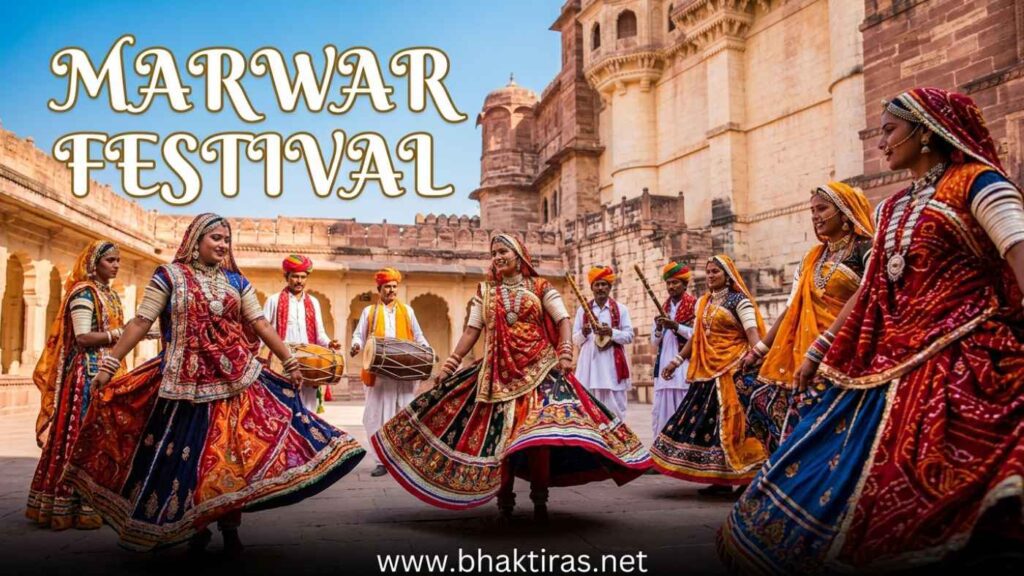
The Marwar Festival is a two-day celebration of Jodhpur and the wider Marwar region, once ruled by the Rathore Rajputs. It began as the Maand Festival, named after Maand – a courtly style of Rajasthani folk singing that recounts the bravery and love stories of the region’s rulers. Held each year around Sharad Purnima in October, it fills the city with folk musicians, dancers, camel and horse polo, turban and moustache contests, and evening concerts below the ramparts of Mehrangarh Fort. Rajasthan Tourism organises it to draw visitors to the Blue City.
Marwar Festival 2026-2028: Dates & Calendar
The Marwar Festival is tied to Sharad Purnima, the full moon of the Hindu month of Ashwin, so its date moves with the lunar calendar each year. The dates below are the expected windows; Rajasthan Tourism confirms the exact schedule closer to the event.
| Year | Dates (approx.) | Days | Notes |
|---|---|---|---|
| 2026 | 24-25 October | Sat-Sun | Around Sharad Purnima (25 Oct) |
| 2027 | 14-15 October | Thu-Fri | Around Sharad Purnima (15 Oct) |
| 2028 | 2-3 October | Mon-Tue | Around Sharad Purnima (3 Oct) |
The festival runs across two days and culminates on the night of the full moon, when the moonlight over Mehrangarh Fort forms the backdrop for the closing concerts. Always check the Rajasthan Tourism calendar before booking, as the programme and dates are finalised each year.
Why the Marwar Festival Is Held
The Marwar Festival is a cultural, not religious, event. It exists to keep the folk arts, oral history and martial traditions of the Marwar region alive and to share them with visitors to Jodhpur.
A tribute to the Rathores
Marwar was the kingdom of the Rathore Rajputs, with Jodhpur as its capital. The festival honours their memory through the songs, dances and horsemanship that once filled their courts, giving modern audiences a window into that world.
The Maand tradition
The event was originally called the Maand Festival. Maand is a refined style of Rajasthani folk singing, close to a raga, used to praise rulers and recount heroic and romantic tales. Reviving Maand and its singers is at the heart of the celebration.
Living folk culture
Rather than a museum display, the festival puts working folk artists – singers, drummers, puppeteers and dancers from villages across the region – on a real stage. It gives them an audience and income while passing their craft to younger performers.
Jodhpur tourism
Rajasthan Tourism uses the festival to bring visitors to the Blue City in the pleasant post-monsoon season. The programme is deliberately built around Jodhpur’s landmarks, so travellers experience the fort, the palace and the old city together with the performances.
What Happens at the Festival, Day by Day
Over two days the programme moves through the city’s landmarks. Timings and the exact order change from year to year, but the mix of music, sport and contests stays broadly the same.
- Opening procession. The festival usually opens with a colourful procession through the old city, with folk artists, decorated camels and costumed performers making their way towards a central venue.
- Folk music and Maand concerts. Singers perform Maand and other Rajasthani forms, backed by instruments like the sarangi, dholak and kamaicha, often in courtyard settings with strong acoustics.
- Folk dances. Troupes present regional dances such as the ghoomar, kalbeliya and fire dances, with the twirling skirts and mirror-work costumes typical of the desert districts.
- Camel and horse polo. One of the festival’s signatures is polo played on camels and on the local Marwari horses, a nod to the region’s cavalry heritage.
- Turban-tying contest. Visitors and locals compete to tie the elaborate Rajasthani safa (turban) quickly and correctly, a skill still tied to status and hospitality here.
- Moustache competition. The famous Marwari moustache contest judges length, curl and grooming, and is one of the most photographed events of the two days.
- Evening concerts at the landmarks. The programme builds to night performances staged near Mehrangarh Fort and Umaid Bhawan Palace, with the illuminated stonework as a backdrop.
- Sharad Purnima finale. The celebrations peak on the full-moon night, closing the festival under the bright Ashwin moon that gives the timing its meaning.
What to Eat at the Marwar Festival
Marwari cuisine grew out of a dry, water-scarce land, so it leans on lentils, gram flour, dried spices and ghee rather than fresh vegetables. The festival is a good excuse to try Jodhpur’s most famous plates.
Dal Baati Churma
The signature meal of the region: baked wheat balls (baati) dunked in ghee, served with a spiced lentil dal and churma, a sweet crumble of crushed baati with sugar and nuts. It is filling, festive and made for sharing.
Mirchi Bada & Pyaaz Kachori
Jodhpur is known for its mirchi bada – a large chilli stuffed with spiced potato, battered and fried – and the flaky, onion-filled pyaaz kachori. Both are classic morning or teatime snacks in the old city.
Gatte ki Sabzi & Ker Sangri
Gram-flour dumplings in a tangy yoghurt gravy (gatte ki sabzi) and ker sangri, a dry curry of desert berries and beans, show how Marwari cooks made rich meals with almost no fresh produce.
Makhaniya Lassi & Sweets
Jodhpur’s thick, saffron-and-nut makhaniya lassi is a local institution, best on a warm festival afternoon. Round it off with sweets like mawa kachori or besan barfi from the city’s old halwais.
Marwar Festival: Tips for Visitors
A few simple pointers to get the most out of the two days in Jodhpur.
Do
- Book Jodhpur hotels well ahead, as rooms fill fast around the festival.
- Check the current Rajasthan Tourism schedule for confirmed dates and venues.
- Carry a hat, sunglasses and water for the daytime outdoor events.
- Try the local Marwari food, from dal baati churma to mirchi bada.
- Ask before photographing performers up close, and tip folk artists fairly.
Avoid
- Do not assume the dates are fixed – they move each year with Sharad Purnima.
- Do not skip the evening concerts; the fort-backed night shows are the highlight.
- Do not haggle aggressively with folk artists or craftspeople for photos.
- Do not wander onto the polo field or performance areas uninvited.
- Do not treat it as a religious festival – it is a cultural and tourism event.
Frequently Asked Questions
When is the Marwar Festival in 2026?
The Marwar Festival 2026 is expected around 24-25 October, timed to Sharad Purnima on 25 October. It is a two-day event in Jodhpur organised by Rajasthan Tourism, and the exact dates are confirmed each year, so they can shift by a day or two.
When is the Marwar Festival in 2027 and 2028?
The Marwar Festival is expected around 14-15 October in 2027 and around 2-3 October in 2028, following Sharad Purnima each year. Because the festival is tied to the lunar full moon of Ashwin, the dates move annually and should be checked with Rajasthan Tourism before travel.
Where is the Marwar Festival held?
The Marwar Festival is held in Jodhpur, the Blue City of Rajasthan, the former capital of the Marwar kingdom. Events take place across the old city, with the main concerts staged against the Mehrangarh Fort and Umaid Bhawan Palace.
Why is it called the Marwar Festival?
It is named after Marwar, the historic region of western Rajasthan ruled by the Rathore Rajputs from Jodhpur. The festival was originally known as the Maand Festival, after Maand, a style of Rajasthani folk singing that praises the region’s rulers.
What happens at the Marwar Festival?
The Marwar Festival features folk music and Maand singing, Rajasthani dances such as ghoomar and kalbeliya, camel and horse polo, and turban-tying and moustache contests. Performances build to evening concerts near Mehrangarh Fort, closing on the Sharad Purnima full-moon night.
Is the Marwar Festival a religious festival?
No, the Marwar Festival is a cultural and tourism event rather than a religious one. It celebrates the music, dance, sport and martial heritage of the Marwar region, and is organised by Rajasthan Tourism to promote Jodhpur to visitors.
What food should I try during the festival?
During the Marwar Festival, try Jodhpur’s signature dal baati churma, the local mirchi bada and pyaaz kachori, and desert dishes like gatte ki sabzi and ker sangri. Cool down with a thick makhaniya lassi, a local favourite.
How many days does the Marwar Festival last?
The Marwar Festival lasts two days and culminates on the night of Sharad Purnima. The programme spreads across Jodhpur’s landmarks, with daytime sport and contests giving way to evening concerts below the fort.
If you are planning a trip, the Marwar Festival is one of the best times to hear Jodhpur sing. Padharo mhare desh – welcome to our land.