
Goddess Nirriti
निरृति
Nirriti is the Vedic goddess of dissolution, decay, misfortune and death. She is not evil but the honest face of impermanence, presiding over the south-west direction as a guardian. Her domain is the ending of things – the necessary passing away that clears the ground for renewal and new life.
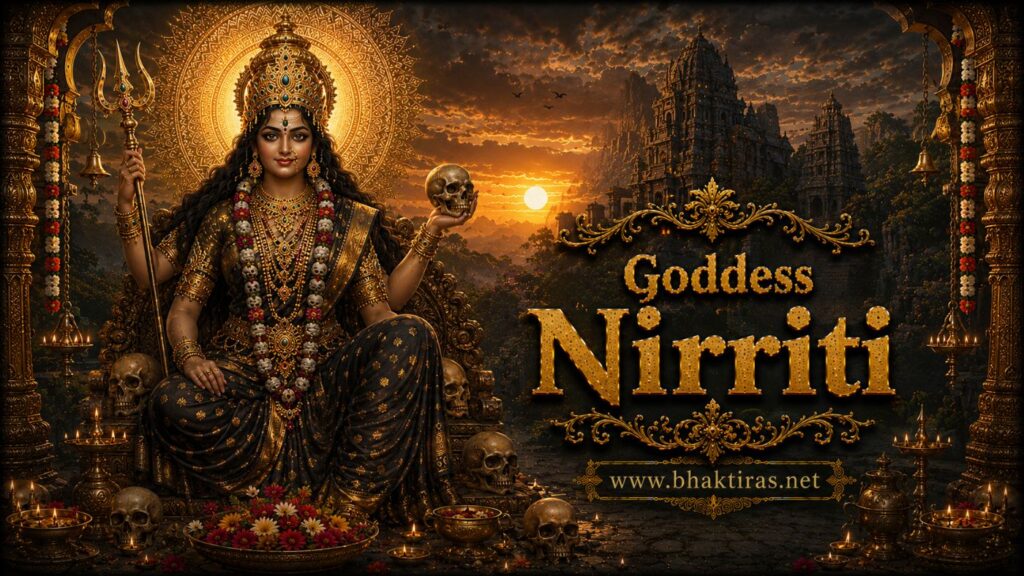
Who Is Goddess Nirriti
Among the goddesses of the Vedic world, Nirriti holds a place few others would want and none could fill. She is the goddess of dissolution – of decay, misfortune, endings and death. To meet her name in the old hymns is to meet the part of life we would rather look away from, and the Vedic seers did not look away. They gave her a name, a direction, and a measure of respect.Not an enemy, but a truth
It is tempting to read Nirriti as a demoness or a figure of evil. That reading misses her entirely. She is a devi within the same divine order that gives us dawn, harvest and birth. Her work is the other half of the same rhythm: things end, forms break down, seasons close. Without that closing, nothing could begin again. Nirriti is the honest face of that truth, neither cruel nor kind, simply real.
A goddess of the difficult side of life
Where Lakshmi brings fortune, abundance and light, Nirriti presides over their absence – the failed crop, the empty house, the illness that does not lift. The Vedic mind did not pretend these things away. Instead it personified them, addressed them, and asked them to keep their distance. To name a hardship is already to begin holding it with some steadiness.
The Goddess of Dissolution and Endings
The Sanskrit root behind her name, nir-rita, points to the undoing of rita – the cosmic order, the right pattern that holds the world in place. Nirriti is what happens when that pattern loosens: dissolution, disorder, the slow or sudden coming-apart of things.Decay as part of the order
This is the paradox at her heart. Nirriti is the absence of order, yet she belongs to the order itself. Rita includes its own undoing. Grain rots so that soil is fed; the body fails so that a life completes its arc; empires and homes and habits all reach their close. The Vedic vision was clean-eyed enough to see decay not as an accident within creation but as one of its working parts.
The one who receives what falls away
In the hymns Nirriti is sometimes the ground that receives what has ended – the one to whom the broken, the spoiled and the finished return. She is invoked so that what must decay passes fully into her keeping and does not linger where the living are. There is a strange mercy in this. She takes what can no longer be held, and in taking it, clears a space.
Guardian of the South-West
In the Hindu ordering of space, each of the directions has a divine guardian, a Dikpala. The east belongs to Indra, the north to Kubera, and the south-west – Nairitya – to Nirriti. Her name and this corner are so bound together that the corner takes its very title from her.The Dikpala of Nairitya
As guardian of the south-west, Nirriti watches over the direction traditionally linked with heaviness, stability and the settling of what endures. It is the corner where things come to rest and where the weight of a place is meant to gather. In the geography of the cosmos she holds this station steadily, a keeper posted at the diagonal between south and west.
Why vastu treats this corner with care
Because the south-west belongs to Nirriti, the vastu tradition treats that corner of a home or plot with particular attention. It is often kept solid and grounded – the place for the heaviest elements, the master’s quarters, the foundation of a structure’s weight – rather than left open or restless. The instinct behind the rule is old: at the corner of endings, one builds firmly and does not invite disturbance.
Nirriti and Alakshmi
As the tradition grew, Nirriti’s themes gathered around another figure: Alakshmi, whose name means simply ‘not-Lakshmi’, the absence of fortune. The two are closely woven, and in many later texts Nirriti and Alakshmi shade into one another.The shadow of Lakshmi
Lakshmi is fortune, grace, the shine of prosperity and well-being. Alakshmi is her shadow – want, quarrel, the tarnish that settles where luck has withdrawn. Where Lakshmi is welcomed with lamps and open doors, Alakshmi is quietly shown out. Yet the pairing is honest: no household knows only good fortune, and the tradition gave the harder season its own name rather than pretending it never came.
Two faces of one truth
To link Nirriti with Alakshmi is to say that dissolution and misfortune are of a piece. The loosening of order shows itself in a home as decline, discord, the fading of prosperity. Nirriti presides over the cosmic version of this; Alakshmi walks its domestic form. Both remind us that fortune is not owed and not permanent, and that its absence, too, has a place in the whole.
The Honest Face of Impermanence
Beneath every one of her associations lies a single teaching, and it is not a bleak one. Nirriti is the honest face of impermanence – the reminder that everything given is also, in time, taken back, and that this is the very condition of new life.Nothing new grows without the old passing away
A field must be cleared before it can be sown. Leaves must fall for the tree to rest and green again. A grief must be lived through before a heart reopens. Nirriti’s domain is that clearing, that falling, that passing-through. She is not the enemy of renewal but its necessary condition. The ground of new creation is always the old creation, dissolved and returned.
Facing endings with acceptance
To hold Nirriti in mind is to practise a kind of honesty most of us avoid. Loss will come. Bodies age, fortunes turn, seasons of life close behind us. Her presence in the tradition is an invitation to meet these truths without denial or panic – to face endings with acceptance, and to trust that what dissolves makes room for what is not yet born.
From Nirriti to Dhumavati
The concerns that Nirriti carries in the Vedic world did not disappear as Hindu thought developed. They flowed onward, gathering into the fierce and searching figures of the Mahavidyas – and nowhere more clearly than in Dhumavati.The current that carries forward
Dhumavati, the ‘smoky one’, is the widow-goddess of the ten Mahavidyas: the deity of absence, of the void, of what remains when all comfort has withdrawn. In her the old themes of Nirriti return – dissolution, misfortune, the honest confrontation with lack. The Vedic goddess of endings becomes, in this later stream, a figure of profound and difficult wisdom, teaching detachment through the very things we fear to lose.
From acknowledgement to insight
Where the Vedic seers acknowledged Nirriti and asked her to keep her distance, the tantric path turns and faces her descendants directly, seeking liberation through them. The difficult truths did not soften over the centuries; they deepened. To trace the line from Nirriti to Dhumavati is to watch a single, unflinching insight mature – that the divine is present even in absence, even in the smoke of what has burned away.
How Nirriti Is Acknowledged in Ritual
Nirriti is not courted for blessings in the way of Lakshmi or Saraswati. She is acknowledged – named, respected, and asked to pass. The Vedic manner with her is careful and dignified, a way of honouring hardship without inviting it to stay.- In Vedic ritual she is addressed directly and respectfully asked to keep her distance, so that decay and misfortune move on rather than settle.
- Offerings made to her are set apart from those of the auspicious deities, marking her separate station within the sacred order.
- As Dikpala of the south-west, she is honoured when the directions are invoked, taking her place among the guardians of space.
- In vastu practice her corner is kept solid and grounded, an architectural form of keeping the goddess of endings settled and at rest.
- Rites at the close of a life or the passing of what has ended acknowledge her domain, entrusting to her what can no longer be held.
- The tone throughout is appeasement and respect rather than fear – a recognition that the hard truths of life deserve their own honest address.
Prayers and Mantras
Prayers to Nirriti are quieter than most – less a plea for gain than a wish for hardship to pass gently and for the strength to meet what cannot be avoided. Her simplest mantra is an offering of respect to the goddess of endings.The core mantra
ॐ निरृत्यै नमः – Om Nirrityai Namah – ‘Om, salutations to Nirriti.’ To recite it is not to invite dissolution but to bow to it honestly: to acknowledge that decay and endings are real, to ask that they pass without cruelty, and to seek the composure to face impermanence with acceptance. Spoken in this spirit, it becomes a small practice in letting go.
Frequently Asked Questions about Goddess Nirriti
Who is Goddess Nirriti?
Nirriti is the Vedic goddess of dissolution, decay, misfortune, endings and death. She presides over the difficult but unavoidable truths of life and guards the south-west direction. Far from being evil, she is understood as the honest face of impermanence within the divine order.
Is Nirriti an evil goddess?
No. Nirriti is not evil. She is a devi who presides over decay and endings – the necessary passing away that clears the ground for renewal. The Vedic seers acknowledged her with respect, seeing her as the honest face of impermanence rather than a force of malice or wickedness.
Which direction does Nirriti guard?
Nirriti is the Dikpala, or guardian, of the south-west direction, known as Nairitya – a name drawn directly from her own. Because this corner belongs to her, the vastu tradition treats the south-west of a home or plot with special care, keeping it solid and grounded.
What is the connection between Nirriti and Alakshmi?
Nirriti's themes closely align with Alakshmi, whose name means the absence of fortune – the shadow of Lakshmi. In many later texts the two figures merge. Both represent decline, want and misfortune, the honest counterpart to prosperity and grace within the larger whole.
Why is the south-west corner important in vastu?
The south-west belongs to Nirriti, the goddess of dissolution, so vastu treats it as the corner of weight and rest. It is kept solid and grounded, often reserved for the heaviest elements or the master's quarters, so that the domain of endings stays settled and undisturbed.
How does Nirriti relate to the Mahavidyas?
Nirriti's themes of dissolution, absence and misfortune flow into the later goddess tradition, most clearly into Dhumavati, the widow-goddess of the ten Mahavidyas. Where the Vedic age acknowledged these truths, the tantric path faces them directly, seeking wisdom through the very things we fear to lose.
How is Nirriti worshipped?
Nirriti is acknowledged rather than courted for gain. In ritual she is respectfully named and asked to keep her distance so misfortune passes on. Her simple mantra, Om Nirrityai Namah, is an offering of respect and a quiet practice in accepting the endings that life brings.
What does Goddess Nirriti teach?
Nirriti teaches acceptance of endings. Her deepest lesson is that nothing new can grow without the old passing away, and that dissolution is the ground from which renewal arises. She invites us to face loss and impermanence with dignity and calm rather than denial or dread.
In honouring Nirriti we learn the gentlest of hard truths – that every ending makes room, and that letting go is part of how life quietly continues.