
Goddess Gayatri
गायत्री
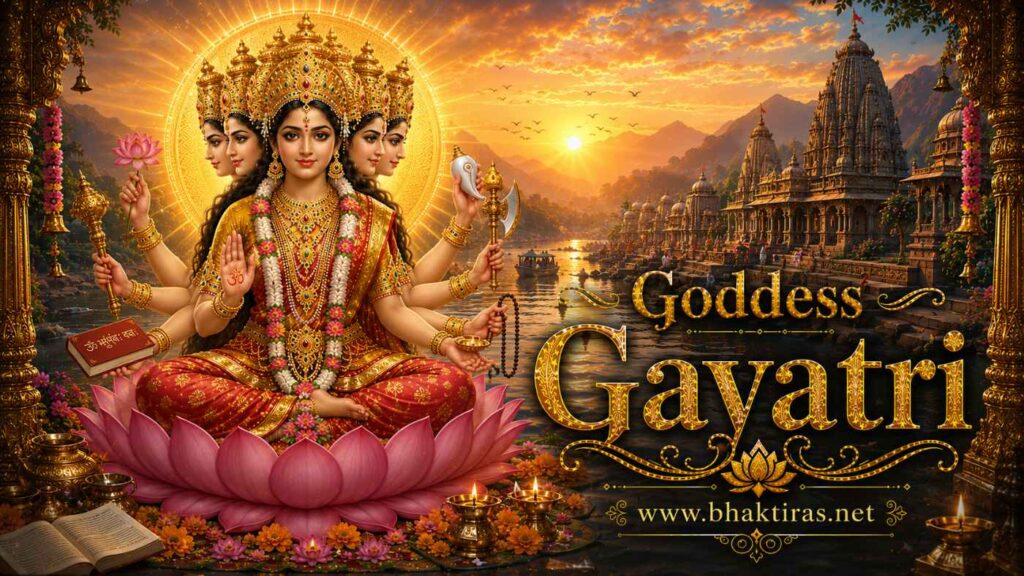
Goddess Gayatri is the living form of the Gayatri Mantra, the most revered of all Vedic verses, which prays that the divine light of the Sun awaken and guide our understanding. Honoured as Vedamata, the Mother of the Vedas, she is often shown five-faced and ten-armed, seated on a lotus with the swan as her vahana, and worshipped at dawn, noon and dusk.
Who Is Goddess Gayatri
Gayatri is not a goddess who arrived through a single great deed or a dramatic descent from the heavens. She is older and quieter than that. She is a verse – the Gayatri Mantra – that Hindus have sung at first light for thousands of years, and over time that verse came to be seen as a living mother who hears it being sung. To chant her is, in the oldest sense, to call her into being.
The mantra she personifies is addressed to Savitr, the divine energy of the Sun, and it asks for one thing only: that the light which fills the sky also fill the mind. There is no request for wealth or victory in it. It is a prayer for clear seeing. Because of this single, luminous intention, Gayatri became the goddess of awakened wisdom, of a mind washed clean of confusion.
She is worshipped across every part of India and by followers of many traditions, from the Vedic priest performing his morning ritual to the ordinary householder who has learned the mantra from a grandparent. Her image is gentle and radiant – a woman of the dawn, holding the scriptures in her hands and looking out from a lotus as though she were the light itself, made visible.
What makes her unusual among the deities is that her form grew out of sound. Long before painters gave her five faces and ten arms, she was the rhythm and breath of a sacred metre. Everything that came after – the temples, the festival, the icon – is an attempt to give a face to that early morning prayer.
The Mother of the Vedas
Gayatri’s most cherished title is Vedamata, the Mother of the Vedas. The name carries a specific idea. In the Hindu view the Vedas are not merely books of hymns but the very structure of sacred knowledge, and the tradition holds that the Gayatri Mantra is the seed and essence from which all that knowledge unfolds. If the Vedas are a great tree, Gayatri is the root and the sap.
This is why, in the old system of learning, a boy’s formal Vedic education began with the Gayatri Mantra. At his upanayana, the ceremony of the sacred thread, the mantra was whispered to him as the first true teaching. To receive Gayatri was to be born a second time into the life of study and discipline. She was, quite literally, the mother who gave him his intellectual and spiritual birth.
Seen this way, Gayatri is less a single deity than the presiding spirit of learning and inner sight. Every prayer, every ritual verse, every act of contemplation is thought to draw on the light she carries. To honour her is to honour the source of understanding itself, and devotees often say that a mind steadied by her mantra becomes fit to receive all other wisdom.
The Gayatri Mantra and Its Meaning
At the heart of this goddess lies a single verse from the Rigveda, composed by the sage Vishwamitra. It opens with the three utterances – Bhur, Bhuvah, Svah – which name the earthly, the middle and the heavenly realms, gathering all of creation into the prayer before a word of petition is spoken.
The verse then turns toward Savitr, the Sun in its role as the giver of life and light, and asks the worshipper to meditate upon that adorable radiance of the divine. The closing words are the soul of the whole prayer: dhiyo yo nah prachodayat – may that divine light inspire and awaken our understanding. It is a request for the inner faculty of thought to be kindled, the way the dawn kindles the visible world.
What gives the Gayatri its depth is this restraint. A worshipper stands before the source of all warmth and asks not for gifts but for clarity – for the mind to be moved toward truth. It is a prayer for illumination in both senses at once: the light that falls on the fields, and the light that dawns within. Devotees hold it as the highest of mantras precisely because it seeks the one thing that makes every other blessing meaningful.
Gayatri and Savitri
Gayatri is spoken of almost in the same breath as Savitri, and the two names are so closely woven that many treat them as one goddess seen from different sides. The link runs straight back to the mantra: it is addressed to Savitr, the solar power, and so the feminine energy of that light naturally takes the name Savitri, the daughter or consort of the Sun.
The tradition sometimes draws a gentle distinction. Gayatri is the mantra as it lives and works within the seeker, the wisdom that rises inwardly; Savitri is the solar radiance in the sky, the outer source of that light. One is the light received, the other the light given. Yet in worship the two flow together, for the whole point of the prayer is that the outer sun and the inner mind should meet.
You will find both names honoured at the sacred junctions of the day, and the goddess who is called Gayatri at dawn is the same presence saluted as Savitri in her solar form. To know one is to be led toward the other. Those drawn to this thread often turn next to the story of Goddess Savitri, the luminous solar counterpart to Gayatri.
Iconography – the Five-Faced Goddess
When artists give Gayatri a form, they reach for symbols that carry her meaning rather than an ordinary human likeness. Each feature is a teaching about the light she embodies.
The Five Faces (Panchamukhi)
Gayatri is often shown Panchamukhi, with five faces looking in every direction. They are taken to represent the five pranas, or vital breaths, and the five subtle elements from which the world is woven – a way of saying that her wisdom pervades the whole of creation and misses nothing.
The Ten Arms
Her ten hands reach out on all sides, holding the emblems of divine power drawn from many gods. The image says that all sacred energies gather in her, and that her grace can be extended in every direction at once toward those who call on her.
The Hamsa (Swan)
Her vahana is the swan, the same bird that carries Brahma. In tradition the hamsa can separate milk from water, a picture of the discriminating mind that tells truth from falsehood – the very faculty her mantra prays to awaken.
The Four Vedas
In her hands she often carries the Vedas, marking her as Vedamata, the Mother of the Vedas. To see her holding the scriptures is to be reminded that all sacred knowledge rests in her keeping.
The Rosary and Kamandalu
The japamala in one hand counts the silent repetitions of her mantra, the discipline of daily devotion. The kamandalu, the water pot, holds the pure water of grace and the calm, unbroken life of the spirit. Together they mark her as both teacher and purifier.
The Tri-Sandhya – Dawn, Noon and Dusk
Gayatri is the goddess of the sandhya, the sacred junctions of the day. The initiated worshipper greets her three times: at dawn as the darkness lifts, at noon when the Sun stands overhead, and at dusk as the light softens and withdraws. This threefold observance is the tri-sandhya, and its rhythm has shaped Hindu devotional life for ages.
Each hour carries its own colour of meaning. The morning chant is a plea for the mind to wake with the world. The midday recitation offers thanks at the height of the Sun’s power. The evening prayer closes the day in gratitude and asks that the inner light not fade with the outer one. In this way the worshipper’s whole day is bound to the movement of the Sun, and to the goddess who is its living voice.
The practice is simple and deeply personal. Facing the light, the devotee steadies the breath and repeats the mantra a set number of times, letting the words settle the mind. It is less a grand ceremony than a quiet appointment kept with the dawn, held again at noon, and honoured once more at dusk.
How Goddess Gayatri Is Worshipped
Devotion to Gayatri is centred on the mantra itself – on saying it, hearing it and living by its intention. The practices are gentle and open to anyone drawn to her light.
- Daily japa – repeating the Gayatri Mantra with a rosary, most often at dawn, is the heart of her worship; even a few quiet rounds are held to steady and clear the mind.
- The tri-sandhya – the initiated observe the three sacred junctions of dawn, noon and dusk, greeting the Sun and the goddess who voices its light.
- Gayatri Jayanti – her festival in the month of Jyeshtha is marked with special recitation, havan (the sacred fire offering) and readings that celebrate her as Mother of the Vedas.
- Havan and homa – offerings made into the fire while chanting her mantra are believed to purify the atmosphere of home and heart alike.
- Meditation on the light – many sit facing the sunrise and dwell on the meaning of the verse, letting the prayer for illumination become an inward practice rather than only spoken words.
- Teaching the young – passing the mantra to children and students continues the old idea of Gayatri as the mother who begins a life of learning.
Prayers & Mantras
The Gayatri Mantra is her fullest prayer, and to chant it is itself the highest act of devotion. Approached with a calm mind and a clear intention, it is offered here in reverence, with its meaning laid open below.
Frequently Asked Questions about Goddess Gayatri
Who is Goddess Gayatri?
Gayatri is the goddess who personifies the Gayatri Mantra, the most revered verse of the Vedas. Honoured as Vedamata, the Mother of the Vedas, she embodies awakened wisdom and the prayer that the divine light of the Sun should illumine the human mind. She is the consort of Brahma.
What is the Gayatri Mantra?
It is a verse from the Rigveda addressed to Savitr, the divine Sun. After naming the three realms, it meditates on the adorable radiance of the divine and asks that this light awaken and inspire our understanding. It is regarded as the supreme mantra for the illumination of the intellect.
Why is Gayatri called the Mother of the Vedas?
Because the tradition holds the Gayatri Mantra to be the seed and essence of all Vedic knowledge. Vedic study once began with this mantra, given at the sacred-thread ceremony, so Gayatri is seen as the source from which the whole of sacred learning unfolds – hence Vedamata, the Mother of the Vedas.
Is Gayatri the same as Savitri?
They are very closely identified and often treated as one goddess. The mantra is addressed to Savitr, the Sun, so the feminine solar power is Savitri, while Gayatri is that same light living as wisdom within the seeker. In worship the two names flow together as inner and outer aspects of one radiance.
Why is Gayatri shown with five faces?
Her five faces, the Panchamukhi form, are understood to represent the five vital breaths and the five subtle elements of creation. The image expresses that her wisdom reaches in every direction and pervades all things, missing nothing within the created world.
When is the Gayatri Mantra chanted?
Traditionally it is recited at the three sacred junctions of the day – dawn, noon and dusk – a practice called the tri-sandhya. The dawn chant is the most cherished. Many also repeat it as daily japa on a rosary at any quiet hour to steady and clear the mind.
What is Gayatri Jayanti?
Gayatri Jayanti is the festival celebrating the goddess, observed in the month of Jyeshtha. Devotees mark it with special recitation of her mantra, havan or fire offerings, and readings honouring her as Vedamata, the Mother of the Vedas and the awakener of wisdom.
What does Gayatri grant to her devotees?
Above all she is asked for wisdom and clarity of mind. Her mantra prays for the intellect to be illumined, so devotees seek from her purity of thought, spiritual insight and freedom from confusion. Her worship is directed toward the awakening of understanding rather than material gain.
May the light of Gayatri fall gently on your mind, and may every dawn find your understanding a little clearer.