
Goddess Chandi
चंडी
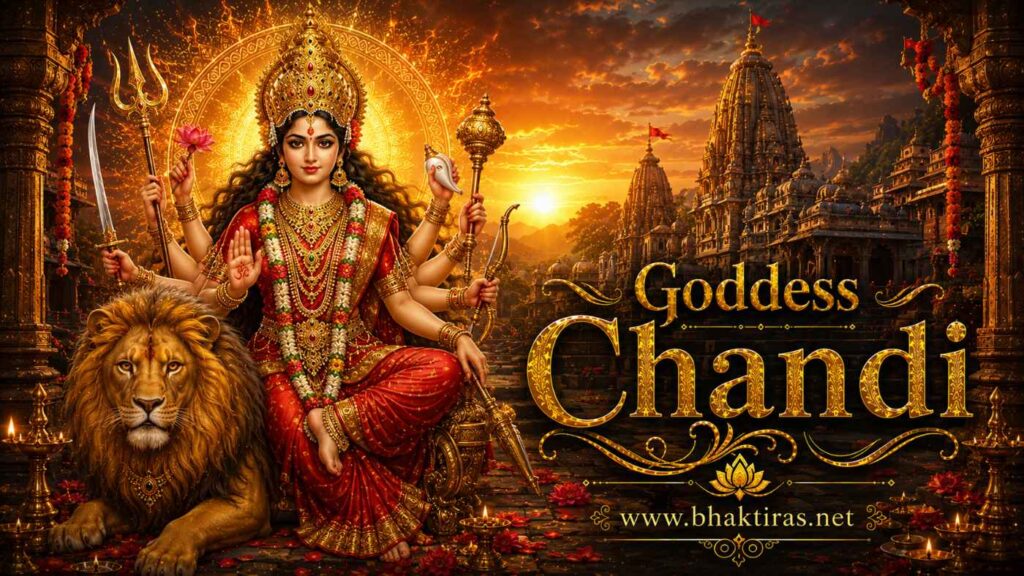
Chandi, also called Chandika, is the fierce warrior form of Goddess Durga and the central deity of the Devi Mahatmya. Riding a lion and carrying the weapons of all the gods, she destroys the demons Madhu-Kaitabha, Mahishasura and Shumbha-Nishumbha. As Mangala Chandi in Bengal, she is also a gentle household mother who guards the family.
Who Is Goddess Chandi
Chandi is the goddess who arrives when the world has run out of other rescuers. When demons grow too strong for even the gods to hold back, it is she who steps onto the battlefield, lion beneath her and every divine weapon in her many hands. Her name carries the sense of one who burns with righteous fury – fierce, unstoppable, impossible to bargain with.Yet to call her only a warrior would miss half of who she is. Chandi is Durga in her battle-blazing aspect, and Durga is Adi Shakti, the primordial energy from which all things come. She is not a lesser deity borrowing power from the male gods; the story tells us they pour their power into her because she alone can wield it. In Bengal, the same goddess is invoked softly as Mangala Chandi, the mother who looks after the health of children and the peace of a home. Fierce protector of the cosmos, tender guardian of the household – both are true at once.The Goddess of the Devi Mahatmya
The heart of Chandi worship is a single sacred text: the Devi Mahatmya, also known as the Durga Saptashati or, most affectionately, the Chandi Path. It sits within the Markandeya Purana and runs to seven hundred verses across thirteen chapters, which is why it is called Saptashati, meaning seven hundred.What makes this text so beloved is its frame. It is told as a story within a story – a dethroned king and a betrayed merchant, both wandering in grief, come to a sage who explains that their sorrow is the work of Mahamaya, the great illusion who is also the great goddess. To lift them out, he narrates her three great victories. In doing so, the Devi Mahatmya became the first Sanskrit scripture to treat the Goddess as the supreme reality rather than a consort or helper. To recite the Chandi Path is to walk through those seven hundred verses and stand, again and again, on the side of light.The Three Great Battles
The Devi Mahatmya is built around three episodes, each answering a moment when evil threatens to swallow the cosmos. Together they show the full range of the goddess – cunning, courage, and overwhelming force.- Madhu and Kaitabha: At the dawn of creation, while Vishnu sleeps on the cosmic ocean, two demons born of his slumber rise to kill Brahma. It is the goddess as Yoganidra, the sleep of yoga herself, who withdraws from Vishnu so that he may wake, then confuses the demons until they are slain. Here she is the hidden power behind creation itself.
- Mahishasura: The buffalo-demon Mahishasura, granted near-invincibility, drives the gods from heaven. Their combined anger streams out as light and forms a single radiant woman – Durga in her Chandika form. She receives a weapon from each god, mounts her lion, and after a shape-shifting duel pins the buffalo down and strikes off its head. This is her most famous victory, celebrated across India as Mahishasuramardini.
- Shumbha and Nishumbha: Two demon brothers demand the goddess as a bride. She refuses, and in the battle that follows she emerges as Kaushiki from Parvati’s own body and calls forth the terrifying Chamunda to devour the demon horde. When her enemies accuse her of relying on helpers, she absorbs them all back into herself and declares, I am alone here in the world – showing that every form of shakti is finally one.
The Chandi Path and Chandi Homa
Among all Shakta practices, few carry the reputation of the Chandi Path. Reciting the full seven hundred verses of the Durga Saptashati is considered one of the most powerful things a devotee can undertake, especially during the nine nights of Navaratri.The recitation is often framed by three companion texts – the Kavach (armour), Argala (bolt), and Keelak (nail) – which prepare and seal the practice. Devotees may read the whole path in one sitting, spread it across the nine days, or chant chosen chapters for a specific need. For larger intentions, families and temples perform the Chandi Homa, a fire ritual in which the verses are offered into flames along with ghee and herbs. The Homa is turned to when the obstacle is great and ordinary effort has failed – for the protection of a household, recovery from illness, or the clearing of long-standing troubles. What both practices share is a spirit of surrender: placing the fight into the hands of the one who has never lost a battle.Mangala Chandi – the Gentle Household Mother
In Bengal and parts of eastern India, the same goddess who splits demons in two is welcomed into ordinary homes under a softer name: Mangala Chandi, the Chandi of wellbeing. Here her blazing edge cools into the warmth of a mother watching over her children.Tuesday is her day. On Tuesdays women gather to offer her simple food, light a lamp, and ask for the things that hold a family together – the health of a child, a safe pregnancy, enough in the house, protection from harm and quarrel. Folk songs and vrata-kathas (vow-tales) tell of merchants and mothers whose fortunes turned when they honoured her and faltered when they forgot. This gentle form does not contradict the fierce one; it completes it. The power that guards the cosmos is the same power that keeps a lamp burning at a family’s threshold, and Bengal has always loved her for being both.Iconography & Symbols
Chandi’s image is meant to be read, not merely admired. Every arm and emblem points back to a story or a truth.The Lion
Her mount is a lion, sometimes a tiger – the wild strength of nature harnessed to a divine purpose. To ride the lion is to rule fearlessness itself, and it marks her as the one force even the fiercest creature obeys.
The Weapons of All the Gods
Her many hands carry Shiva’s trident, Vishnu’s discus, Indra’s thunderbolt, Varuna’s conch, the sword (khadga), the bow, and the noose (pasha). Each was given by a god, so her arms hold the united power of heaven – she fights as all of them at once.
The Blazing Light
In the Devi Mahatmya she is born from the merged radiance of the gods, so she is often shown haloed or golden, too bright to look at directly. The light signals that she is not made of matter but of pure energy, shakti taking form.
The Severed Demon
At her feet lies the fallen buffalo-demon, often with his human form emerging from the beheaded buffalo. It is not cruelty on display but the plain message of the text: under her, no evil survives.
How Goddess Chandi Is Worshipped
Worship of Chandi ranges from the grand and communal to the quiet and domestic. A devotee can approach her through elaborate ritual or a single sincere lamp.- Reciting the Chandi Path (Durga Saptashati) during Navaratri, either the full seven hundred verses or selected chapters
- Performing the Chandi Homa, a fire ritual offering the verses into flames for protection and the removal of great obstacles
- Chanting the Chandi Mantra, Om Aim Hreem Kleem Chamundayai Vichche, on a mala
- Keeping the Mangala Chandi vrata on Tuesdays for the health and prosperity of the family
- Offering red flowers such as hibiscus, along with sindoor, incense and lamps at her image
- Joining Durga Puja and Navaratri pandals where she is honoured as Mahishasuramardini
- Reading the companion hymns – Kavach, Argala and Keelak – before and after the main recitation
Temples & Sacred Sites
Because Chandi is Durga in her fierce aspect, her shrines overlap with the great Devi temples of India, and many hilltop and forest sanctuaries carry her name directly.- Chandi Devi Temple, Haridwar (Uttarakhand) – a Shakti shrine on Neel Parvat, one of the Siddha Peethas of the region
- Chandika Devi and Chandi shrines scattered across the hills of Uttarakhand and Himachal Pradesh
- Mangala Chandi temples and household shrines throughout Bengal, especially active on Tuesdays
- The fifty-one Shakti Peethas, where the fierce forms of the goddess are venerated across the subcontinent
- Durga temples and Navaratri pandals nationwide, where the Chandi Path is recited during the festival
- Chandi Sthans in eastern India honoured as the presiding protector of village and clan
Prayers & Mantras
Chandi’s mantras are among the most potent in the Shakta tradition. Chanted with attention, they are said to build a shield of protection around the devotee. The most widely used is the Navarna Mantra, the nine-syllable seed of the goddess.Navarna Mantra
ॐ ऐं ह्रीं क्लीं चामुण्डायै विच्चे
Om Aim Hreem Kleem Chamundayai Vichche
This nine-syllable mantra weaves together three seed-sounds – Aim for the power of wisdom (Saraswati), Hreem for the sustaining power (Lakshmi), and Kleem for creative energy (Kali) – and offers them to Chamunda, the fierce goddess who devours all darkness. Devotees chant it before reciting the Chandi Path, or on its own as daily protection. A simple invocation many keep on their lips is Ya Devi Sarvabhuteshu Shakti-rupena Samsthita, Namastasyai Namastasyai Namastasyai Namo Namah – salutations to the Goddess who dwells in all beings as power itself.
Frequently Asked Questions about Goddess Chandi
Who is Goddess Chandi?
Chandi, also called Chandika, is the fierce warrior form of Goddess Durga and the central deity of the Devi Mahatmya. Riding a lion and carrying the weapons of all the gods, she slays the demons Madhu-Kaitabha, Mahishasura and Shumbha-Nishumbha. She is Adi Shakti, the primordial power, in her battle-blazing aspect.
What is the Chandi Path?
The Chandi Path is the recitation of the Devi Mahatmya, also known as the Durga Saptashati – a set of seven hundred verses within the Markandeya Purana. It narrates the goddess's three great victories over demons. Reciting it, especially during Navaratri, is considered one of the most powerful of all Shakta practices.
What is the difference between Chandi and Durga?
They are not separate goddesses. Durga is the broad name for the supreme goddess, while Chandi is Durga specifically in her fierce, demon-slaying aspect on the battlefield. When the goddess grows wrathful to destroy evil, the texts call her Chandi or Chandika. Every Chandi is Durga; the name simply emphasises her ferocity.
What is the Chandi Homa?
The Chandi Homa is a fire ritual in which the verses of the Durga Saptashati are offered into a sacred flame along with ghee and herbs. Families and temples perform it for protection, healing, and the removal of great obstacles – usually when the difficulty is serious and ordinary effort has not been enough.
Who is Mangala Chandi?
Mangala Chandi is the gentle, benevolent form of Chandi worshipped in Bengal and eastern India. Invoked on Tuesdays, she is the household mother who guards the health of children, the wellbeing of the family and the prosperity of the home. She is the same goddess as the fierce Chandi, seen in her caring aspect.
Which demons does Chandi defeat in the Devi Mahatmya?
The Devi Mahatmya recounts three victories. She helps destroy Madhu and Kaitabha at the dawn of creation, slays the buffalo-demon Mahishasura who had driven the gods from heaven, and defeats the brothers Shumbha and Nishumbha along with their generals. Together these show she can overcome evil in every form.
When is Goddess Chandi worshipped?
Chandi is worshipped most intensely during Navaratri and Durga Puja, when the Chandi Path is recited over the nine nights. In her Mangala Chandi form she is honoured every Tuesday. Devotees also perform the Chandi Homa at any time when they seek strong protection or the removal of major obstacles.
May Goddess Chandi guard you as she guards the cosmos – fierce against every darkness, tender at the threshold of your home.