
Goddess Satyabhama
सत्यभामा
Satyabhama is the spirited third chief queen of Krishna at Dwarka and the daughter of the Yadava noble Satrajit. She is honoured as an incarnation of Bhudevi, the Earth goddess. Proud, passionate and fiercely devoted, she rode into battle beside Krishna to end the demon Narakasura and is remembered for the Parijata tree and Syamantaka jewel stories.
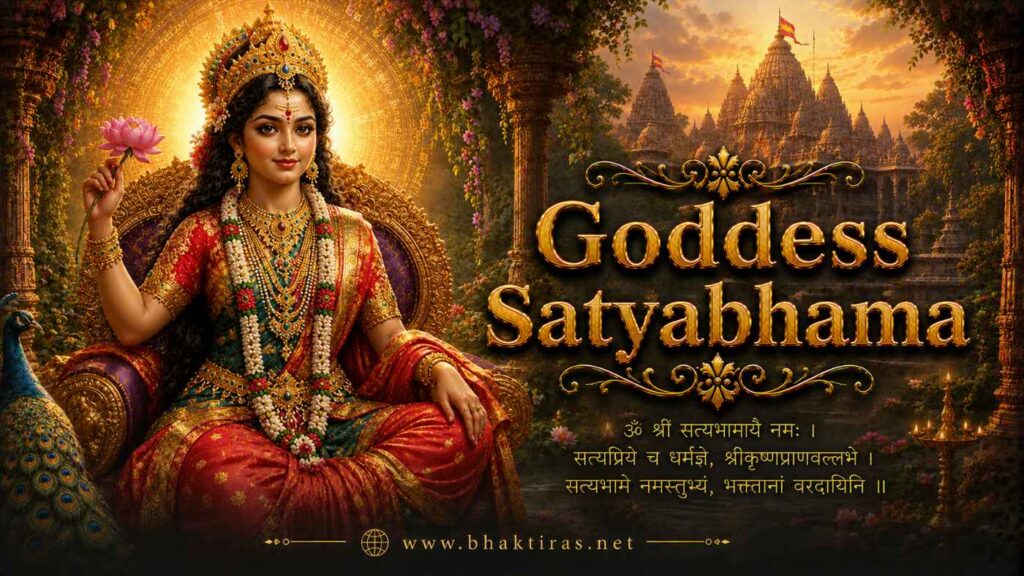
Who Is Goddess Satyabhama?
Satyabhama is the third of Krishna’s eight chief queens, the Ashtabharya, and among the most vividly drawn women in the Bhagavata Purana. Where Rukmini is gentle and self-effacing, Satyabhama is bold, quick-tempered and openly proud of Krishna’s love for her. She speaks her mind, expects to be cherished, and gives her heart without reserve. That warmth and fire together make her feel remarkably human.
She was born a princess of Dwarka, the daughter of Satrajit, a wealthy Yadava who owned the radiant Syamantaka jewel. Her marriage to Krishna grew out of the tangled story of that gem, and from the start she was a partner who could stand at his shoulder rather than behind him.
What sets Satyabhama apart from an ordinary queen is her divine identity. Tradition names her an incarnation of Bhudevi, the goddess who is the Earth itself. This is not a decorative title. It becomes the pivot of her greatest deed, when the Earth-born queen is the one destined to end an Earth-born demon.
Across the Puranas she appears as a woman who loves fiercely, sulks openly, argues, forgives, and grows. Her pride is real, and so is the lesson she is gently taught about it.
An Incarnation of the Earth Goddess
To understand Satyabhama you have to look past the palace at Dwarka to something far older. Hindu tradition holds that she is the human descent of Bhudevi, the goddess of the Earth, sometimes called Bhumi or Prithvi. Bhudevi is one of the two consorts of Vishnu alongside Shri, and where Shri governs fortune and abundance, Bhudevi is patience, strength and the ground beneath all living things.
This identity shapes how her devotees read her whole life. Her steadiness under pressure, her willingness to bear insult and then rise, her instinct to protect what is hers, all echo the qualities of the Earth herself. The Earth endures, and so does Satyabhama.
The link matters most in the battle against Narakasura. In the older tellings Narakasura was himself a son of Bhudevi, born of the Earth in an earlier age. There is an old rule in these stories that a mother-born power can be undone in the way it was first set, and so it is fitting, almost inevitable, that Bhudevi in her form as Satyabhama should be present at his end. Her role is not a bystander’s. She is written into the demon’s fate.
The Syamantaka Jewel and Her Marriage
A gem that made trouble
Satrajit, Satyabhama’s father, worshipped Surya the sun god and received from him the Syamantaka, a jewel that shone like a small sun and produced gold each day for anyone pure of heart. Satrajit kept it close and, when Krishna suggested it might better serve the whole Yadava community, refused. Pride ran in the family.
A false accusation
One day Satrajit’s brother Prasena took the jewel out hunting and was killed by a lion, which in turn was slain by Jambavan, the bear-king, who carried the gem to his cave. When Prasena did not return, Satrajit whispered that Krishna, who had once wanted the jewel, must have stolen it. The slander stung Krishna deeply.
Setting the record straight
To clear his name Krishna tracked the jewel to Jambavan’s cave, fought the mighty bear for days, and won not only the Syamantaka but Jambavan’s respect and his daughter Jambavati in marriage. Krishna returned the gem to a shame-faced Satrajit.
The marriage
Overcome with regret for his false accusation, Satrajit offered Krishna both the jewel and his daughter Satyabhama in marriage. Krishna accepted Satyabhama and gently declined to keep the gem. So the woman who would become his warrior-queen came to him not as a prize but as a reconciliation, a bond born out of a wrong made right.
The story is often retold for its twists, but at its heart it explains something about Satyabhama’s character. She entered Krishna’s household carrying her father’s pride and her father’s remorse, and she never quite lost either edge.
Satyabhama and the Slaying of Narakasura
The demon king Narakasura of Pragjyotisha had grown monstrous in power. He had seized the earrings of Aditi, mother of the gods, taken the parasol of Varuna, and imprisoned sixteen thousand women in his fortress. When the gods appealed to Krishna, he set out to end the tyrant, and Satyabhama would not be left behind.
She rides to war
Satyabhama mounted Garuda alongside Krishna and rode straight into the demon’s realm. This is one of the rare images in the Puranas of a queen in armour at the front of battle, and it is entirely in character for her. When Krishna paused, wounded or feigning weariness in some tellings, it was Satyabhama who took up the bow and pressed the fight, refusing to let the demon gain the field.
The blow that had to be hers
Because Narakasura had a boon that he could die only at the hand of his mother, and because Satyabhama was Bhudevi, the Earth-mother herself, the final blow fell as it was fated to fall. In many versions Satyabhama looses the arrow that ends him, fulfilling the very condition of his protection. The Earth reclaimed what had grown from her.
A festival remembered
Narakasura’s defeat is remembered each year as Naraka Chaturdashi, the day before the main night of Diwali, celebrated as the victory of light over a cruel darkness. The freed women were given honour and shelter, and the stolen treasures of heaven were restored.
No other queen of Krishna is shown fighting at his side like this. The Narakasura story is where Satyabhama’s two identities, proud princess and Earth goddess, meet in a single decisive act.
The Parijata Tree and the Tulabharam
If the battle shows Satyabhama’s strength, two quieter stories show her heart, her jealousy and, in the end, her growth.
The Parijata flower
The sage Narada, who enjoyed stirring gentle mischief among Krishna’s queens, once brought a single celestial Parijata blossom and gave it to Rukmini. Its heavenly fragrance filled the palace, and when Satyabhama learned of the gift she was hurt and indignant. To prove his love, Krishna travelled to Indra’s heaven and brought back the whole Parijata tree, planting it so that its flowers fell into Satyabhama’s courtyard while its shade reached Rukmini’s. Even his affection, the story hints, kept a careful balance between his queens.
The weighing of Krishna
The Tulabharam tale, again set going by Narada, tested Satyabhama’s pride directly. She agreed to give Krishna’s weight in gold to win him in a mock ritual of devotion. All her jewels and gold were heaped on one pan, yet the scale would not lift Krishna’s side. Only when Rukmini placed a single tulsi leaf, offered with pure love, did the balance move. Wealth and pride could not weigh him. Simple devotion could.
These stories are told with affection, never cruelty. Satyabhama is not humiliated so much as taught, and the lesson she receives, that love given humbly outweighs love that demands, is one every devotee is meant to take to heart.
Satyabhama and Rukmini – Two Sides of Devotion
Satyabhama is almost always spoken of together with Rukmini, and the pairing is deliberate. The two queens are drawn as opposites so that between them they show the whole shape of love for the divine.
Rukmini is the model of quiet surrender. She loves without asking for proof, serves without seeking praise, and it is her humble tulsi leaf that outweighs a mountain of gold. She is often linked with Lakshmi, the goddess of grace and fortune.
Satyabhama is love with its guard up and its heart wide open. She wants to be told she is cherished, she competes, she pouts, she demands the Parijata for her own courtyard. And yet her devotion is no less true, only louder and more human. As Bhudevi she carries the strength of the Earth, and when it matters most she fights for her lord with a bow in her hands.
Together they teach that the path to the divine has room for both temperaments, the still soul and the fiery one. Satyabhama reminds us that passion, pride and even jealousy can be turned toward God, and that the Earth-born heart, once it learns humility, loves with its whole force.
How Goddess Satyabhama Is Remembered
Satyabhama lives on in worship, story and stage far beyond the pages of the Puranas. She is remembered in these ways:
- As one of the Ashtabharya, the eight chief queens of Krishna, honoured together in Dwarka and in Vaishnava tradition across India.
- Beside Krishna in temple iconography, especially in images of the Narakasura battle where she rides Garuda with him.
- Through the festival of Naraka Chaturdashi, the pre-Diwali day that recalls the demon’s defeat and the freeing of his captives.
- In the classical Parijatapaharanam theme, the bringing of the Parijata tree, retold in Sanskrit poetry, dance-drama and Yakshagana.
- In devotional retellings of the Tulabharam, cited whenever teachers wish to show that humble love outweighs proud offering.
- As an emblem of the strong, spirited woman in bhakti literature, loved for her very human flaws as much as her courage.
Her appeal is that she is not a distant, flawless figure. Devotees see their own pride, longing and love reflected in her, and take comfort that even these can be offered to the divine.
Prayers and Mantras
Satyabhama is most often invoked alongside Krishna, in her aspect as his beloved queen and as Bhudevi, the Earth goddess. A simple salutation names and honours her:
ॐ सत्यभामायै नमः
Om Satyabhamayai Namah
“I bow to Satyabhama.”
Devotees also honour her Earth-goddess nature through Bhudevi, praying for patience, endurance and the strength to bear life’s burdens with grace, and asking that pride be softened into loving humility, the very lesson her own stories carry.
Offered with a sincere heart, even the shortest of these salutations is held to draw the warmth of the queen who loved Krishna without holding anything back.
Frequently Asked Questions about Goddess Satyabhama
Who is Satyabhama?
Satyabhama is the third of Krishna's eight chief queens at Dwarka and the daughter of the Yadava noble Satrajit. She is honoured as an incarnation of Bhudevi, the Earth goddess, and is remembered as a spirited, proud and deeply devoted queen who even rode into battle at Krishna's side.
Which goddess is Satyabhama an avatar of?
Satyabhama is regarded as an incarnation of Bhudevi, the Earth goddess, one of the consorts of Vishnu. This identity is central to her story, since it is as the Earth-mother that she is able to bring about the death of the Earth-born demon Narakasura.
How did Satyabhama marry Krishna?
Her marriage came out of the Syamantaka jewel episode. Her father Satrajit had falsely accused Krishna of stealing the gem. When Krishna proved his innocence and recovered the jewel, a remorseful Satrajit offered his daughter Satyabhama to Krishna in marriage as amends.
What is Satyabhama's role in killing Narakasura?
Narakasura could be killed only by his mother, and because Satyabhama was Bhudevi, the Earth-mother from whom the demon was born, she was destined to end him. She rode into battle on Garuda beside Krishna and, in many tellings, loosed the arrow that fulfilled the demon's fate.
What is the Parijata tree story about Satyabhama?
When Krishna gave a single celestial Parijata blossom to Rukmini, Satyabhama felt slighted. To prove his love, Krishna brought the entire Parijata tree from Indra's heaven and planted it so its flowers fell into Satyabhama's courtyard while its shade reached Rukmini, a gesture of balanced affection between his queens.
What does the Tulabharam story teach?
In the Tulabharam, Satyabhama tried to match Krishna's weight in gold and jewels, but the scale would not move. Only Rukmini's single tulsi leaf, offered in pure love, balanced him. The story teaches that humble devotion outweighs proud and lavish offerings.
How is Satyabhama different from Rukmini?
Rukmini is gentle, self-effacing and quietly surrendered, often linked with Lakshmi. Satyabhama is bold, proud and openly passionate, linked with Bhudevi. Together they show two valid temperaments of devotion, the still soul and the fiery one, both turned wholly toward the divine.
May Satyabhama’s warmth, her fearless heart and her hard-won humility bless every home that remembers her.