
Radha Rani
राधा
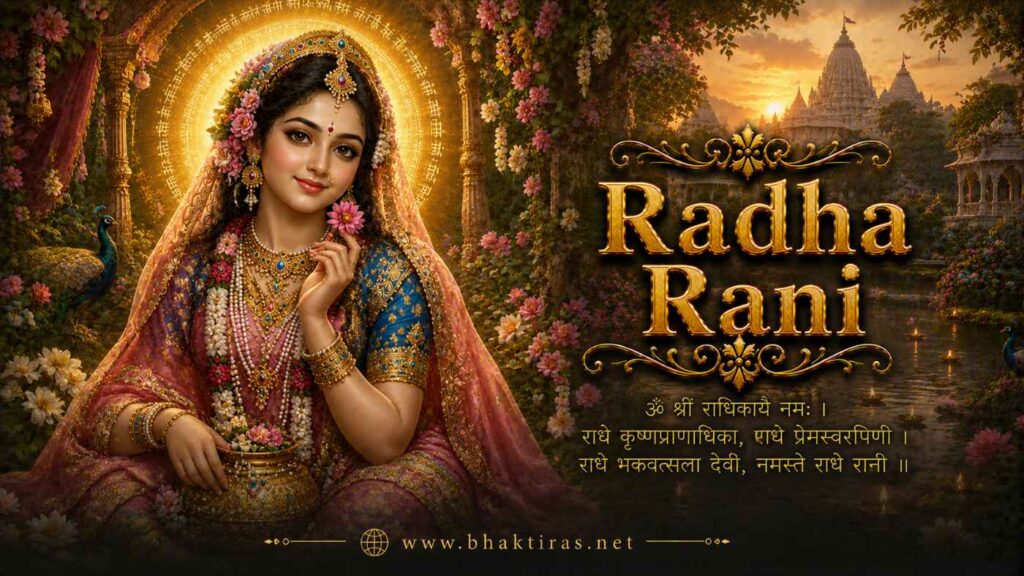
Radha Rani is the beloved of Krishna and the foremost gopi of Braj, worshipped as the very form of divine love and devotion. In Gaudiya Vaishnava theology she is Krishna's hladini shakti, his own bliss-energy, so that Radha and Krishna are one reality. Her festival is Radhashtami, and devotees greet each other with Radhe-Radhe.
Who Is Radha Rani?
Radha Rani is the beloved of Krishna, the young cowherd girl of Braj whose love for him became the highest measure of devotion a soul can offer. She was the daughter of Vrishabhanu and his wife Kirti, born in the village of Barsana on the low hills across the Yamuna from Vrindavan. Because she is the daughter of Vrishabhanu, she carries the tender name Vrishabhanuja. To the people of Braj she is simply Kishori – the young girl – or Radhe, a name they call out morning and evening as both greeting and prayer.
Yet Radha is far more than a figure in a village story. In the devotional heart of Hinduism she is the personification of prema, love without condition or calculation, and the model of bhakti, the soul turning wholly toward God. Where other forms of the Goddess show power, protection, or wisdom, Radha shows the sweetness of longing. Her worship is soft rather than fearsome, intimate rather than distant.
The Puranas that tell of her – chiefly the Brahmavaivarta and the Padma – place her at Krishna’s side not as one companion among many, but as his equal and his source of joy. The great lyric poem Gita Govinda by Jayadeva sings her love and her separation in verses still recited in temples eight centuries later. And in the songs of Braj, no gopi is named before Radha, for she gathers all their love into herself.
Radha and Krishna – Two Halves of One Love
Vaishnava theology gives Radha a place that goes beyond romance or companionship. She is described as Krishna’s hladini shakti – his own power of bliss and delight. Krishna is the source of all joy, and Radha is that joy made a person. Just as sweetness cannot be separated from sugar, or heat from fire, Radha cannot be separated from Krishna. They are not two beings who meet, but one reality that has become two so that love can flow between them.
This is why Braj speaks of Radha first. Devotees say Radhe-Krishna and Radhe-Shyam, placing her name before his, and they worship him as Radha-Vallabha, ‘the beloved of Radha’, and Radha-Ramana, ‘the one who delights Radha’. To honour Radha is understood as the surest way to reach Krishna, because it is through her love that he is best known. She is the door, the mood, and the offering all at once.
In the fullest reading of the Brahmavaivarta Purana, Radha is the feminine half of the one Godhead – Krishna’s shakti through whom the whole world of divine play unfolds. The love between them is not human affection projected onto heaven, but the eternal exchange of joy at the very root of existence. Human love, the tradition says, is only a faint shadow of that.
The Love of Vrindavan and the Raas Leela
The setting of Radha’s story is Braj – the groves of Vrindavan, the flowering meadows along the Yamuna, the hills of Barsana and Nandgaon. Here Krishna spent his boyhood among the cowherds, playing his flute at dusk. When its sound drifted across the fields, the gopis left their homes and their duties and followed it into the forest, forgetting everything but him. Among them Radha’s love burned brightest.
The high point of this love is the raas leela, the great circular dance on the autumn full-moon night. Krishna multiplied himself so that he danced beside each gopi at once, yet at the centre of it all was Radha. Devotional readers understand the raas not as an ordinary dance but as the soul’s union with God, freely given and freely received, where the self forgets itself entirely in the beloved.
The stories of Braj also keep the small, human touches that make the love so tender – Radha waiting in a bower for Krishna who is late, the two of them quarrelling and making peace, Krishna stealing butter and Radha’s smile, the teasing of the gopis at the riverbank. These moments, carried in songs and paintings for centuries, hold both a lover’s play and a deep spiritual meaning: God comes close, hides, is sought, and is found again.
Radha as the Soul's Longing for God
What raises Radha above every other lover in Hindu devotion is not her union with Krishna but her separation from him – what the tradition calls viraha. When Krishna left Vrindavan for Mathura and then Dwarka, Radha remained behind, and her longing became the deepest teaching of the whole story. She did not follow him or fade away; she carried his absence as a fire that only burned brighter with time.
In the eyes of the devotee, this viraha is the truest form of love. To want God so completely that his absence becomes a kind of presence, to weep for him and find that the weeping itself is sweet – this is the state the bhakti tradition holds highest. Radha’s tears are not sorrow at loss but the ache of a heart that has room for nothing else. Her longing is offered as the map for every soul that seeks the divine.
The Gita Govinda gives voice to this mood in verse after verse, moving between meeting and parting, joy and yearning. When devotees sing those lines, they are not only remembering a love from long ago; they are asking their own hearts to long that way – to place God so far above all else that his coming would be their only joy and his absence their only pain.
Radha in the Gaudiya Tradition
No movement exalted Radha more than the Gaudiya Vaishnava tradition founded by Chaitanya Mahaprabhu in sixteenth-century Bengal. Chaitanya taught that the love of the gopis, and above all the love of Radha, is the highest form of devotion any soul can reach – higher than reverence, higher than servitude, higher even than friendship with God. It is love given for its own sake, wanting nothing in return.
Chaitanya’s followers understood him as Krishna himself who had taken on the mood and golden complexion of Radha, so as to taste from the inside the love she felt for him. From this came the practice of raganuga bhakti – devotion that follows the heart of the gopis, entering their longing rather than merely admiring it. The name of Radha is chanted alongside Krishna’s, and the Hare Krishna prayer itself carries this tradition across the world.
Through these teachers – Rupa Goswami, Sanatana Goswami, and the saints who settled in Vrindavan – the theology of Radha’s love was written down in careful detail, and the sacred sites of Braj were rediscovered and restored. Their work is why Vrindavan today is filled with temples to the divine couple, and why the sweetness of Radha bhakti still flows so strongly there.
Radhashtami and the Festivals of Braj
Radha’s own festival is Radhashtami, kept on the eighth day of the bright half of the month of Bhadrapada, a fortnight after Krishna Janmashtami. It marks her appearance in Barsana, and on this day her birthplace fills with pilgrims. Her image is bathed, dressed in fresh finery, and offered sweets and flowers, while devotees fast until noon – the hour of her birth – and sing her glories. In many temples the deity of Radha, usually kept a little veiled, is shown more openly on this one day.
Beyond her own festival, Radha is present in every celebration of Krishna, for the two are never truly worshipped apart. The most joyous of these is Holi, and nowhere is it more famous than in Barsana, where the women re-enact an old teasing between the villages of Radha and Krishna. In the Lathmar Holi the women of Barsana playfully drive back the men of Nandgaon with sticks, and the streets run with colour and laughter for days. It is love turned into festival, the whole town playing out the play of the gods.
Janmashtami, Sharad Purnima – the night of the raas dance – and the many seasonal swings and flower festivals of Vrindavan all keep Radha at their centre. In Braj the calendar itself is a long remembrance of the love between Radha and Krishna, and the pilgrim who walks its paths walks through their story.
How Radha Rani Is Worshipped
Radha is almost always worshipped together with Krishna, the two standing side by side as the complete divine couple. Her worship is gentle and full of feeling, less about ritual precision than about the mood of love the devotee brings. These are the ways her presence is kept:
- Greeting one another with Radhe-Radhe or Jai Shri Radhe – a name used across Braj as both hello and blessing.
- Chanting Radhe-Krishna and Radhe-Shyam, placing her name first as a mark of devotion.
- Offering flowers, tulsi leaves, sweets, and butter to the joined images of Radha-Krishna, especially in the evening arti.
- Singing bhajans and the verses of the Gita Govinda that tell of her love and her longing.
- Fasting and keeping vigil on Radhashtami, breaking the fast at midday in honour of her birth.
- Walking the Braj parikrama – the pilgrim paths of Barsana, Vrindavan, and the Yamuna where her story unfolded.
- Repeating the simple mantra Om Radhayai Namah to hold her name and love in the heart.
Temples & Sacred Sites
The whole of Braj is Radha’s shrine, but a few places hold her presence with special warmth. Pilgrims move between them through the year, following the paths of her story:
- Barsana – Radha’s birthplace, crowned by the Radha Rani temple on its hill, the heart of her worship and the home of Lathmar Holi.
- Banke Bihari, Vrindavan – one of the most loved temples of the divine couple, where the deity’s darshan is given in brief, curtained glimpses.
- Radha Vallabh, Vrindavan – the temple of Krishna as ‘the beloved of Radha’, where she is honoured through his very name.
- Prem Mandir, Vrindavan – a modern marble temple of Radha-Krishna, glowing with light and carved with scenes from their life.
- Radha Raman, Vrindavan – a centuries-old Gaudiya shrine, tended in the same tender tradition since the time of the Goswamis.
- Rawal – the village near Gokul which some traditions honour as Radha’s place of birth.
Prayers & Mantras
Radha’s mantras are short and full of feeling, meant to be repeated softly until the name itself becomes love. The simplest and most cherished is this:
ॐ राधायै नमः
Om Radhayai Namah
‘I bow to Radha’ – an offering of the whole heart to the beloved of Krishna, and through her love, to Krishna himself. Many devotees also join her name to his and chant राधे कृष्ण (Radhe Krishna) or जय श्री राधे (Jai Shri Radhe), holding the two together as one, which is how Braj has always known them.
Frequently Asked Questions about Radha Rani
Who is Radha?
Radha is the beloved of Krishna and the foremost gopi of Braj, born in Barsana to Vrishabhanu and Kirti. She is worshipped as the embodiment of divine love and pure devotion, and in Vaishnava theology she is Krishna's hladini shakti – his own energy of bliss and his inseparable other half.
Were Radha and Krishna married?
In most traditions Radha and Krishna were not married in the ordinary sense; their love belongs to a higher order than worldly ties. Some texts speak of a divine union, but devotees hold that their bond is eternal and spiritual, above marriage – the union of the soul with God rather than a household relationship.
Why do we say Radhe-Krishna with Radha first?
Radha's name is placed first as a sign of devotion and because, in Vaishnava thought, her love is the surest path to Krishna. Honouring her is understood to please him most, since she is his own bliss-energy. To reach Krishna, the tradition says, one goes through the love of Radha.
What does hladini shakti mean?
Hladini shakti means the power of bliss or delight. Krishna is the source of all joy, and Radha is that joy made a person. As sweetness cannot be parted from sugar, Radha cannot be parted from Krishna – she is his own energy of happiness, which is why the two are seen as one reality in two forms.
When is Radhashtami celebrated?
Radhashtami falls on the eighth day of the bright half of the month of Bhadrapada, a fortnight after Krishna Janmashtami, usually in August or September. It marks Radha's appearance in Barsana. Devotees fast until noon, the hour of her birth, then bathe and dress her image and offer sweets and songs.
Where was Radha born?
Radha is most widely believed to have been born in Barsana, the hilltop village in the Braj region, as the daughter of Vrishabhanu and Kirti. Some traditions instead name Rawal, a village near Gokul, as her birthplace. Barsana today is the great centre of her worship.
What is the raas leela?
The raas leela is the great circular dance of Krishna with the gopis on an autumn full-moon night in Vrindavan. Krishna appeared beside each gopi at once, yet Radha was at its centre. Devotees read it not as an ordinary dance but as the soul's joyful, self-forgetting union with God.
Why is Radha central to Krishna worship?
Because Radha and Krishna are understood as one divine reality – he the source of joy, she that joy embodied. The two are almost never worshipped apart, and temples across Braj enshrine them together as the divine couple. Radha's love is held up as the highest devotion, so honouring her is honouring Krishna.
May the name of Radhe be sweet on your lips and her love soft in your heart – Radhe Radhe.