
Goddess Dhumavati
धूमावती
Dhumavati is the seventh Mahavidya, the smoky elder-widow goddess who embodies the void, dissolution and detachment. Behind her stark appearance she is a wise grandmother who teaches acceptance of loss, freedom from craving, and the calm that comes when we stop clinging. Devotees revere her as a giver of moksha and a quiet remover of sorrow.
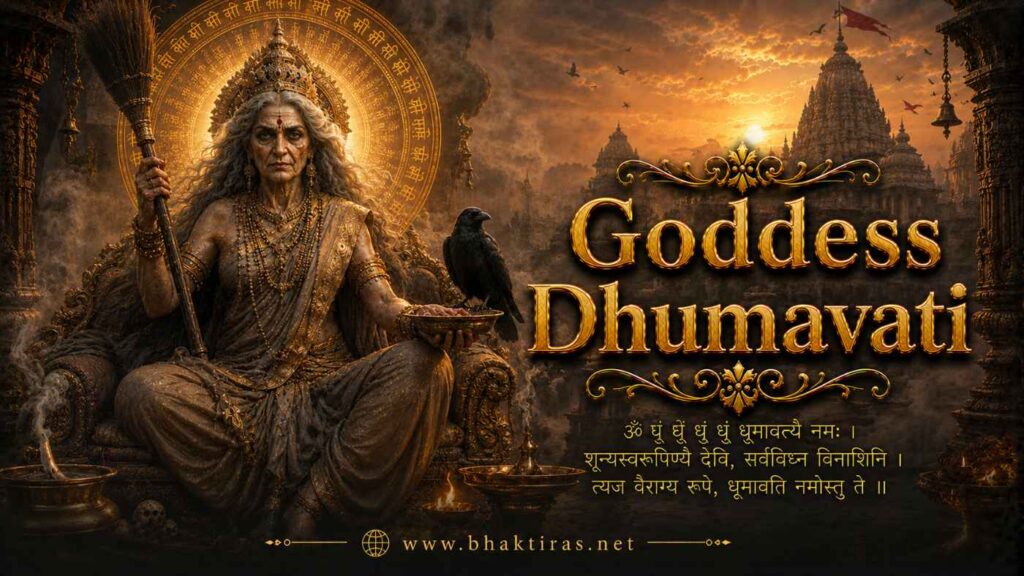
Who Is Goddess Dhumavati?
Dhumavati is the seventh of the ten Mahavidyas, the great wisdom goddesses of the Tantric path. She appears as an old woman, thin and pale, her hair loose and grey, seated on a chariot that has no horses to pull it. In one hand she holds a winnowing basket, the humble tool a village woman uses to separate grain from chaff. A crow perches on her banner. She is smoke given form, and her name simply means ‘the smoky one’.It is easy, at first glance, to call her a goddess of misfortune. Loss, hunger, disappointment, old age and death all gather around her. But this is a shallow reading. Dhumavati does not cause these things; she is the truth of them. Everything that lives will one day fade, and she is the face of that fading. To meet her is to meet the part of life we usually turn away from – and to learn that it, too, has a teacher’s kindness in it. She is less a bringer of bad luck than a fierce old grandmother who tells you what no one else will, and loves you enough to do it. Those who sit with her find that the fear of loss loosens its grip, and what remains is a strange, steady freedom.The Wisdom of the Void
At the heart of Dhumavati’s teaching is emptiness – not as despair, but as spaciousness. She is the goddess of the void, the great silence that comes before creation and returns after every ending. Smoke is her perfect symbol: it has no fixed shape, it drifts, it dissolves, it cannot be grasped. When we try to hold it, it slips away. Dhumavati asks us to notice how much of our suffering comes from trying to hold what was always meant to pass. She teaches the hard, honest truths of life plainly. Bodies age. Friends leave. Fortunes turn. Hunger is real. Rather than promise that these will never touch us, she offers something steadier – the ability to stand within them without breaking. Her detachment is not coldness. It is the calm of someone who has already let go, who has grieved fully and come out the far side with nothing left to fear. In her presence the mind stops bargaining with reality and simply rests. That rest is the beginning of true freedom, and it is why the Tantras count her among the great givers of liberation.The Story of Her Origin
The best-loved account of Dhumavati’s birth is told about the goddess Sati, the first wife of Shiva.The hunger that could not be fed
The story goes that Sati was overcome by a fierce, consuming hunger. She asked Shiva again and again for something to eat, and he, lost in his own meditation, kept putting her off. At last her hunger grew so vast that she swallowed Shiva himself, drawing the great god into her body. When Shiva pressed her to release him, she opened her mouth and let him out – and from that act something changed forever. By swallowing her own husband she had become a widow. The smoke of that hunger and that loss rose up and clothed her, and she took the pale, ageing, solitary form of Dhumavati.
Why the story matters
The tale is not really about a quarrel over food. It speaks of desire so complete that it consumes even the divine, and of the widowhood, the emptiness, that follows when every craving has finally been spent. Dhumavati is what remains after the fire of wanting has burnt through everything. She is smoke, not flame – the still, grey aftermath in which nothing is left to lose. Her widowhood is not shame but freedom: having given up even her husband, she belongs to no one and answers to nothing. That total independence is the source of her power.
Iconography and Symbols
Every detail of Dhumavati’s form is a teaching. Her image is meant to unsettle the comfortable mind and then, gently, to free it.The smoke
Her name and her body are smoke. It rises from what has been burnt, has no shape of its own, and always dissolves. Smoke reminds the worshipper that all forms are passing, and that clinging to any of them is the root of sorrow.
The crow
A crow rides on her banner and serves as her vehicle. Long linked with death, cremation grounds and the ancestors, the crow is a bird most people shoo away. Dhumavati honours it, teaching that nothing in creation is truly outcast or unclean.
The winnowing basket
She holds a soop, the flat basket used to toss grain in the air so the wind carries off the useless husk. It is her most tender symbol: she separates the real from the false in our lives, letting the chaff of illusion blow away so only what matters is left in the hand.
The horseless chariot
Her chariot has no horses, yet it moves. This is the paradox of one who needs nothing outside herself to act. She is complete in her emptiness, unmoved by the usual engines of desire that drive the rest of the world forward.
Old age and white garments
She is depicted as elderly, thin and dressed in plain, faded white – the colours of a widow. Where other goddesses shine with youth, she wears the honest face of time. Her age is her authority; she has seen everything end and is still here, teaching.
Why Devotees Worship the 'Inauspicious'
It surprises many people that a goddess so linked with loss is worshipped at all – and even more that she is turned to for relief. But this is exactly the paradox at her centre. Because Dhumavati is the fullness of every ending, she has power over endings. Devotees pray to her to bring an end to their sorrow, to cut away troubles that will not otherwise leave, to burn off the weight of old negative karma, and to protect them from enemies and hostile forces. She is called upon in times of grief, poverty and crisis – not to pretend the pain away, but to carry the one who suffers through it and out the other side. There is a deeper reason still. What a soul most wants, beneath every smaller wish, is release – moksha, the end of the whole cycle of grasping and losing. Dhumavati, the goddess of the void, is the direct road to that release. She strips away attachment until the seeker is light enough to be free. Worshipping her is not courting bad luck; it is asking the one who is not afraid of loss to teach us the same fearlessness.Among the Ten Mahavidyas
The ten Mahavidyas are ten forms of the one Great Goddess, each showing a different face of ultimate reality. Kali is time and transformation, Tara the guiding light across dark waters, Tripura Sundari the beauty of the whole world, Bhuvaneshwari its endless space. Within this circle Dhumavati holds a place no other can. Where the others often shine, she smoulders. She is the Mahavidya of the void, of the phase after fullness when everything draws back into stillness. If Kali is the fierce dance of dissolution, Dhumavati is the quiet grey ash that settles once the dance is done. Tantric teachers place her among the fiercer, more secret of the ten, and her worship is treated with great care and respect. Yet she is no less compassionate than her sisters. Each Mahavidya leads the seeker toward the same freedom by a different door; Dhumavati’s door is the one marked acceptance. She teaches that the wisdom found in emptiness is as holy as the wisdom found in light, and that a soul is not complete until it has learned to love even the dark.How She Is Worshipped
Dhumavati’s worship is quiet, sincere and treated with reverence. Because she is a fierce Mahavidya, her rites are traditionally learned from a qualified teacher, but her core practices are simple and can be offered by any devotee with a steady heart.- Chant her seed mantra Dhum or the fuller Om Dhoom Dhoom Dhumavati Devyai Svaha with a calm, unhurried breath.
- Offer plain and unfussy things – simple grains, black sesame, and offerings without pomp, in keeping with her spare nature.
- Light a lamp and sit in silence before her image, letting the mind release its grievances and fears rather than asking for gain.
- Worship her especially in the evening, in the dark fortnight of the moon, and at times of grief or ending, when her presence is closest.
- Approach her with respect and humility rather than fear; devotees say she is stern to the arrogant but deeply kind to the sincere.
- Reflect on impermanence as part of the practice – reading or contemplating the passing nature of all things is itself an offering she accepts.
Temples and Sacred Sites
Temples to Dhumavati are rare, which suits a goddess who keeps to the edges of things. The most famous is in the ancient city that has always been at home with endings.- Dhumavati Temple, Varanasi – the best-known shrine to the goddess, set in the great city of Kashi on the banks of the Ganga, where life and death sit side by side. Fittingly, she is worshipped here in a place devoted to liberation and the crossing over of souls.
- Small shrines and Tantric peethas across North and Central India also honour her, usually tended by those who follow the Mahavidya path rather than by large public congregations.
- In many Shakta temples she is worshipped within the group of the ten Mahavidyas, taking her place among the great goddesses even where she has no separate shrine of her own.
Prayers and Mantras
Dhumavati’s mantras are short and grave, built around the sound of smoke. Repeated with faith, they are said to quiet grief, loosen attachment and turn the mind toward the freedom she embodies.- Seed mantra: धूं – Dhoom. The single syllable of smoke, chanted to invoke her presence.
- Mool mantra: ॐ धूं धूं धूमावती देव्यै स्वाहा – Om Dhoom Dhoom Dhumavati Devyai Svaha. An offering of the self to the goddess of the void.
Frequently Asked Questions about Goddess Dhumavati
Is Dhumavati inauspicious?
She is often called inauspicious because she embodies loss, old age and endings, but this is a shallow view. Dhumavati is not a bringer of bad luck; she is the honest face of impermanence. Worshipped with respect, she becomes a wise teacher who removes sorrow and grants inner freedom.
Who is Goddess Dhumavati?
Dhumavati is the seventh of the ten Mahavidyas, the great Tantric wisdom goddesses. She appears as a smoky, elderly widow riding a horseless chariot with a crow banner, holding a winnowing basket. She represents the void, dissolution and the wisdom of detachment.
Why is Dhumavati shown as a widow?
Her widowhood comes from the story in which Sati, overcome by hunger, swallowed Shiva and so became a widow, taking on the smoky form of Dhumavati. Her widowhood is not a mark of shame but of total independence: belonging to no one, she is completely free.
What does Dhumavati grant her devotees?
Devotees turn to her for release from grief, freedom from craving, protection from enemies and hostile forces, and the burning away of negative karma. Above all she is honoured as a great giver of moksha, the final liberation, because she is the goddess of endings themselves.
What do her symbols mean?
Smoke shows the passing nature of all forms; the crow honours what others reject; the winnowing basket separates truth from illusion; the horseless chariot shows she needs nothing outside herself; and her old age and white garments express the honest wisdom of time and letting go.
How is Dhumavati worshipped?
Her worship is quiet and sincere, often learned from a qualified teacher. Devotees chant her Dhum mantra, offer simple grains and lamps, and worship her in the evening or dark fortnight. She is approached with humility and reverence rather than fear, and is kind to the sincere.
Where is the main Dhumavati temple?
The most famous shrine is the Dhumavati temple in Varanasi, the ancient city of Kashi on the Ganga, long associated with death and liberation. Elsewhere she is usually worshipped within the group of the ten Mahavidyas rather than in temples of her own.
May the smoky grandmother teach you to hold life gently, to grieve without breaking, and to find the quiet freedom that waits on the far side of letting go.