
Goddess Chhinnamasta
छिन्नमस्ता
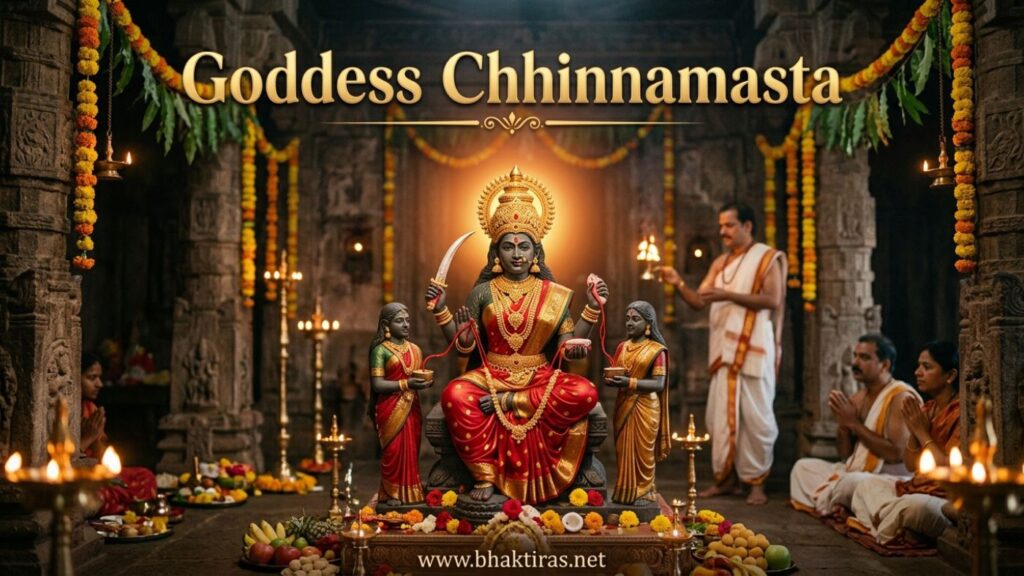
Chhinnamasta is the sixth of the ten Mahavidyas, the self-decapitated goddess who holds her own severed head in one hand and a scimitar in the other. Three streams of blood from her neck nourish her own head and two attendants. She is the great symbol of self-sacrifice, self-transcendence, and the mastery of desire.
Who Is Goddess Chhinnamasta
Among the ten Mahavidyas, the great goddesses of tantric wisdom, Chhinnamasta is the one whose image stops a person in their tracks. She stands unclothed and unafraid, and in a single moment she has cut off her own head with a scimitar. In one hand she holds the blade, in the other she cradles her severed head, its eyes open and calm. From the wound at her neck rise three arcs of blood, and this is where the shock gives way to meaning: two of those streams flow into the mouths of her attendants, and the third curves back to feed her own severed head. Nothing is wasted. Nothing is lost.
To meet her only as a violent picture is to miss her entirely. Chhinnamasta is a teaching rendered in the boldest visual language the tradition could find. She shows what it means to give oneself completely, to hold nothing back, and to discover that in the deepest giving there is no death at all, only a turning of the life-force from one form into another. Her name means simply “she whose head is severed,” yet the head she holds is still awake, still drinking, still alive.
The seers who described her placed her sixth among the Mahavidyas, between the fierce Bhairavi and the quiet Dhumavati. In that sequence she marks the moment of breakthrough, the flash of energy released when the ordinary sense of self is set down. She is called Prachanda Chandika, the fiercely blazing one, and Vairochani, she who shines. Both names point to the same truth: what looks like an ending in her form is really an outpouring of light.
For those who come to her with an open heart, Chhinnamasta is not frightening. She is the goddess who asks the hardest question and then answers it with her own body: what will you offer, and what remains of you when you have offered everything.
The Meaning of Her Startling Form
Every part of Chhinnamasta’s image carries weight, and the tradition reads it the way one reads a sacred verse, slowly and with attention. The severed head is not a symbol of destruction. It is the mind laid down, the constant chatter of “I want” and “I fear” set aside so that a clearer awareness can wake up. When the head comes off, the smaller self loses its grip, and what flows out is the raw energy that self had been holding onto.
That energy becomes the three streams of blood, and here the goddess turns a startling picture into a lesson about generosity. Blood is life. Instead of guarding it, she pours it out, and it goes precisely where it is needed: to her two companions and to her own waiting mouth. The message is quiet but firm. True self-giving is not loss. Life offered fully returns to the giver, changed and renewed. Death and nourishment are shown to be a single motion, seen from two sides.
Beneath her feet lies the couple Kama and Rati, desire and pleasure, locked in embrace. Chhinnamasta does not crush them or turn away from them. She stands upon them, drawing her power from the very force of desire while no longer being ruled by it. This is her mastery: not the killing of longing but its transformation, the moment when the fire that usually scatters a person becomes the fire that lifts them. She teaches that the energy of desire, once redirected, is the same energy that awakens the spirit.
So her form, terrifying at first glance, resolves into one of the most hopeful teachings in the whole tradition. Sacrifice and renewal, death and life, the giving away of the self and its deeper recovery, are all held together in one steady figure who has already passed through the fear and come out serene.
The Story of Her Origin
A Bath by the River
One of the best-loved stories tells of a day when the Great Goddess, in the company of two attendants named Dakini and Varnini, went down to a river to bathe. The three of them played in the water and enjoyed the cool of the morning, and when they finished they rested on the bank. But the day had grown long, and the two companions began to feel a deep, aching hunger. Their faces darkened. They turned to the goddess and asked her, gently at first and then plainly, for something to eat.
The Offering
The goddess asked them to wait, and they waited, but hunger is patient with no one, and again they pleaded. Then a wave of compassion rose in her, larger than any ordinary answer. She had nothing to give them but herself, and so she gave herself. Lifting the scimitar, she cut off her own head in a single stroke. Her head fell into her own left hand, and from her neck sprang three fountains of blood. Two streams she directed into the mouths of Dakini and Varnini, so that their hunger was finally stilled, and the third she guided into her own severed mouth, so that she too was nourished by her own gift.
What the Story Teaches
The tale is short, but those who meditate on it find it endless. A mother who feeds her children from her own body, a teacher who pours herself out for her students, anyone who has given past the point of comfort and found that they were not emptied but somehow filled, has touched the truth of Chhinnamasta. She is compassion carried to its furthest edge, where giving and receiving become one act. The hunger of her companions is our own hunger, and the head she offers is the small, grasping self that she was ready to set down so that love could flow without limit.
Iconography and Symbols
The Severed Head
Held calmly in her own hand, the head represents the mind released from its usual grip. Its open, living eyes show that awareness does not die when the small self is set down; it grows clearer.
The Scimitar
The curved blade is the instrument of decisive release. It cuts through hesitation, illusion and self-clinging in one clean stroke, the courage to let go without looking back.
The Three Streams of Blood
Life poured out rather than hoarded. Two streams feed her attendants and one returns to her own head, showing that whatever is truly given away comes back transformed and renewing.
Dakini and Varnini
Her two attendants stand on either side, drinking. They are the forces her energy sustains, and they remind the seeker that self-giving always nourishes something beyond the self.
Kama and Rati Beneath Her Feet
The embracing couple of desire and pleasure. By standing upon them, she draws on the power of desire while remaining its master, transforming raw longing into spiritual fire.
Her Nakedness and Red Hue
Unclothed, she hides nothing; her red or sunrise complexion marks her as pure energy, unashamed and complete, the life-force seen without any covering.
Kundalini and Self-Transcendence
Tantric teachers read Chhinnamasta as a living map of the inner journey, the rising of kundalini, the coiled spiritual energy said to sleep at the base of the spine. In this reading the three streams of blood become the three great channels through which the breath and life-force travel, and the goddess herself is the energy that shoots upward when those channels open. The severing of the head is the piercing of the highest centre at the crown, the point where the individual awareness dissolves into a wider one.
What makes her teaching so bold is the way it treats desire. The couple beneath her feet, Kama and Rati, are the very appetite that most spiritual paths try to suppress. Chhinnamasta does not suppress it. She stands upon it and turns it into ascent. The same heat that pulls a person outward toward endless wanting can, when reversed, pull them inward and upward toward awakening. She embodies that reversal, the moment the energy of longing stops scattering and starts to rise.
This is why she is a goddess of courage. To let the ordinary self be cut away, even for an instant, takes a fearlessness that cannot be faked. Yet her calm face promises that on the other side of that fear there is no annihilation, only a vaster life. She teaches that self-transcendence is not the erasing of a person but the widening of them, until the boundary between giver and gift, between self and world, grows thin and finally opens.
Among the Ten Mahavidyas
The ten Mahavidyas are ten faces of the one Great Goddess, each holding a different key to wisdom. They range from the gentle Kamala, goddess of abundance, to the terrifying Kali, and each teaches by embodying a truth the mind would rather avoid. Chhinnamasta sits sixth in the traditional order, and she is often counted among the most fierce and demanding of the group, a goddess for those ready to face the reality of sacrifice head on.
She shares deep kinship with Kali, for both stand at the meeting point of life and death and both strip away every comforting illusion. Yet where Kali holds severed heads in her hands, Chhinnamasta holds her own, and this single detail sets her apart. Her lesson is turned inward. She does not ask what the world must surrender; she shows what the seeker must be willing to offer of themselves.
Within the sequence of the Mahavidyas she marks a threshold. The goddesses before her build energy and fierceness; the goddess who follows her, Dhumavati, is all stillness and dissolution. Chhinnamasta is the flash between them, the burst of released power that carries a soul from one state to the next. To worship her is to seek that decisive moment when the old self falls away and something freer stands in its place.
How She Is Worshipped
Chhinnamasta is chiefly a tantric goddess, approached with care and, in her deeper rites, under the guidance of a teacher. For most devotees, however, worship of her takes gentle and steady forms centred on courage, gratitude and the willingness to give.
- Recitation of her mantra: devotees repeat her seed and root mantras with a mala, holding steady attention on the sound rather than on the fierce image.
- Meditation on her form: practitioners contemplate the meaning behind each symbol, using her image as a doorway into fearlessness and selfless giving rather than as an object of fright.
- Offerings at her shrines: flowers, red cloth, sindoor and lamps are offered, especially at Rajrappa and Chintpurni, where crowds gather on festival days.
- Observance of the Mahavidya cycle: she is honoured alongside the other Mahavidyas, particularly during Navaratri and on days sacred to the fierce forms of the Goddess.
- Seeking her for courage: people turn to her when facing a hard sacrifice, a decisive change, or the need to let go of something they have long clung to.
- Guided tantric sadhana: serious practitioners undertake her disciplines only under a qualified guru, treating her rites with the seriousness they demand.
Temples and Sacred Sites
Though she is a goddess of the inner path, Chhinnamasta is worshipped at living shrines that draw pilgrims from across northern and eastern India. Two are especially dear to her devotees.
- Rajrappa, Jharkhand: set where the Bhera river tumbles into the Damodar, the Chhinnamasta temple at Rajrappa is her most famous shrine. The roar of the falls and the wild setting make it a place of intense devotion, and it draws steady streams of worshippers seeking her fierce grace.
- Chintpurni, Himachal Pradesh: among the revered Shakti Peethas of the Himalayan foothills, the temple at Chintpurni is associated with Chhinnamasta and is a major stop on the pilgrim circuit of the region. Devotees climb its hill to ask the Mother to fulfil their heartfelt wishes.
- Other regional shrines: smaller temples and tantric seats devoted to her are found across Bengal, Bihar and Nepal, where she is worshipped within the wider tradition of the Mahavidyas.
Prayers and Mantras
Her mantras are dense with seed syllables, each one carrying a current of her energy. They are best received from a teacher, but their sound alone, chanted with reverence, is held to steady the heart and kindle courage. The central mantra invokes her as Vajravairochani, the one who blazes like a thunderbolt of light.
Frequently Asked Questions about Goddess Chhinnamasta
Who is Goddess Chhinnamasta?
Chhinnamasta is the sixth of the ten Mahavidyas, the self-decapitated goddess who holds her own severed head and a scimitar. Three streams of blood from her neck feed her severed head and two attendants. She is the great symbol of self-sacrifice, self-transcendence and the mastery of desire.
Why does she hold her own severed head?
The severed head represents the small, grasping self and the busy mind, willingly set down so that a wider awareness can awaken. Because the head remains alive and drinking, the image teaches that this letting-go is not death but a release of energy into a freer, clearer form of life.
What do the three streams of blood mean?
Blood is life-force. Instead of hoarding it, Chhinnamasta pours it out: two streams nourish her attendants and one returns to her own head. This shows that whatever is truly given away is not lost but comes back transformed, and that giving and receiving are a single motion.
Why does she stand on the couple Kama and Rati?
Kama and Rati are desire and pleasure. By standing upon them, Chhinnamasta draws power from desire while remaining its master. She does not destroy longing but transforms it, turning the scattering fire of appetite into the rising fire of spiritual awakening.
Where are her most famous temples?
Her most renowned shrine is at Rajrappa in Jharkhand, set beside the meeting of the Bhera and Damodar rivers. She is also worshipped at Chintpurni in Himachal Pradesh, a revered hill temple on the Himalayan pilgrim circuit. Smaller shrines exist across Bengal, Bihar and Nepal.
Is Chhinnamasta a frightening goddess?
Her image can startle at first, but her teaching is one of the most hopeful in the tradition. She embodies selfless giving, courage and renewal. Devotees approach her not with fear but with reverence, seeking the strength to let go and the assurance that deep sacrifice leads to a fuller life.
How is Chhinnamasta related to Kali?
Both are fierce Mahavidyas who stand at the threshold of life and death and strip away illusion. The difference is inward: Kali holds the severed heads of others, while Chhinnamasta holds her own. Her lesson is turned toward the seeker, asking what the self is willing to offer.
May Goddess Chhinnamasta grant you the courage to give freely and the calm to see that nothing offered in love is ever truly lost.