
Goddess Tara
तारा
Tara is the second of the ten Mahavidyas, the great goddesses of Tantra. Her name means star, and also the one who ferries devotees across danger and the ocean of existence. She is worshipped especially at Tarapith in Bengal. In her Nila Saraswati form she gives speech and wisdom. She is distinct from the Buddhist Tara.
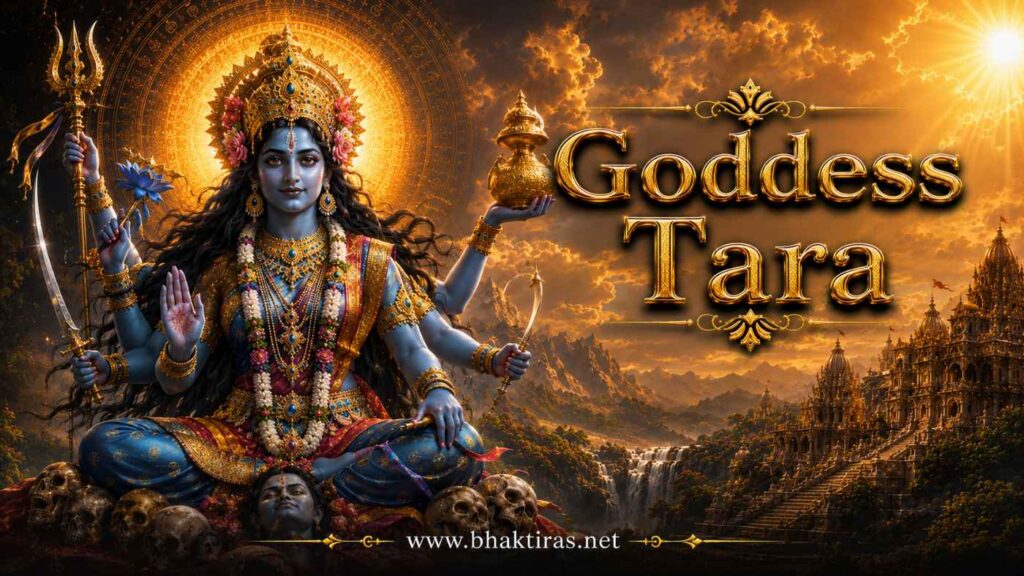
Who Is Goddess Tara
Goddess Tara is one of the ten Mahavidyas, the circle of wisdom goddesses at the heart of Tantric worship. Her name carries two meanings at once, and both matter. Tara is the star, the fixed light that sailors and travellers look to when everything else is dark. And Tara is the one who takes you across – across a river in flood, across a stretch of danger, across the whole restless ocean of birth and death. To call on her is to ask for a hand in the moments when you cannot see the far shore.
She is often placed right beside Kali, and the two are closely related. Where Kali is the wild, unbounded night, Tara is the light within that night – fierce, dark-blue, standing on a corpse, and yet turning toward you like a mother who has heard a child cry. People who come to her speak less of fear and more of rescue. She is the goddess you reach for when you are in trouble and have run out of your own strength.
It helps to be clear about which Tara this page describes, because several figures share the name. This is the Hindu Mahavidya Tara, worshipped in the Tantras and honoured above all at Tarapith in Bengal. She is not the same as the Buddhist bodhisattva Tara, though the two traditions grew up as neighbours and both hold her as a saviour of compassion. She is also not Tara the wife of the sage Brihaspati, whose story belongs to a different set of tales. When we say Tara here, we mean the guiding star of the Mahavidyas.
Understanding her begins with that single idea: a light that saves. Every part of her form, however fierce it looks, comes back to that promise of crossing over.
The Star That Ferries Across
The word tara comes from a root that means to cross, to carry over, to take safely to the other side. The star in the sky earns the name because it steers you home; the goddess earns it because she steers the soul. In older prayers she is called Tarini, the one who ferries, and the image is very physical – a boat, a rope, an arm reaching down to a drowning person.
What is she carrying us across? On one level, plain danger: illness, poverty, enemies, the storms of an ordinary life. Devotees have always turned to her in emergencies, and Tantric texts single her out as swift, the goddess who answers fast. On a deeper level, she carries us across samsara itself – the long, wearying cycle of birth and death – to the far bank of freedom. The two meanings are not separate. Helping a frightened person through one bad night and helping a soul through many lifetimes are, for her, the same gesture of mercy.
This is why her fierce look never becomes cruel. A dark, blazing goddess standing on a corpse could easily read as terror. But her purpose is protection. The fire in her is the fire that burns away what traps you, and the star in her is the light that shows the way out. She frightens only what would harm you.
How Tara Saved Shiva
The poison and the mother
The best-loved story of Tara comes from the churning of the ocean, the Samudra Manthan. As gods and demons churned the cosmic sea for the nectar of immortality, the churning first threw up not nectar but Halahala, a poison so terrible it could have ended all creation. To save the worlds, Shiva gathered the poison and drank it. He held it in his throat, which turned blue – and this is one reason he is called Nilakantha, the blue-throated one – but the poison began to overpower even him. The great god sank, unconscious and helpless.
The one who nursed the destroyer
In this moment the Mother came as Tara. She took the fallen Shiva to her breast and nursed him, and her milk drew out and neutralised the burning of the poison, reviving him. Sit with how striking that is. Shiva, the destroyer of universes, the one who swallowed a poison no one else could touch, is himself saved – held and healed like an infant by the goddess. It tells you exactly what kind of power Tara is. She is not a lesser helper standing behind the great gods. She is the rescuing source that even the greatest can lean on when they have given everything.
This is also why her fierce blue form and her deep motherliness are not a contradiction. The same goddess who stands on a corpse with a blade is the one who cradled Shiva and fed him back to life. Fierceness and tenderness are two hands of a single act of saving.
Iconography & Symbols
Tara’s image is dense with meaning. Each feature is a lesson about how she protects, and Tantric artists follow the descriptions closely.
Deep blue body
She is dark blue, the colour of a night sky and of the deep sea. Blue is the colour of the infinite – of that which is so vast it looks dark. It marks her as boundless and beyond the ordinary world.
Standing on a corpse
She stands with one foot on a corpse, understood as Shiva in his still, quiescent form. Pure awareness lies motionless; her active power moves upon it. Life and death rest under her feet, held rather than feared.
The scimitar
In one hand she holds a curved sword. It is the blade that cuts through fear, delusion and every knot that binds the soul. What she severs is never the devotee, only the chains around them.
The scissors
She carries a pair of shears. With them she snips the thread that ties a soul to the endless round of rebirth – a quiet, exact tool for the work of setting free.
The blue lotus
A blue lotus, the utpala, rests in another hand. Growing pure out of dark water, it is the sign of wisdom that opens even in hard conditions, and it gives her the gentle side of her fierce look.
The severed head
She holds a freshly cut head. Like Kali, she carries it as a sign of ego undone – the false self surrendered, so the true self can cross over. It marks the death of pride, not of the person.
Tiger-skin garment
She wears a tiger skin about her waist. It shows her as an untamed, ascetic power at home in cremation grounds and wild places, free of the world’s coverings and comforts.
The single matted lock
Her hair is bound in one twisted braid, which gives her the name Ekajata, she of the single matted lock. The one braid speaks of one-pointed focus – a mind gathered wholly toward the goal.
Read together, these signs describe a goddess who removes obstacles at the root. She burns fear, cuts the thread of rebirth, and stands unshaken on the ground of death itself – all so a devotee can reach safety.
Nila Saraswati – the Blue Goddess of Speech
One of Tara’s most tender aspects is Nila Saraswati, the blue Saraswati. Here the fierce protector becomes the giver of speech, language and clear understanding. The pairing is not as strange as it first sounds. If Tara is the one who ferries souls across, then the boat she often uses is the word – a mantra, a teaching, a name of God repeated until it carries you.
As Nila Saraswati she is prayed to by seekers, students and reciters for the power of speech that is both eloquent and true. Where the familiar white Saraswati presides over learning and the arts in their bright, ordered form, the blue Saraswati points to a deeper, tantric knowledge – the wisdom that comes not only from books but from the direct experience won in intense practice. Her blue is the colour of that depth.
This aspect also softens how we picture her. The same goddess who holds a scimitar in the cremation ground places a name on the tongue of a stammering child and steadies the voice of one who must speak the truth. Guidance, for Tara, is not always a dramatic rescue. Sometimes it is simply the right word arriving at the right time.
Tara and the Ten Mahavidyas
Tara belongs to the group of ten Mahavidyas, the great wisdom goddesses. Each is a distinct face of the one Supreme Goddess, and together they map the many ways divine power can meet a human life – from the terrifying to the beautiful, from the utterly formless to the sweetly maternal. Kali usually stands first in the group, and Tara stands second, right at her side.
That closeness to Kali is worth understanding. The two share a fierce, dark appearance, a home in the cremation ground, and a link with time and death. But they are not the same. Kali is boundless, formless night, power without edge or limit. Tara is the shaping, guiding light within that vastness – the star that gives a direction. If Kali is the ocean, Tara is the pole star by which you cross it. Devotees often approach Tara when they want that same immense power but with a steadier, more guiding hand.
Placing her among the Mahavidyas keeps her in her true setting. She is not a stray folk deity but part of a considered spiritual system, a doorway that Tantric practice offers to those ready for a more direct and demanding path.
Tarapith & Tantric Worship
The living heart of Tara’s worship is Tarapith, a temple town in the Birbhum district of West Bengal, on the bank of the Dwarka river. It is one of the great seats of Tantric practice in India, and Tara is its presiding mother. The temple sits beside an old cremation ground, and rather than hiding this, the tradition holds it close – here the goddess is met at the very edge of life and death, which is precisely where she does her work of ferrying souls across.
Tarapith is bound up with the memory of Bamakhepa, the mad saint, one of the most beloved devotees of the goddess anywhere in Bengal. He lived in and around the cremation ground in the nineteenth century, wild in manner and childlike before the Mother, treating Tara not as a distant power but as his own parent whom he could scold, plead with and adore. Stories of his fierce love and his miracles are still told at the shrine, and pilgrims feel his presence there almost as much as the goddess’s own.
Because Tara’s worship runs through Tantra, it deserves to be spoken of with care and respect. Its practices are precise, often carried out under a qualified teacher, and its imagery of the cremation ground is not morbid but a steady looking at what most people turn away from. For the ordinary devotee, none of this need be intimidating. A prayer, a lamp and a sincere heart are welcome at her feet, and Tara has always been quickest to answer those who come to her simply, in need.
How Goddess Tara Is Worshipped
Tara is worshipped both in grand Tantric rites and in the small, honest devotions of daily life. For most people, the second is where a real relationship with her begins. A few simple practices are enough to turn toward her.
- Light a lamp, preferably with a blue or dark flame-colour in mind, and offer it while asking for her protection and clear guidance.
- Recite her mantra, Om Hreem Streem Hum Phat, with focus – even a fixed daily count builds a steady thread of connection.
- Offer red hibiscus flowers, which are dear to her as they are to Kali, along with water and a little sweet.
- Keep her worship especially in mind on Tuesdays and on the dark-moon nights, times traditionally sacred to the fierce goddesses.
- Read or listen to the story of how she nursed Shiva and how she ferries devotees across, letting the sense of her as a rescuing mother settle in.
- If possible, make a pilgrimage to Tarapith, or simply hold that great shrine in mind while praying to her from home.
Above all, she responds to sincerity and trust. Tara asks less for elaborate ritual than for the honesty of someone who truly needs help and is willing to reach for her hand.
Prayers & Mantras
Sound is central to Tara’s worship. Her mantras are compact and charged, and reciters treasure them as the very boat by which she ferries. The core mantra, given below, is short enough to hold through a whole day.
Frequently Asked Questions about Goddess Tara
Who is the Hindu goddess Tara?
Tara is the second of the ten Mahavidyas, a fierce yet deeply maternal goddess whose name means 'star' and 'she who ferries across.' She is the guiding light who carries her devotees over the ocean of danger, difficulty and worldly existence, and she is worshipped above all at Tarapith in Bengal.
What does the name Tara mean?
Tara comes from the root meaning 'to cross over.' She is the star that guides sailors and seekers through darkness, and the mother who ferries her children across samsara, the sea of birth and death. To call on Tara is to ask for rescue and safe passage through life's hardest crossings.
Is the Hindu Tara the same as the Buddhist Tara?
They share a name and the theme of compassionate rescue, and the traditions influenced one another, but they are distinct. The Hindu Tara is a fierce Mahavidya of the Shakta and Tantric path, dark-blue and standing on a corpse, while the Buddhist Tara is a serene bodhisattva of compassion.
Why is Tara called Nila Saraswati?
In one of her forms Tara is the blue goddess of speech and transcendent knowledge, and so she is called Nila Saraswati, 'the blue Saraswati.' Where Saraswati grants worldly learning and the arts, Tara as Nila Saraswati bestows the deeper, liberating wisdom and the power of the sacred word.
How did Tara save Lord Shiva?
When Shiva drank the Halahala poison that rose from the churning of the ocean, it began to overwhelm even him. The Mother, in her form as Tara, took him onto her lap and nursed him at her breast, drawing out the poison's harm. Tara is thus honoured as the goddess who rescued Shiva himself.
Where is Goddess Tara worshipped?
Her most famous shrine is Tarapith in Birbhum, Bengal, one of the great Tantric seats, long associated with the saint Bamakhepa. She is also revered across Shakta and Tantric traditions in eastern India and Nepal, invoked for protection, guidance and liberation from fear and danger.
Whenever the way ahead looks dark, Tara is the star that holds steady – the mother who ferries her children across, and never lets go of the reaching hand.