
Goddess Kali
काली
Kali is the fierce form of the Divine Mother, goddess of time, death, and liberation. Behind her dark, frightening image lies boundless love. She destroys the ego, evil, and fear itself, granting fearlessness and moksha. Kali is not a demon or an evil power, but the tender Mother who frees her children.
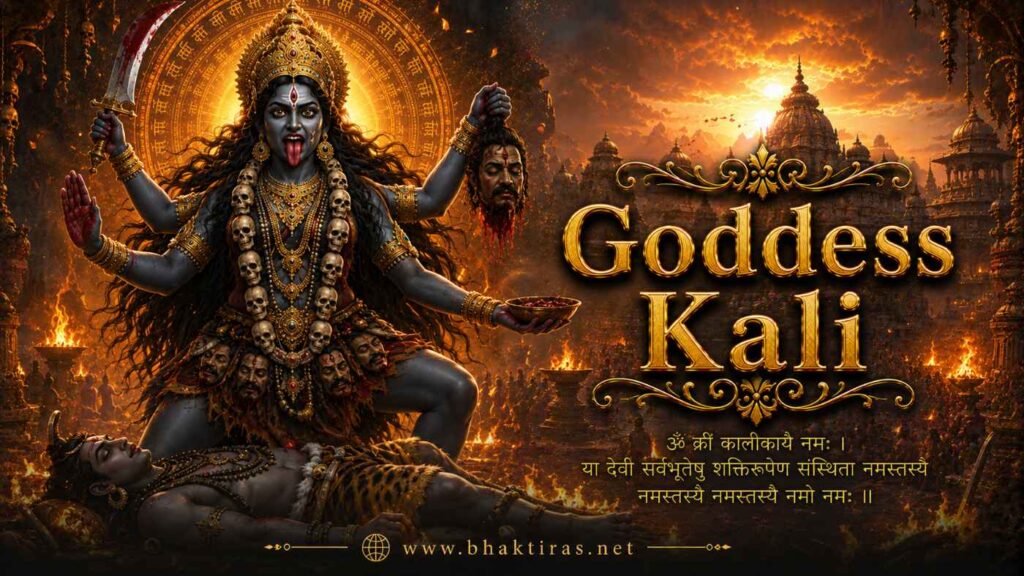
Who Is Goddess Kali?
The first time most people see an image of Kali, they feel a shiver. A dark goddess with a lolling red tongue, four arms, a sword dripping red, a garland of severed heads, and her foot planted on the chest of a prone Shiva – it is a lot to take in. And yet in Bengal, in Assam, and in millions of homes across India, this same figure is called by the softest word a child knows: Ma. Mother.
That contrast is the whole point. Kali is the Divine Mother in her fiercest form, and everything terrifying about her carries a tender meaning underneath. Her name comes from kala, time – so she is time itself, the force that carries every living thing toward its end and, past that end, toward release. She is called the dark one not because she is evil, but because she is the deep, formless ground into which all colours and forms finally dissolve, the way every sound eventually returns to silence.
Kali is counted among the Mahavidyas, the ten great wisdom-goddesses of the Tantric tradition, and she is often placed first among them. In that tradition she is not a minor or frightening spirit to be appeased. She is Adya Shakti, the primordial energy from which the whole universe unfolds and back into which it will fold again.
To understand her, you have to correct a fear at the very start. Kali does not destroy her children. She destroys what stands between her children and freedom – the grasping ego, the fear of death, the illusion that we are separate and small. She is frightening only to the part of us that clings. To the heart that lets go, she is the most loving Mother imaginable.
The Slaying of Raktabija
The best-known story of Kali comes from the Devi Mahatmya, and it explains how she first appeared. The Divine Mother, in her form as Durga, was locked in a long war against the demon armies of Shumbha and Nishumbha. Among their generals was Raktabija, who carried a terrible boon.
Why Kali Stands on Shiva
The most iconic image of Kali shows her standing with one foot on the chest of Shiva, who lies pale and still beneath her, while her tongue juts out as if caught in a moment of shock. Behind this striking picture is a beloved story.
Iconography & Symbols – What Her Terrifying Form Means
Every frightening detail of Kali’s appearance is a teaching. Read the way her devotees read it, and the terror turns into tenderness.
Kali the Mother – Beyond the Fear
Once the symbols are understood, the fear falls away and something warmer takes its place. Kali is, above all, a Mother – and a mother’s love is not always soft. A mother will also pull her child back from a fire, speak sharply to stop a mistake, and hold tightly through a storm. Kali’s love works this way, on the scale of the whole soul.
What she destroys is precisely what harms us: the ego that keeps us anxious and grasping, the fear of death that shadows every joy, the illusion of being cut off and alone. To a devotee, standing before Kali is like standing before someone who cannot be fooled and will not flatter you – and who loves you completely anyway. There is a strange relief in that. With Kali there is no need to pretend, no corner of yourself to hide.
This is why her worshippers speak of fearlessness. When you have handed everything – even the fear of death – to the Mother who governs time and death themselves, what is left to be afraid of? Kali offers the boldest gift in all of devotion: abhaya, freedom from fear. And beyond fearlessness she offers moksha, the final release, dissolving the seeker back into the boundless Mother from whom they came. Her terrifying form is simply the door; behind it waits the most unconditional love a soul can know.
Kali in Bengal & Ramakrishna's Devotion
Nowhere is Kali loved as intimately as in Bengal. Here she is not a distant, dreadful deity but Ma Kali, spoken to like a member of the household – scolded, coaxed, sung to, and adored. Bengali poet-saints such as Ramprasad Sen wrote tender, teasing songs to her, treating the fierce goddess as a beloved and sometimes exasperating mother.
The most famous devotee of Kali was Sri Ramakrishna Paramahamsa, the nineteenth-century mystic who served as priest at the Dakshineswar Kali temple beside the Ganga in Kolkata. Ramakrishna did not merely perform rituals for the image; he spoke to the Mother, wept for her, and refused to eat until he felt her living presence. His longing grew so intense that, by his own account, the stone image dissolved and Kali revealed herself as living consciousness itself. From that direct experience he taught that the Divine Mother is not a lifeless idol but a real, loving presence available to anyone who calls with a whole heart.
Every autumn, on the new-moon night of Diwali, Bengal comes alive with Kali Puja. While much of India lights lamps for Lakshmi, Bengal and Assam worship Kali through the darkest night of the year – fitting for a goddess who is herself the fertile darkness. Clay images of the Mother are worshipped in homes and grand pandals, hibiscus flowers are offered, and the night fills with drums, incense, and the sense that the Mother is very near.
How Goddess Kali Is Worshipped
Devotion to Kali is direct and heartfelt. It asks less for elaborate ritual and more for surrender – the willingness to place one’s fears at the Mother’s feet. Common practices include:
- Offering red flowers, especially red hibiscus, which is dear to her, along with red vermilion (sindoor).
- Reciting her mool mantra, Om Kreem Kalikayai Namah, and chanting the Devi Mahatmya or Kali stotras.
- Worshipping on Tuesdays and Saturdays, days traditionally sacred to her fierce, protective aspect.
- Celebrating Kali Puja on the Diwali new-moon night, and honouring her during Navaratri.
- Lighting lamps in the evening and singing devotional songs (shyama sangeet) that address her as loving Mother.
- Above all, cultivating fearlessness and surrender – handing over anxiety, ego, and the fear of death to her care.
Temples & Shakti Sites
Kali is worshipped across India, but a few sites carry a special power and draw pilgrims from everywhere:
- Kalighat, Kolkata – one of the fifty-one Shakti Peethas, where a part of Sati is said to have fallen. It is among the most revered Kali temples in the world and gave the city of Kolkata its name.
- Dakshineswar Kali Temple, Kolkata – the riverside temple on the Ganga where Sri Ramakrishna served and had his direct visions of the Mother, now a place of deep pilgrimage.
- Kamakhya Temple, Assam – a great Shakti Pestha and Tantric centre on the Nilachal hill, sacred to the Mother in her creative and fierce aspects and closely tied to Kali worship.
- Countless village and town shrines across Bengal, Assam, and South India (where she is honoured as Bhadrakali and Chamunda) keep her worship alive in daily life.
Prayers & Mantras
Chanting her name is the simplest and most intimate way to draw near to Kali. Her mool mantra is short, powerful, and beloved by devotees who repeat it as a call to the Mother:
ॐ क्रीं कालिकायै नमः
Om Kreem Kalikayai Namah
Om, salutations to Kalika, the Divine Mother. The seed-syllable Kreem is Kali’s own sound-form, said to carry her energy of transformation and release. Repeated with love, this mantra calls upon the Mother to cut through fear and ignorance and to grant her child fearlessness and freedom.
Frequently Asked Questions about Goddess Kali
Who is Goddess Kali?
Kali is the Hindu goddess of time, death and liberation, one of the ten Mahavidyas. Behind her fierce dark form – garland of skulls, lolling tongue, sword in hand – she is the fiercely loving Mother who destroys the ego and grants fearlessness. She is worshipped above all in Bengal and Assam.
Is Goddess Kali good or evil?
Kali is not evil at all. Her terrifying appearance frightens away fear itself. She destroys the ego, ignorance and the demons within, not her devotees. To those who surrender, she is the most tender Mother of all, granting protection, courage and liberation. Saints like Ramakrishna knew her only as pure love.
Why does Kali stand on Lord Shiva?
In her fury after slaying demons, Kali danced a destruction that threatened the world. To stop her, Shiva lay down in her path. When she stepped on him and recognised her husband beneath her feet, she bit her tongue in surprise and shame. The image shows even fierce power humbled by love.
Why does Kali wear a garland of skulls?
Her garland holds fifty severed heads, representing the fifty letters of the Sanskrit alphabet – the whole of language, knowledge and creation. The skulls also remind us that the body is impermanent. She wears our mortality as an ornament, teaching fearlessness in the face of death.
Why is Kali's tongue sticking out?
The lolling red tongue is most often explained by the story of her stepping on Shiva and biting her tongue in embarrassment, halting her dance of destruction. On a deeper level it expresses her boundless, untamed energy suddenly checked by awareness and love.
Where is Goddess Kali worshipped?
Kali is beloved across India but especially in Bengal and Assam. Her great temples include Kalighat and Dakshineswar in Kolkata and Kamakhya in Assam. She is honoured most grandly on Kali Puja, held on the new-moon night of Diwali, with lamps, red hibiscus and all-night devotion.
What is the main mantra of Kali?
Her core seed mantra is 'Om Kreem Kalikayai Namah', where 'Kreem' is the bija sound sacred to her. Devotees chant it for courage, protection and the dissolving of fear and ego. It is repeated with devotion, often on a rudraksha mala, especially on Tuesdays, Saturdays and Kali Puja night.
May the fierce and loving Mother Kali cut away every fear that binds you and hold you close in her boundless, fearless love.