
Lord Ganesha
गणेश
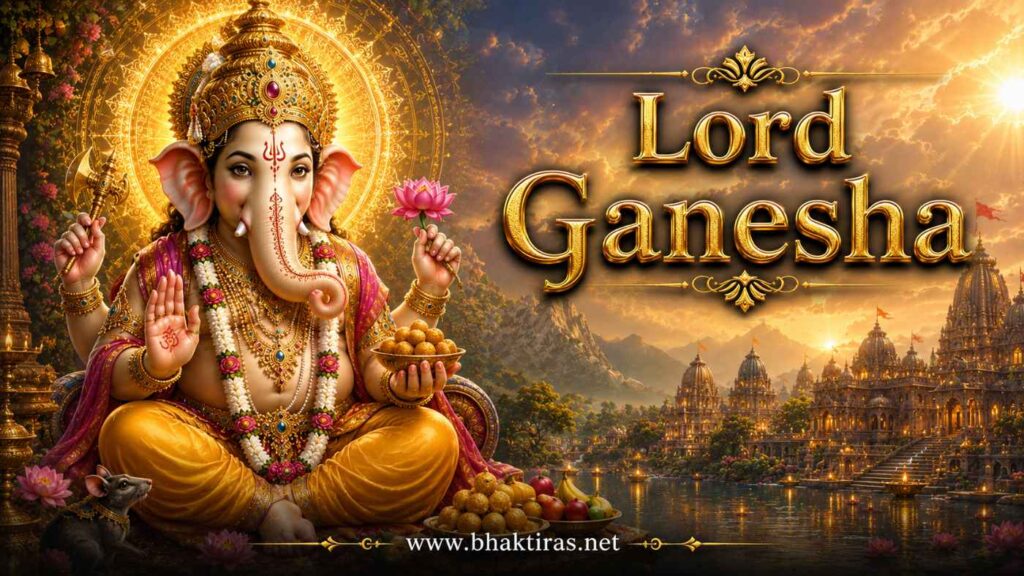
Lord Ganesha is the elephant-headed son of Shiva and Parvati, worshipped across India as Vighnaharta, the remover of obstacles. He is the god of wisdom, new beginnings, and intellect, and is invoked first before any prayer, journey, or venture. His mount is a small mouse, and he is beloved for his fondness for modak sweets.
Who Is Lord Ganesha
Lord Ganesha is one of the most loved and instantly recognisable gods in the Hindu world. With the head of an elephant and the round body of a contented child, he is the son of Shiva and Parvati, and he holds a place no other deity does: he is prayed to first. Before a wedding, before opening a shop, before starting a journey or writing the opening lines of a book, people call on Ganapati to clear the path ahead.
His most famous title is Vighnaharta, the remover of obstacles. But the same word can also mean the one who places obstacles, and both readings matter. Ganesha does not simply sweep every difficulty aside; he decides which hurdles help us grow and which should be lifted. That is why he is also the god of wisdom and good judgement, not only of easy success.
Ganesha belongs to no single region. He is worshipped from Tamil Nadu to Kashmir, in homes, temples, and even at the entrances of buildings where a small image watches over the doorway. His warmth comes partly from how approachable he feels – fond of sweets, riding a humble mouse, quick to forgive, and endlessly patient with his devotees.
He is the head of the ganas, the mischievous attendant hosts of Shiva, which is where his name comes from: gana (group) and isha (lord). To know Ganesha is to know a god who is grand and cosmic yet completely at home in the ordinary corners of daily life.
Iconography & Symbols
Almost every part of Ganesha’s form carries a teaching. His image is not just a portrait; it is a set of quiet reminders about how to live and think well.
Elephant Head
The great head stands for wisdom and the willingness to think big. An elephant is calm, strong, and remembers much – qualities a wise mind should hold.
Large Ears
The broad ears remind us to listen more than we speak, to take in advice and knowledge patiently before reacting.
Small Eyes
His small, focused eyes teach concentration – the ability to look closely at a single task and see detail others miss.
Broken Tusk
The single broken tusk, giving him the name Ekadanta, stands for sacrifice and for keeping a promise even at personal cost.
Large Belly
The round belly, source of the name Lambodara, shows the capacity to digest all of life – the good and the bitter alike – with grace.
Ankusha (Goad)
The goad in one hand is used to prod the mind forward, urging effort and steering us away from laziness and wrong turns.
Pasha (Noose)
The noose gently pulls the devotee closer to the goal while also holding back runaway desires and distractions.
Modak
The sweet dumpling in his hand is the reward of a well-lived spiritual life – the sweetness that follows sincere effort.
The Mouse
The small mouse at his feet stands for desire and restless ego, held in check beneath a god who has mastered both.
Why He Is Always Worshipped First
In almost every Hindu ritual, the first offering goes to Ganesha, no matter which god the ceremony is truly for. This custom, called prathama pujya – the first to be worshipped – has both a story and a logic behind it.
One well-loved account tells of a contest among the gods to decide who would be honoured first at the start of all rites. Ganesha won it through cleverness rather than speed, and Shiva granted him the boon that no worship would succeed unless it began with him. From then on, invoking Ganapati at the outset became the way to ensure a smooth, obstacle-free ceremony.
The deeper meaning is practical. Any new undertaking, whether a prayer, a business, or a marriage, meets resistance. By turning to the remover of obstacles at the very beginning, the devotee sets an intention: to face the work ahead with a clear, focused, humble mind. Starting with Ganesha is a way of saying, before anything else, may this begin well.
The Family of Lord Ganesha
Ganesha’s family sits at the very heart of Hindu devotion. His father is Shiva, the great ascetic and lord of destruction and renewal, and his mother is Parvati, the goddess of love, power, and devotion. Together with their two sons, they form the divine household of Mount Kailash.
His brother is Kartikeya, also known as Skanda or Murugan, the youthful commander of the gods’ armies and a great warrior. The two brothers appear together in several stories, sometimes as gentle rivals, which lets each of their strengths shine – Kartikeya’s valour and Ganesha’s wit.
In much of northern and western India, Ganesha is linked with two goddesses, Riddhi and Siddhi, often understood as prosperity and spiritual attainment, and sometimes with Buddhi, wisdom. In many southern traditions he is honoured as a celibate god. These different views coexist easily, each drawing out a facet of what he represents.
How Lord Ganesha Is Worshipped
Ganesha’s worship is warm and personal, easy to begin at home and rich enough to fill a grand temple festival. A few offerings and customs are especially dear to him.
- Durva grass – three or five blades of this humble grass are offered to Ganesha above almost all else, a favourite that pleases him more than costly gifts.
- Modak – the steamed sweet dumpling is his most beloved food; a plate of modak is the classic offering on his festival day.
- Twenty-one – the number 21 recurs in his worship, from 21 durva blades to 21 modaks to 21 repetitions of his name, seen as especially auspicious.
- Sankashti vrat – devotees keep the Sankashti Chaturthi fast each month, breaking it only after seeing the moon, praying for troubles to be resolved.
Red flowers, especially hibiscus, sindoor, and the chanting of his name complete a simple puja. Wednesday is considered his day, and the fourth lunar day, Chaturthi, is sacred to him each month.
Ganesh Chaturthi & the Ashtavinayak
Ganesh Chaturthi is his greatest festival, celebrated with enormous joy across India and most spectacularly in Maharashtra. Clay images of Ganesha are brought home and into public pandals, welcomed as an honoured guest, and worshipped for a set number of days with sweets, songs, and aarti. The festival ends with visarjan, the immersion of the image in water, when devotees bid him farewell with the loving cry Ganpati Bappa Morya, pudhchya varshi lavkar ya – come again soon next year.
Closely tied to his worship in Maharashtra is the Ashtavinayak, a pilgrimage to eight ancient temples, each holding a self-manifested image of Ganesha with its own legend. Completing the circuit is a cherished act of devotion.
- Mayureshwar (Moreshwar) at Morgaon
- Siddhivinayak at Siddhatek
- Ballaleshwar at Pali
- Varadavinayak at Mahad
- Chintamani at Theur
- Girijatmaj at Lenyadri
- Vighneshwar at Ozar
- Mahaganapati at Ranjangaon
Pilgrims traditionally begin and end at Morgaon, weaving the eight shrines into a single journey of faith through the Maharashtra countryside.
A Story Every Devotee Knows
Ganesha’s life is told through a handful of stories that children learn early and never forget. Each one carries a lesson wrapped in warmth and a touch of humour.
How He Got the Elephant Head
Parvati once shaped a boy from turmeric paste and breathed life into him, setting him to guard her door while she bathed. When Shiva returned and the boy, not knowing his father, refused him entry, a fierce clash followed and the boy’s head was struck off. Seeing Parvati’s grief, Shiva vowed to restore his life, and his attendants fetched the head of the first creature they found – an elephant. Revived and crowned as their leader, the boy became Ganesha, and Shiva declared he would be worshipped before all others.
The Race Around the Parents
Shiva and Parvati offered a divine fruit to whichever son could first circle the whole world. Kartikeya set off at once on his peacock. Ganesha simply walked around his parents and bowed, saying that they were his entire world. Charmed by his wisdom, they gave him the prize – a reminder that devotion and insight can outrun sheer speed.
Writing the Mahabharata
When the sage Vyasa needed a scribe swift enough to record the vast Mahabharata, Ganesha agreed, on the condition that Vyasa never pause in dictation. Vyasa in turn asked that Ganesha understand each verse before writing it. Partway through, Ganesha’s pen broke, and rather than stop, he snapped off one of his own tusks and wrote on. This is why he is called Ekadanta, the one-tusked lord.
Prayers & Mantras
Chanting Ganesha’s name is said to clear the mind and settle the heart before any effort. His mantras are short, easy to remember, and often the very first that a child learns.
The simplest and most widely used is the Mool Mantra: ॐ गं गणपतये नमः – Om Gam Ganapataye Namah – meaning a salutation to Ganapati, the lord of all groups and beings, invoking his blessing on any beginning.
Equally beloved is the opening shloka Vakratunda Mahakaya suryakoti samaprabha, nirvighnam kuru me deva sarvakaryeshu sarvada – O curved-trunk, mighty-bodied one, radiant as a million suns, make my every undertaking free of obstacles, always. Recited at the start of ceremonies, exams, and journeys, it captures in a single breath why he is turned to first.
Frequently Asked Questions about Lord Ganesha
Why does Lord Ganesha have an elephant head?
According to the best-known story, Parvati created Ganesha to guard her door, and when he stopped Shiva from entering, his head was struck off in the ensuing fight. To console Parvati, Shiva restored the boy's life by fixing an elephant's head on him. The elephant head came to represent wisdom, memory, and the ability to think big.
Why is Ganesha worshipped first among all gods?
Ganesha holds the boon that no worship or venture succeeds unless it begins with him. As Vighnaharta, the remover of obstacles, invoking him first clears the path for any prayer, ceremony, or new undertaking. Beginning with Ganesha also sets a mindful, humble intention before the real work starts, which is why he is called the first to be worshipped.
What is Ganesha the god of?
Ganesha is the god of wisdom, intellect, and new beginnings, and above all the remover of obstacles. He is called on before starting anything important, from studies and business to weddings and journeys. He also represents good judgement, since as Vighnaharta he decides which difficulties help us grow and which should be lifted away.
Why does Ganesha ride a mouse?
Ganesha's mount, the mouse called Mushika, symbolises desire and the restless ego. A mouse can slip anywhere and gnaw through anything, much like unchecked wants. By riding upon it, Ganesha shows that a wise mind keeps desire and ego under control rather than being ruled by them. The pairing of a large god on a tiny mount also carries gentle humour.
What is Ganesh Chaturthi?
Ganesh Chaturthi is the biggest festival for Lord Ganesha, marking his birth and celebrated most grandly in Maharashtra. Clay images are welcomed into homes and public pandals, worshipped for several days with sweets and aarti, and finally immersed in water in a farewell called visarjan. Devotees send him off with the cry Ganpati Bappa Morya, asking him to return soon next year.
What are the favourite offerings of Lord Ganesha?
Ganesha is famously fond of modak, the steamed sweet dumpling, which is the classic offering on his festival day. He is also especially pleased by durva grass, offered in blades of three or five, and by red flowers such as hibiscus. The number 21 recurs in his worship, from 21 modaks to 21 durva blades to 21 repetitions of his name.
Why is Ganesha called Ekadanta?
Ekadanta means the one-tusked lord. The name comes from the story of writing the Mahabharata, when Ganesha served as scribe for the sage Vyasa. When his pen broke mid-dictation and he could not pause, he snapped off one of his own tusks and continued writing. The broken tusk stands for sacrifice and for keeping a promise whatever the cost.
What is the Mool Mantra of Lord Ganesha?
The Mool Mantra of Ganesha is Om Gam Ganapataye Namah, written in Devanagari as ॐ गं गणपतये नमः. It is a simple salutation to Ganapati, lord of all groups and beings, and is chanted to invoke his blessing at the start of any task. The seed sound Gam is his special bija, or seed syllable, believed to carry his energy.
Whatever you are about to begin, may Ganapati clear the way and steady your mind – Ganpati Bappa Morya.