
Cheti Chand 2027 – Sindhi New Year & Jhulelal Jayanti
चेटी चंड
When is Cheti Chand in 2027?
Cheti Chand falls on Thursday, 8 April 2027. It marks the Sindhi New Year and the birth anniversary of Jhulelal, the patron deity of Sindhi Hindus. The day is observed on the second day of the bright fortnight of Chaitra, just after Gudi Padwa and Ugadi.
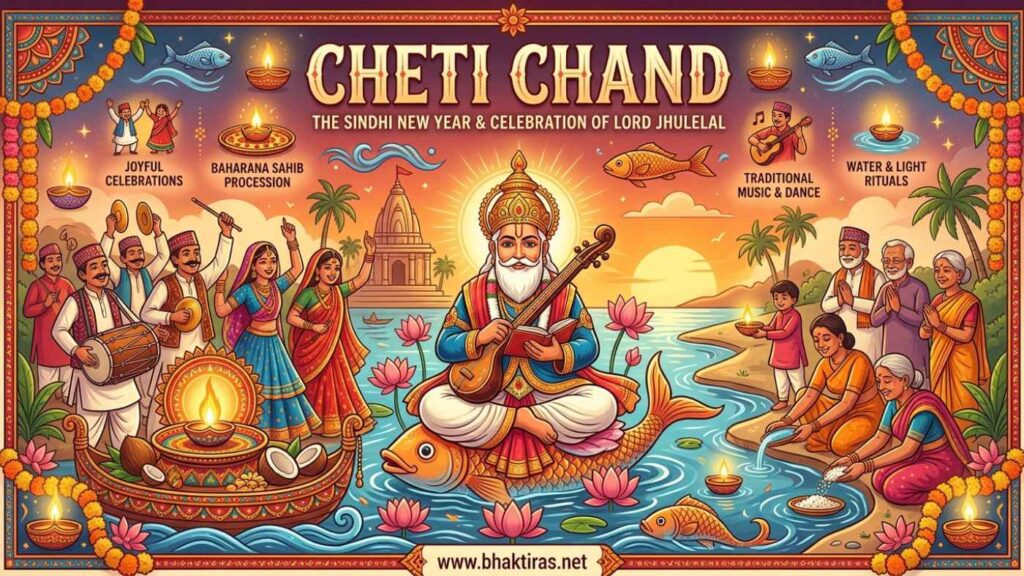
Cheti Chand is the Sindhi New Year and the birth anniversary of Jhulelal, the community’s beloved patron deity revered as an incarnation of the water god Varuna. Falling on the second day of the bright fortnight of Chaitra, it arrives just after Gudi Padwa and Ugadi in spring. For Sindhi Hindus dispersed across India and the world since Partition, the day is both a joyful new beginning and a heartfelt act of gratitude to the deity believed to have shielded their ancestors from persecution.
Cheti Chand 2026-2028: Dates & Calendar
The next Cheti Chand falls on Thursday, 8 April 2027. Because it follows the lunisolar Hindu calendar, the date shifts each year against the Gregorian calendar.
| Year | Date | Day | Notes |
|---|---|---|---|
| 2026 | 20 March | Friday | Chaitra Shukla Dwitiya |
| 2027 | 8 April | Thursday | Next occurrence |
| 2028 | 28 March | Tuesday | Chaitra Shukla Dwitiya |
The festival always lands a day or two after Gudi Padwa and Ugadi, which fall on the first day of Chaitra Shukla Paksha, since Cheti Chand marks the second day of the same fortnight.
Why Cheti Chand Is Celebrated
Cheti Chand is celebrated as the Sindhi New Year and the birth anniversary of Jhulelal, honouring the deity credited with protecting the Sindhi Hindu community.
The birth of Jhulelal
Sindhi tradition holds that Jhulelal, also called Uderolal, was born on this day in answer to the community’s prayers. He is revered as an incarnation of Varuna, the Vedic god of water, and is the Ishta Deva of Sindhi Hindus.
A story of protection
According to the legend, a tyrannical ruler pressured the Sindhi Hindus to abandon their faith. After forty days of prayer on the banks of the Indus, Jhulelal is said to have appeared to defend the community and secure their freedom of worship.
A new year and a new identity
The day opens the Sindhi calendar year and, since the Partition of 1947 scattered the community, has grown into a marker of shared Sindhi identity. Celebrations now link families across India and the diaspora on a single spring day.
Deities & Figures Worshipped
The central figure of Cheti Chand is Jhulelal, the patron deity of Sindhi Hindus, worshipped alongside water as a sacred element.
Jhulelal
Jhulelal, also known as Uderolal, Amarlal and Zinda Pir, is the Ishta Deva of Sindhi Hindus. Believed to be an incarnation of the water god Varuna, he is honoured on Cheti Chand with lamps, hymns and the Baharana Sahib offering.
Varuna (Jal Devta)
Because Jhulelal is seen as a form of Varuna, the god of water and the seas, water itself is central to the day’s worship. Devotees carry water as part of the sacred tray taken in procession to a river or lake.
Key Rituals, Step by Step
The day blends solemn worship of Jhulelal with lively community celebration, centred on the Baharana Sahib procession.
- Preparing the Baharana Sahib. Families arrange a ceremonial tray holding a jyot (oil lamp), water, mishri (sugar crystals), cardamom and a coconut, often set on a mound of rice or wheat.
- Temple worship. Devotees visit Jhulelal temples and darbars to offer prayers, light lamps and seek the deity’s blessings for the new year.
- The procession. The community carries the Baharana Sahib in a joyful procession, singing hymns as they move towards the nearest river, lake or water body.
- Offering to the water. At the water’s edge, the offerings are presented to Jhulelal in his form as the water god, honouring the element sacred to him.
- Chhej and Chaliho songs. Groups perform the Chhej, the traditional Sindhi stick dance, and sing Chaliho hymns that recall the forty days of prayer offered to Jhulelal.
- Exchanging greetings. People greet one another with Cheti Chand Jyoon Lakh Lakh Vadhayoon, meaning countless good wishes for the new year.
- Sharing a festive meal. Families gather to share traditional Sindhi dishes and sweets, closing the day with food and fellowship.
Special Foods of Cheti Chand
Sindhi kitchens turn out both sweet and savoury classics for the new year table.
Tairi
A festive sweet rice, tairi is flavoured with sugar and ghee and often studded with dry fruits. It is a staple of Cheti Chand celebrations.
Dal pakwan
A much-loved Sindhi breakfast of crisp fried pakwan wafers served with spiced chana dal, frequently prepared for the festive morning.
Sai bhaji
A hearty dish of spinach cooked with lentils and vegetables, sai bhaji is a wholesome part of the Sindhi festive spread.
Koki
A thick, layered Sindhi flatbread seasoned with onion and spices, koki is griddled until crisp and served warm.
Festive sweets
Homes prepare an assortment of Sindhi sweets to mark the new year, shared with family and neighbours as part of the celebration.
How Sindhis Celebrate Around the World
Once rooted in the historic region of Sindh, Cheti Chand today unites the Sindhi diaspora wherever they have settled.
India
Large celebrations take place in cities with sizeable Sindhi populations, such as Mumbai, Pune, Ahmedabad, Ulhasnagar and Jaipur, with public processions and community gatherings.
The global diaspora
Sindhi communities in countries including the United Arab Emirates, the United Kingdom, the United States, Singapore and Hong Kong mark the day with temple worship and cultural programmes.
Historic Sindh
The festival originates in the Sindh region, now in Pakistan, where the shrine associated with Jhulelal remains a place of reverence for both Hindu and Muslim devotees.
Cheti Chand Do's and Don'ts
A few simple customs help keep the day meaningful and respectful.
Do
- Prepare the Baharana Sahib tray with care and devotion.
- Greet family and friends with Cheti Chand Jyoon Lakh Lakh Vadhayoon.
- Visit a Jhulelal temple or darbar to offer prayers.
- Take part in the community procession and Chhej dance.
- Share traditional Sindhi food and sweets with loved ones.
Avoid
- Do not treat the water offering casually; it honours Jhulelal as Varuna.
- Do not let the day pass without a thought of gratitude for the community’s protection.
- Avoid polluting rivers or lakes; keep offerings mindful of the environment.
- Do not exclude elders and neighbours from the celebration.
- Avoid turning the occasion into mere feasting without any prayer.
Frequently Asked Questions
When is Cheti Chand in 2027?
Cheti Chand falls on Thursday, 8 April 2027. It marks the Sindhi New Year and the birth anniversary of Jhulelal, observed on the second day of the bright fortnight of Chaitra.
When is Cheti Chand in 2026 and 2028?
Cheti Chand was on 20 March 2026 and will fall on 28 March 2028. The date shifts each year because it follows the lunisolar Hindu calendar, always landing on Chaitra Shukla Dwitiya.
Why is Cheti Chand celebrated?
Cheti Chand is celebrated as the Sindhi New Year and the birth anniversary of Jhulelal. Tradition holds that Jhulelal appeared to protect the Sindhi Hindu community from religious persecution, so the day is also an act of gratitude and a marker of Sindhi identity.
Which god is worshipped on Cheti Chand?
Jhulelal, also called Uderolal, is worshipped on Cheti Chand. He is the patron deity of Sindhi Hindus and is revered as an incarnation of Varuna, the Vedic god of water.
What is the Baharana Sahib procession?
The Baharana Sahib is a ceremonial tray carrying a lit oil lamp, water, mishri, cardamom and a coconut. Devotees carry it in procession to a river or lake, offering it to Jhulelal in his form as the water god.
What foods are eaten on Cheti Chand?
Traditional Cheti Chand foods include tairi (sweet rice), dal pakwan, sai bhaji, koki and an assortment of Sindhi sweets. Families gather to share these dishes as part of the new year celebration.
How do Sindhis greet each other on Cheti Chand?
Sindhis greet one another with Cheti Chand Jyoon Lakh Lakh Vadhayoon, which conveys countless good wishes for the new year. The greeting is exchanged among family, friends and the wider community.
Is Cheti Chand the same as Gudi Padwa and Ugadi?
Cheti Chand is distinct but closely timed with Gudi Padwa and Ugadi. All three fall in the same spring fortnight of Chaitra; Gudi Padwa and Ugadi mark the first day, while Cheti Chand is observed on the second day as the Sindhi New Year.
May Jhulelal bless your year with light and courage. Cheti Chand Jyoon Lakh Lakh Vadhayoon.