
ॐ
Tara Chalisa
श्री तारा चालीसा
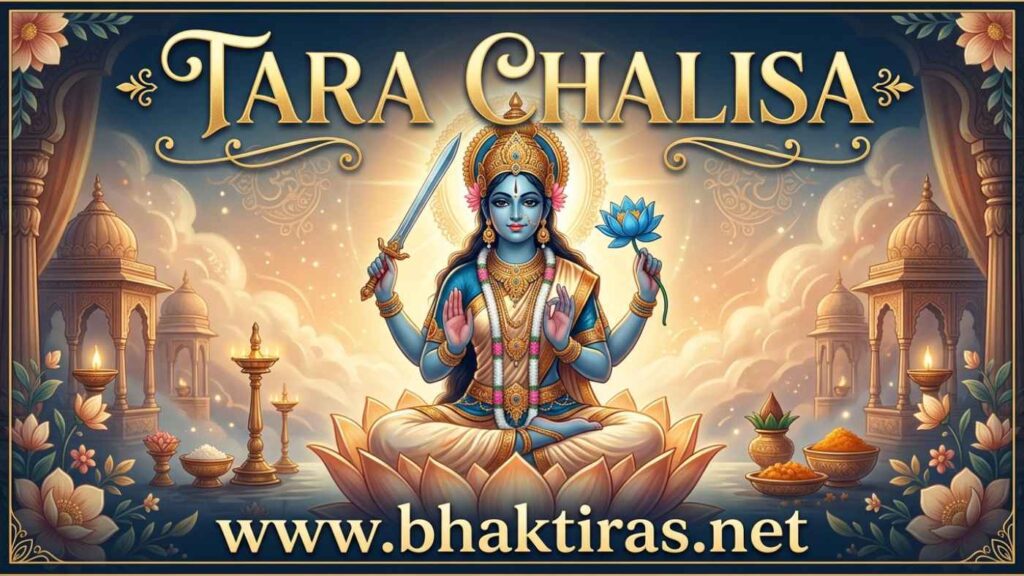
The Tara Chalisa is a forty-verse devotional hymn to Maa Tara, the second of the ten Mahavidyas and the fierce blue goddess of speech, wisdom, and the void. Her name comes from the root that means to ferry across, and she is invoked as the mother who carries her devotees over the ocean of worldly fear. This page gives the complete Tara Chalisa lyrics in easy English transliteration, and every verse is paired with its own plain-English meaning so you can follow the words and their sense together.
Maa Tara is worshipped above all at Tarapith in Bengal, where her cremation-ground shrine draws seekers of tantric grace. Reciting her Chalisa is a simple, accessible way to turn the mind toward her protective, knowledge-giving presence.
Tara Chalisa Lyrics in English (Transliteration)
Roman transliteration for easy chanting. Tap “Meaning” under any verse for the English translation.
Shri Ganapati Guru Gauri, Pujihaun Sir Nai
Tara Bal Jal Sokhani, Bimal Vidya Dai
Meaning
Bowing my head, I first honour Ganesha, my Guru, and Goddess Gauri. O Tara, you who dry up hostile forces the way heat draws off water, please grant me pure and untainted knowledge.
Namo Namo Tara Jagdamba
Tum Bin Hot Na Hoii Amba
Meaning
I bow again and again to you, Tara, mother of the whole universe. Nothing at all comes to pass without you, O Mother.
Jay Hemavati Jay Jagdambe
Jay Achala Jay Durge Ambe
Meaning
Victory to you, golden-hued mother of the worlds. Victory to you who cannot be shaken or reached, victory to you, Durga, O Mother.
Shivashankar Ki Tum Ho Pyari
Karahu Kripa Mati Ho Sanhari
Meaning
You are the beloved of Lord Shiva. Show me your grace and cut away my pride and dullness of mind.
Jay Gayatri Ved Ki Mata
Tum Bin Kahu Na Sughar Vidhata
Meaning
Victory to you as Gayatri, the mother of the Vedas. Without you even the creator cannot shape things well.
Brahma Vishnu Mahesh Sawari
Tinon Dev Tumhare Pujari
Meaning
Brahma, Vishnu, and Mahesh move at your command. All three of these gods are your worshippers.
Karahu Daya Mati Mamta Bhaari
Hum Sabki Tum Ho Hitakaari
Meaning
Pour out your deep compassion and motherly love upon us. You are the well-wisher of us all.
Srishti Palan Tumhare Bas Mein
Tum Bin Kahun Na Duja Jag Mein
Meaning
The keeping of all creation rests in your hands. In this world there is no other refuge but you.
Rakshak Ho Tum Param Vishal
Tumhari Kripa Sada Suphal
Meaning
You are the vast and supreme protector. Your grace always bears fruit.
Sharnagat Ki Tum Ho Mata
Kripa Karo Ambe Vighna Hata
Meaning
You are the mother of all who take shelter with you. Be gracious, O Mother, and clear away every obstacle.
Shatru Vinashini Mati Ho Mati
Tum Bin Purna Kahun Nahi Pati
Meaning
You destroy enemies both outside and within. Without you nothing is ever fully attained.
Bhav Sagar Sab Paar Karave
Tara Bhavani Kripa Barasave
Meaning
You carry everyone across the ocean of worldly existence. O Tara Bhavani, rain down your grace.
Sant Janon Ki Tum Ho Pyari
Tum Bin Hot Na Koi Bhikhari
Meaning
You are dear to the saints and the wise. With you as refuge, no one is left truly destitute.
Riddhi Siddhi Ki Tum Ho Data
Vipatti Haro Sabki Vidhata
Meaning
You are the giver of prosperity and spiritual attainments. As the ordainer of fate, you take away everyone's misfortunes.
Deen Heen Ke Dukh Harani
Tum Ho Sabki Adhipati Marani
Meaning
You remove the sorrows of the lowly and the poor. You are the sovereign mistress over all.
Aghat Ki Tum Ho Mahima Bhaari
Tum Bin Srishti Na Koi Udhaari
Meaning
Your unfailing glory is boundless. Without you no being in creation finds deliverance.
Sharnagat Ko Na Tajna
Tum Bin Kaun Karu Uddhar
Meaning
Never abandon the one who has come to you for shelter. Apart from you, who else can grant release?
Kripa Drishti Karahu Hum Par
Sukh Sampatti Hoy Ghar Ghar
Meaning
Turn your merciful gaze upon us. Let happiness and plenty fill every home.
Daya Karo Ab Tum Mati Mari
Hum Par Ambe Kripa Utari
Meaning
Have mercy on me now, O Mother. Let your grace descend upon us.
Mata Tum Hi Jagat Ki Palan Haari
Tum Hi Bhaktan Ki Bhayahaari
Meaning
O Mother, you alone sustain the world. You alone drive away the fears of your devotees.
Tum Hi Aadishakti Kalika Maai
Tum Hi Sant Janon Ki Sukhadaayi
Meaning
You are the primordial power, Mother Kalika. You are the giver of joy to the saints and the wise.
Taarani Tarala Tanvi Kahlaati
Nij Janon Ki Mangaldaata Kahlaati
Meaning
You are called the ferrier across, the shimmering one of slender form. You are called the bringer of every blessing to your own people.
Taara Taruna Vallari Tum Hi
Teer Rupa Tari Shyaama Tanu Ksheen Ho Tum Hi
Meaning
You are Tara, youthful and tender as a climbing vine. You are the arrow and the boat, the dark one with a slender, spare form.
Baama Khepa Ki Paalan Kartri
Maa Tum Hi Kahlaati Ho Siddhi Daatri
Meaning
You nurture those on the left-hand tantric path. O Mother, you are called the bestower of spiritual accomplishments.
Mata Roop Tumhaara Ati Paavan
Bhaktan Ki Ho Tum Manbhaavan
Meaning
O Mother, your form is deeply pure and holy. You capture the hearts of your devotees.
Tumse Itar Nahin Kachhu Dooja
Tum Ho Sur-Nar Muni Jan Ki Bhoopa
Meaning
There is nothing whatsoever apart from you. You are the ruler of gods, humans, and sages alike.
Tum Hi Mata Nagalok Mein Basti
Jan-Jan Ki Vipada Harti
Meaning
You are the Mother who dwells even in the realm of serpents. You lift away the troubles of every single soul.
Tum Hi Mata Kahlaati Prlayankaari
Sakal Trailokya Ki Bhayahaari
Meaning
You are the Mother named as the bringer of cosmic dissolution. You banish the fear of all three worlds.
Maa Tumne Hi Shiv Praan Bachaye
Tumhare Sumiran Se Vish Paar Na Paaye
Meaning
O Mother, it was you who saved Shiva's life. Because he remembered you, the poison could not pass beyond his throat.
Das Mahavidya Kram Mein Tum Aati
Dwitiya Vidya Tum Kahlaati
Meaning
Among the ten Mahavidyas you stand in their order. You are named the second great wisdom.
Mata Tum Hi Saraswati Kahlaati
Tum Hi Ho Gyaan Ki Adhishthaatri
Meaning
O Mother, you are also called Saraswati. You are the presiding power of all knowledge.
Neel Saraswati Hai Naam Tihaaro
Chahun Lok Phailo Jagmag Ujiyaaro
Meaning
Your name is Neel Saraswati, the blue Saraswati. Your shining light spreads across all the worlds.
Shmashan Priya Shmashana Kahlaati
Ekjata Jagdamba Kahlaati
Meaning
You love the cremation ground and are called its dweller. You are called Ekjata, the single-braided one, mother of the universe.
Mata Shiv Tumhari God Viraaje
Mundmaal Gale Mein Ati Saaje
Meaning
O Mother, Shiva reclines in your lap. A garland of skulls adorns your neck with striking beauty.
Baam Marg Poojan Tumko Ati Pyaara
Sharanaagat Ki Tum Ho Sahaara
Meaning
Worship along the left-hand path is very dear to you. You are the mainstay of all who seek your shelter.
Veerbhoomi Ki Mata Tum Vaasini
Tum Hi Aghora Tum Hi Vilaasini
Meaning
You are the Mother who abides in the land of the brave. You are both the fearless one and the one at joyful play.
Tumharo Charit Jagat Aadhaara
Tumse Hi Maa Chahun Dishi Ujiyaara
Meaning
Your story is the ground on which the world rests. O Mother, from you light streams out in every direction.
Tumharo Charit Sada Main Gaau'n
Tumahi Maat Roop Mein Paau'n
Meaning
May I always sing the account of your deeds. May I find you present as my own mother.
Chinta Sagari Haro Mahataari
Tumharo Aasara Jagat Mein Bhaari
Meaning
O Great Mother, dry up the whole ocean of my worry. Your support in this world is the mightiest of all.
Turiya Tarala Teevragamini Tumhi
Neel Tara Ugra Vishahari Bhi Tumhi
Meaning
You are the transcendent fourth state, the shimmering, swift-moving one. You are the Blue Tara, the fierce one, and also the taker-away of poison.
Tum Para Paraatpara Ateeta Kahlaati
Vedaarambha Vedaatara Tumhi
Meaning
You are called the supreme, higher than the highest, the one beyond all. You are the very opening of the Vedas and the essence carried within them.
Sharnagat Ki Raksha Karu, Dusht Dalan Kar Pay
Tara Bhavani Mati Mati, Sankat Dur Karay
Meaning
Guard those who seek your refuge and crush the wicked underfoot. O Tara Bhavani, again and again, take away all my troubles.
Benefits of Reciting the Tara Chalisa
Devotees turn to the Tara Chalisa as a steadying daily practice, and its verses point to several kinds of grace that regular recitation is said to bring:
- Freedom from fear: Tara is invoked as the goddess who ferries the soul across fear, so her Chalisa is chanted for courage in anxious or uncertain times.
- Clarity and knowledge: As Neel Saraswati and the goddess of speech, she is petitioned for sharper intellect, learning, and clear expression.
- Protection from harm: The hymn repeatedly names her as protector and destroyer of hostile forces, seen and unseen.
- Relief from worry and grief: The closing verses ask her to dry up the ocean of anxiety and lift away the sorrows of the lowly.
- Prosperity in the home: Several verses ask for happiness and plenty to fill every household.
- Spiritual progress: As the second Mahavidya, she is sought as a guide toward steadiness in meditation and the path of liberation.
When and How to Chant the Tara Chalisa
Tara is most often honoured on Tuesdays and Fridays, and the early Brahma Muhurta hours before dawn are considered especially fitting; her great annual day is Tara Jayanti during the Magh Gupt Navratri. Bathe and wear clean clothes, sit before her image or a simple lamp, and recite the Chalisa unhurried, following the meaning of each verse rather than racing through the words. Many keep a light diet on the day and continue the practice for forty days. The heart of it is steady, sincere attention, offered in thought, word, and deed.
About the Tara Chalisa
The Tara Chalisa follows the classic pattern of the genre: an opening doha, forty chaupai couplets, and a closing doha, composed in devotional Hindi. Its verses gather the many faces of Maa Tara, the second of the ten Mahavidyas, as the golden Hemavati, the beloved of Shiva, Neel Saraswati of the blue radiance, Ekjata of the single braid, and the fierce guardian of the cremation ground. Woven through them is the well-known account of Tara saving Shiva after he drank the world’s poison, and her role as the mother who carries seekers safely across every danger. The text is anonymous and traditional, passed down among worshippers of the Mahavidyas.
Frequently Asked Questions
What is the Tara Chalisa?
The Tara Chalisa is a forty-verse devotional hymn to Maa Tara, the second of the ten Mahavidyas. Framed by an opening and closing doha, its chaupai verses praise her as the fierce blue goddess of speech, wisdom, and protection who ferries her devotees across fear.
What are the benefits of reciting the Tara Chalisa?
Devotees recite it for courage and freedom from fear, for clearer knowledge and speech, for protection from harm, and for relief from worry and grief. It is also chanted for prosperity in the home and for steady progress on the spiritual path.
Which day is best to recite the Tara Chalisa?
Tuesdays and Fridays are considered most auspicious for Maa Tara, and the pre-dawn Brahma Muhurta hours are especially favourable. Her main annual occasion is Tara Jayanti, observed during the Magh Gupt Navratri.
How many verses are in the Tara Chalisa?
The word Chalisa means forty, and this hymn has forty chaupai verses. These are framed by an opening doha and a closing doha, following the standard Chalisa structure.
Can the Tara Chalisa be recited in English?
Yes. This page gives the full Tara Chalisa in Roman English transliteration with a meaning for every verse, so anyone who does not read Devanagari can still recite it accurately. Sincere devotion matters more than fluent pronunciation.
Is this the same Tara worshipped in Buddhism?
Tara is revered in both Hindu and Buddhist traditions. In Hinduism she is the second Mahavidya and a fierce form of the Great Goddess, while in Buddhism Tara is honoured as a compassionate saviour; the traditions share her name and her role as one who rescues and guides.
॥ Tara Chalisa ॥