
ॐ
Chhinnamasta Chalisa
श्री छिन्नमस्ता चालीसा
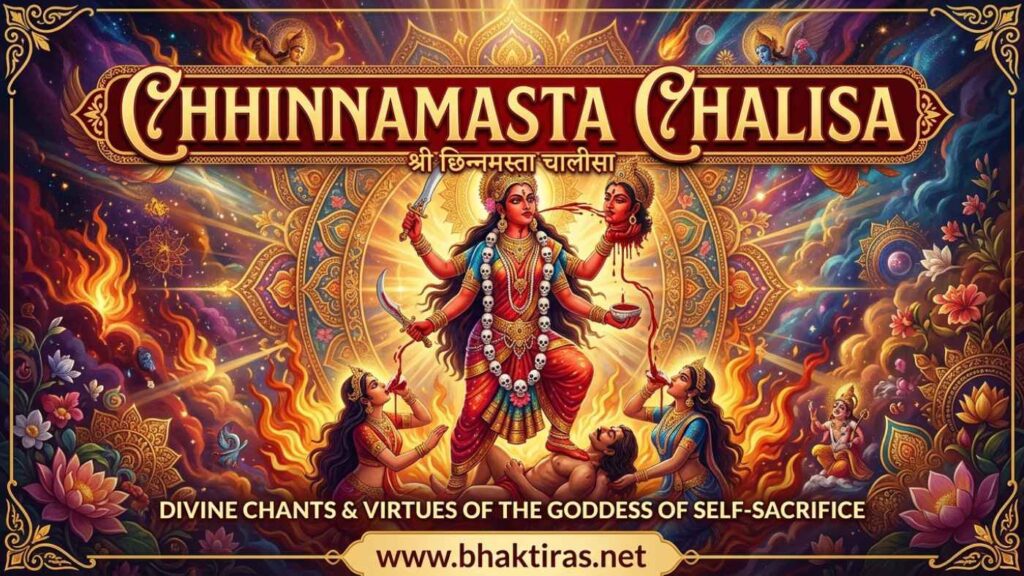
The Chhinnamasta Chalisa is a forty-verse hymn to Goddess Chhinnamasta, the sixth of the ten Mahavidyas and the self-decapitated goddess who holds her own severed head. Her fierce image is a teaching about self-sacrifice, mastery over desire, and the rising of kundalini energy. This page gives the full Roman English transliteration alongside an original line-by-line meaning, so you can follow the words even without reading Devanagari. It also covers the benefits, the best days to recite, and simple guidance on how to chant with focus.
Chhinnamasta Chalisa Lyrics in English (Transliteration)
Roman transliteration for easy chanting. Tap “Meaning” under any verse for the English translation.
Apna mastak kaat kar leenha haath mein thaam,
Kamalasan par pag tale dalit huye Ratikam.
Jagataran hi kaam hai, Rajrappa hai dhaam,
Chhinnamastaka ko karun baranbar pranam.
Meaning
Having severed her own head, she holds it in her hand, and while seated on a lotus she treads the god of desire beneath her feet. Her whole purpose is to lift up the world, and her sacred home is Rajrappa; again and again I bow to Chhinnamastaka.
Jay Ganesh Janani gun khani,
Jayati Chhinnamastaka Bhavani.
Meaning
Glory to the mother of Ganesha, the very source of all good qualities. Victory to Chhinnamastaka, the Divine Mother Bhavani.
Gauri Sati Uma Rudrani,
Jayati Mahavidya Kalyani.
Meaning
You are Gauri, Sati, Uma and Rudrani in your many forms. Victory to you, the great goddess of wisdom who brings blessing and welfare.
Sarvamangala Mangalakari,
Mastak khadga dhare avikari.
Meaning
You are auspiciousness itself and the giver of every good fortune. You raise the sword to your own head, yet you remain changeless and untouched.
Rajrappa mein vaas tumhara,
Tumse sada jagat ujiyara.
Meaning
Your dwelling is at Rajrappa, your beloved shrine. The whole world stays lit and bright because of you.
Tumse jagat charachar mata,
Bhajen tumhe Shiva Vishnu vidhata.
Meaning
O Mother, everything that moves and everything still comes from you. Even Shiva, Vishnu and Brahma the creator worship you.
Yati Muniindra nit dhyan lagaven,
Narad Shesha nitya gun gaven.
Meaning
Ascetics and the greatest of sages keep their minds fixed on you in meditation. Narada and Shesha sing your praises day after day.
Medha Rishi ko tumne tara,
Surath ka saubhagya nikara.
Meaning
You carried the sage Medha across life's troubles. You brought forth the good fortune of King Surath.
Vaishya samadhi gyan se mandit,
Hua Ambike pal mein pandit.
Meaning
O Ambika, the merchant named Samadhi, graced by deep meditative insight, became a truly wise man in a single moment by your grace.
Rajrappa ka kan-kan nyara,
Damodar pavan jal dhara.
Meaning
Every grain of Rajrappa is special and set apart. There the Damodar river flows with pure, sanctifying water.
Mili jahan Bhairavi Bhavani,
Mahima amit na jaat bakhani.
Meaning
At the place where Bhairavi and Bhavani came together, the greatness is boundless and cannot be fully told.
Jay Shailesh suta ati pyari,
Jaya aur Vijaya sakhi pyari.
Meaning
Victory to the dearly loved daughter of the mountain king Himalaya. Jaya and Vijaya are her cherished companions.
Sangam tata par gayi nahane,
Lagi sakhiyon ko bhukh satane.
Meaning
She went down to the riverside confluence to bathe. While there, her companions were seized by sharp hunger.
Tab sakhiyan ne bhojan manga,
Sun chitkar jaga anuraga.
Meaning
Then the companions begged her for food. Hearing their pleading cry, her tender love for them rose up.
Nij sir kaat turat dikhlayi,
Apna shonit unhein pilayi.
Meaning
At once she cut off her own head and showed it to them. She gave them her own blood to drink to satisfy their hunger.
Tabse kahe sakal budh gyani,
Jayatu Chhinnamasta varadani.
Meaning
Ever since that day all the wise and learned declare together: victory to Chhinnamasta, the giver of boons.
Tum Jagadamba Anadi Ananta,
Gavat satat Ved muni santa.
Meaning
You are the mother of the universe, without any beginning and without any end. The Vedas, sages and saints sing your glory without pause.
Udahul phool tumhe ati bhaye,
Suman kaner charan raj paye.
Meaning
The red hibiscus flower is especially dear to you. The kaner blossom and other flowers find their blessing at the dust of your feet.
Bhandaradah sangam tata pyare,
Ek divas ek vipra padhare.
Meaning
At the beloved bank of the Bhandaradah confluence, one day a certain Brahmin arrived.
Lie shankh choodi kar mala,
Aayi ek manoram bala.
Meaning
He was carrying conch-shell bangles and garlands in his hands. Just then a lovely young girl appeared before him.
Gaur badan shashi sundar majjita,
Rakta vasan shringar susajjita.
Meaning
Her face was fair and beautiful, bathed in a moon-like glow. She was dressed in red and adorned with fine ornaments.
Boli vipra idhar tum aao,
Mujhe shankh choodi pahnao.
Meaning
She said, O Brahmin, come here to me. Slip these conch-shell bangles onto my wrists.
Bala ko choodi pahankar,
Chala vipra atishay sukha pakar.
Meaning
After fitting the bangles onto the girl, the Brahmin set off, filled with unusual happiness.
Sunahu vipra bala tab boli,
Jatil rahasya potli kholi.
Meaning
Then the girl said, Listen, O Brahmin, and she opened up a tangled, hidden secret to him.
Param vichitra charitra akhanda,
Mere Janak Jageshwar panda.
Meaning
Her story was utterly wondrous and whole in itself: My father, she said, is Jageshwar, the temple priest.
Daam tohi choodi kar denge,
Ati harshit satkar karenge.
Meaning
He will pay you the price for the bangles. He will welcome you with great delight and honour.
Pahuche dvija panda ke ghar par,
Chakit huye vah bhi sab sunakar.
Meaning
The Brahmin reached the priest's house. He too, and everyone there, was amazed to hear the whole account.
Dono bhandar dah par aaye,
Chinnamasta ka darshan paaye.
Meaning
The two of them went together to the Bhandaradah bank. There they received the blessed vision of Chhinnamasta herself.
Udit chandramukh shoshin vasani,
Jan man kalush nishachar asani.
Meaning
Her face shone like the rising moon. She drives out the impurity and darkness from the minds of her devotees like a weapon against night.
Rakta kamal asan sit jwala,
Divya rupini thi vah bala.
Meaning
Seated on a red lotus amid a bright, cool flame, that young girl revealed her divine, radiant form.
Boli Chinnamastaka Mai,
Bhandar dah hamare man bhai.
Meaning
Mother Chhinnamastaka spoke and said, The Bhandaradah confluence is a place close to my heart.
Jako vipada bahut satave,
Durjan pret jise dhamkave.
Meaning
Whoever is worn down by heavy misfortune, or is threatened by wicked people and by evil spirits,
Badhe rog rin ripu ki peera,
Hoye kasht se shithil sharira.
Meaning
Whoever is burdened by growing illness, by debt, by the pain caused by enemies, and whose body is worn weak by suffering,
To nar kabhu na man bhramave,
Turat bhag Rajrappa aave.
Meaning
That person should never let the mind fall into confusion. They should hurry at once to Rajrappa and come to me.
Kare bhakti poorvak jab pooja,
Sukhi na ho uske sam dooja.
Meaning
When they perform the worship with true devotion, no one else will be as happy and content as they become.
Ubhaya vipra ne kinha pranama,
Poorn bhae unke sab kama.
Meaning
Both the Brahmins bowed low before her in reverence. Every one of their wishes was completely fulfilled.
Padhe Chinnamasta Chalisa,
Ambahi nitya jhukavahi sisaa.
Meaning
Whoever recites the Chhinnamasta Chalisa each day and bows their head daily before the Mother,
Ta par kripa matu ki hoyi,
Phir vah karai chahe man joi.
Meaning
upon that person the Mother's grace descends, and then they can accomplish whatever their heart truly desires.
Main ati neech lalchi kami,
Nahi gun gyan na bhakti abhrami.
Meaning
I am very lowly, greedy and full of wanting. I have no real virtue, no true knowledge, and no steady, faultless devotion.
Mere man ki suno bhavani,
Veh vighna haro jadmati gyani.
Meaning
O Bhavani, hear the prayer within my heart. Remove the obstacles of this dull-minded one and grant me clear understanding.
Puran karahu araj yahi meri,
Sunat hi bhavani bandhan teri.
Meaning
Fulfil this single request of mine, O Mother. The moment you hear it, O Bhavani, the binding knots of worldly life are loosened.
Jo din padhe chalisa ek, so paavat hi anand.
Chhinnamastaka prasann hoi, kare abheysthit kaand.
Meaning
Whoever recites this Chalisa daily attains deep joy. Chhinnamastaka is pleased with them and makes their undertakings firm and successful.
Benefits of Reciting the Chhinnamasta Chalisa
Devotees turn to the Chhinnamasta Chalisa when they need courage, protection, and a clearer mind. Regular recitation is said to bring:
- Freedom from obstacles: It helps clear stubborn hurdles and negativity that block your progress.
- Protection from enemies and fear: As a fierce guardian goddess, Chhinnamasta is invoked for safety from ill-wishers and for release from fear.
- Wisdom and sharp intellect: Being a Mahavidya, a goddess of wisdom, she is asked for clarity, knowledge, and good judgement.
- Success and stability: The verses ask for the removal of debt, illness, and hardship, and for effort to bear fruit.
- Inner strength and calm: Steady chanting is felt to build courage, steady the emotions, and support control over anger.
- Spiritual awakening: Her symbolism of self-offering and rising energy makes this a hymn for those on a serious inner path.
When and How to Chant the Chhinnamasta Chalisa
Tuesdays and Fridays are considered ideal for beginning this practice, and Chhinnamasta Jayanti is the most significant day of all. The Brahma Muhurta hours before dawn are traditionally preferred, though an evening recitation is also welcome. Bathe and put on clean clothes, sit in a quiet spot facing east or north, and if possible keep an image of the goddess before you with a lamp and incense lit. Recite the verses slowly, with clear words and a settled mind. Because her worship is powerful, many devotees keep it simple and sincere, and those drawn to deeper Tantric practice do so only under a knowledgeable teacher.
About the Chhinnamasta Chalisa
The Chhinnamasta Chalisa follows the classic Chalisa form: an opening doha, forty chaupai verses, and a closing doha, composed in devotional Hindi. Its verses do more than praise; they retell the story of the goddess of Rajrappa and Bhandaradah in Jharkhand, including the well-known episode in which she severs her own head to feed her hungry companions. Woven through it are references to the sages Medha and the story of King Surath from the Devi Mahatmya, along with promises of relief from debt, disease, and fear for those who worship her with faith. The text presented here is a traditional hymn, offered with an original English transliteration and meaning.
Frequently Asked Questions
What is the Chhinnamasta Chalisa?
It is a devotional hymn of forty verses, framed by an opening and closing couplet, dedicated to Goddess Chhinnamasta, the sixth of the ten Mahavidyas. The verses praise her, retell her story at Rajrappa, and ask for protection, wisdom, and relief from hardship.
What are the benefits of reciting the Chhinnamasta Chalisa?
Devotees recite it to clear obstacles and negativity, gain protection from enemies and fear, receive wisdom and sharp intellect, find success and stability in their efforts, and build inner courage and calm. It is also chanted as a support for spiritual growth.
Which day is best to recite the Chhinnamasta Chalisa?
Tuesdays and Fridays are considered especially suitable, and Chhinnamasta Jayanti is the most auspicious day. The pre-dawn Brahma Muhurta hours are traditionally favoured, though it may also be recited in the evening with devotion.
How many verses are in the Chhinnamasta Chalisa?
It contains forty main chaupai verses, along with one doha at the beginning and one at the end, which is the standard structure of a Chalisa.
Can the Chhinnamasta Chalisa be recited in English?
Yes. This page provides the full text in Roman English transliteration, so anyone who cannot read Devanagari can still recite the verses correctly, along with an English meaning for each line to help you follow the sense.
Who is Goddess Chhinnamasta?
Chhinnamasta is the sixth Mahavidya, a fierce form of the Divine Mother shown holding her own severed head. Her image represents self-sacrifice, mastery over desire, and the awakening of inner energy. Her famous temple stands at Rajrappa in Jharkhand.
॥ Chhinnamasta Chalisa ॥