
ॐ
Dhumavati Chalisa
श्री धूमावती चालीसा
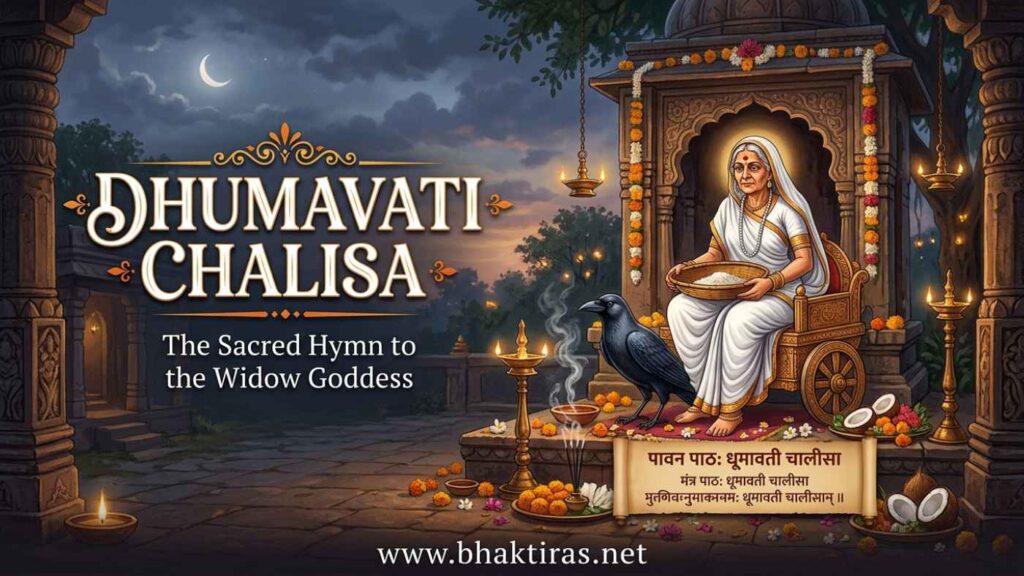
The Dhumavati Chalisa is a devotional hymn to Goddess Dhumavati, the seventh of the ten Mahavidyas. She is worshipped as the widow goddess of smoke-form who removes deep misfortune, dissolves obstacles that ordinary prayer cannot reach, and protects devotees from enemies, disease and calamity. This page gives the full chalisa in easy English transliteration, so you can read and pronounce every line, together with a clear original meaning for each verse.
The text here joins the forty-verse chalisa with the classical Dhumavati Ashtakam, the eight-part Sanskrit stotra recited by her devotees. Because Dhumavati is an unconventional Tantric deity, her verses describe a fierce, cremation-ground form; the meanings below explain the imagery in plain language.
Dhumavati Chalisa Lyrics in English (Transliteration)
Roman transliteration for easy chanting. Tap “Meaning” under any verse for the English translation.
Jayati jay Dhumavati, mahima agam apar
Ashtak stotra prakat kare, Devi tav upkar
Meaning
Victory to Dhumavati, whose greatness cannot be measured or reached by the mind. May this Ashtak stotra make plain your kindness, O Devi.
Jay jay jay Dhumavati mata
Sadhak ke sankat haranihari nit vidhata
Meaning
Hail three times to Mother Dhumavati. You are the eternal ordainer who lifts away the seeker's every trouble.
Prat: rup kumari sukhdai
Madhyanh mein praudh chhavi chhai
Meaning
At dawn you take the form of a young girl who gives joy. By midday you appear as a woman in her prime.
Sandhya mein vriddha ban viraje
Mundamal gal shobha saje
Meaning
At dusk you sit in the form of an aged woman. A garland of skulls hangs at your throat as your ornament.
Khatvang dharan karahu Bhavani
Kapal jata sang maha Bhavani
Meaning
You hold the skull-topped staff, O Bhavani. With matted locks and a skull in hand, you are the great Bhavani.
Daitya shir mala gah aabhushan
Bhairav sang tav leela nirmal
Meaning
A necklace of demon heads is worn as your jewellery. With Bhairava at your side, your divine play remains pure.
Rakt sura harshit kar mata
Mahish maha yam rup dikhata
Meaning
You are pleased by offerings of blood and wine, O Mother. You reveal the fearsome form linked with Yama and the buffalo.
Asthi khand karahu ras vilasa
Bhishan hasya, karahu sanhasa
Meaning
You take delight even among broken bones. Your dreadful laughter rings out across the ground.
Damaru dhwani tav gunje bhari
Pret sang Mahakal savari
Meaning
The sound of your damaru drum booms heavily. You move with ghosts and ride alongside Mahakala.
Tantan ghanta kare ninada
Bhairavi chhavi jagat vikhyata
Meaning
Your bells ring out with a clanging note. Your Bhairavi form is known across the whole world.
Mund mala shobhe suhaye
Chanda-Munda sanhar karaye
Meaning
The garland of skulls shines beautifully upon you. You brought about the destruction of the demons Chanda and Munda.
Vam kan bimba chandra biraje
Dakshin bhanu tej biraje
Meaning
The disc of the moon rests at your left ear. The blazing light of the sun shines at your right.
Nakshatra har jata vistaara
Mund mala gale ujiyara
Meaning
Stars form a necklace across your spreading matted hair. The skull garland lights up your neck.
Trishul kare, nag samhale
Mahakal priya, bhay na tale
Meaning
You carry a trident in your hand and hold serpents with ease. Dear to Mahakala, you drive away every fear.
Tail abhyakt veni suhaye
Rasabh vahan rup dikhaye
Meaning
Your single oil-anointed braid looks striking. You show yourself mounted upon a donkey.
Smashan vasini tu jagmata
Sarva siddhi de sharan vidhata
Meaning
You dwell in the cremation ground, yet you are Mother of the world. To those who take refuge you grant every spiritual attainment.
Rudhir rasana rakt vilasi
Kali rup, karo jag vasi
Meaning
Your tongue is red and revels in blood. In the form of Kali, you make your home within the world.
Mahaghor sankat jab chhaye
Teri aradhana phaldai
Meaning
When a great and terrible crisis closes in, worship offered to you bears fruit.
Mahayuddh, rog, shatru sanhare
Mantr jap se siddh nihare
Meaning
You put an end to great wars, diseases and enemies. Through steady chanting of your mantra, the devotee sees success.
Jo yah chalisa padhe dhyata
Siddhi pave, sankat tal jata
Meaning
Whoever reads this chalisa with a focused mind gains attainment, and their troubles are turned aside.
Dhumavati kripa kar, bhavsagar se tar
Bhaktan par anukampa kar, jag mein kar uddhar
Meaning
O Dhumavati, be gracious and carry us across the ocean of worldly existence. Show mercy to your devotees and bring deliverance in this world.
Maa Dhumavati Ashtak Stotram
Atha Stotram
Meaning
Here begins the Ashtak Stotram, the eight-part hymn of Mother Dhumavati.
Pratarya syatkumari kusumkalikaya japmala japanti
Madhyahne praudhrupa vikasitvadana charunetra nishayam
Meaning
At morning she is a maiden, telling her beads on a rosary of flower buds. At noon she is mature, with a bright face and lovely eyes; and at night she changes again.
Sandhyayam vriddharupa galitkuchayuga mundamalam
Vahanti sa devi devadevi tribhuvanjanani kalika patu yushman
Meaning
At dusk she is aged, wearing a garland of skulls. May that Goddess, deity of deities, mother of the three worlds, Kali herself, protect you.
Baddhva khatvangakotau kapilvarjatamandlampadmayone:
Krritva daityottamangaissrajamurasi shir shekhartarkshyapakshai:
Meaning
With the skull-staff bound at its tip and tawny matted locks, she has made a garland of the finest demon heads across her chest, her head crowned with eagle feathers.
Purnam raktaisuranam yam mahish mahashringamadaya panau
Payadvo vandyamanpralaymuditaya bhairav: kalratryam
Meaning
Taking in her hand the great horn of Yama's buffalo, brimming with the blood of demons, may Bhairava, who rose rejoicing at the time of dissolution, guard you through the dark night as you worship.
Charvantimasthikhandamprakatkatkatashabdsanghatam
Ugra~nkurvana pretmadhye kahahkahahahasyamugra~nkrishangi
Meaning
Chewing shards of bone with a loud grinding clatter, gaunt of body, she stands among the ghosts uttering a fierce, echoing laughter.
Nityannityaprasakta damarudimadimam spharayanti mukhabjam
Payannashchandikeyam jhajhamajhamajhama jalpmana bhramanti
Meaning
Ever absorbed in her play, she swells the beat of the damaru and makes her lotus face shine. May this Chandika, wandering and murmuring with a jingling sound, protect us.
Tantantantantatantaprakratmatmanatghantam vahanti
Sphemsphemsphemskarakratkatkit hasa nadsanghattbhima
Meaning
She carries a bell that clangs on and on, terrible in her clash of sounds and her hissing, crackling laughter.
Lolammundagrmala lalahalahalolalolagravachanchrvanti
Chandmundam matmatmatite charvayanti punatu
Meaning
With a swaying garland of skulls and a restless flickering tongue, she chews upon Chanda and Munda. May she purify us.
Vame karne mrigankpralayparigatandakshine suryabimbankanthe
Nakshatraharamvvarvikatjatajutke mundmalam
Meaning
On her left ear the dissolution-worn moon, on her right the disc of the sun, at her neck a garland of stars, and on her terrible piled matted hair a garland of skulls.
Skandhe krritvoragendradhvajnikarayutambrahmkankalbharam
Sanhare dharayanti mam haratu bhayambhadrada bhadrakali
Meaning
On her shoulder she bears the weight of Brahma's skeleton along with the serpent-king's banner. May the auspicious, boon-giving Bhadrakali, who carries this at the time of dissolution, remove my fear.
Tailabhyaktaikaveni trapumayavilaskarnikakrantkarna
Lauhenaikena krritva charannalinkamatman: padshobham
Meaning
With one oil-anointed braid, her ears graced by gleaming tin ornaments, she adorns her lotus-lovely feet with a single iron anklet.
Digvasa rasabhen grasati jagdidamya yavakarnapura
Varshinyatiprabaddha dhvajvitatbhuja sasi devi tvameva
Meaning
Clad in the directions themselves, riding the donkey, with barley-ears as her earrings, she devours this world; raining down and firmly bound, her arms spread wide with a banner, you alone are that Goddess.
Sangrame hetikrritvaissarudhirdashanairyadbhatanam
Shirobhirmalmavaddhya murdhni dhvajvitatbhuja tvam shmashane pravishta
Meaning
In battle she makes weapons of the blood-smeared teeth of warriors, binds a garland of their severed heads upon her head, and with wide-spread arms bearing a banner she enters the cremation ground.
Drrishta bhutaprabhutaih prithutarjaghna vaddhnagendraknchi
Shulagravyagrahasta madhurudhirasada tamranetra nishayam
Meaning
Beheld by the hosts of spirits, broad of hip, girded with the serpent-king as her belt, holding the point of a spear in her busy hand, ever fond of sweet blood, her eyes copper-red through the night.
Damshtra raudre mukhe.asmimstava vishati jagaddevi sarvam kshanarddhat
Sansarasyantakale nararudhiravasha samplave bhumadhumre
Meaning
O Devi, into this fierce fanged mouth of yours the whole world passes in half an instant. At the end of the age, taken up with human blood, you stand amid the flood upon the smoke-grey earth.
Kali kapaliki sashavashayanatara yogini yogamudra raktaruddhih
Sabhastha bharnbhayhara tvam shiva chandaghanta
Meaning
You are Kali, the Kapalika who reclines upon a corpse, the Yogini seated in yogic pose, the one who stanches blood; present in the assembly, remover of fear, you are the gracious Chandaghanta.
Dhumavatyashtakampunyam sarvapadvinivarakam
Ya: pathetsadhako bhaktya siddhim vvindanti vanchitam
Meaning
This holy Ashtakam of Dhumavati wards off every calamity. The seeker who recites it with devotion gains the attainment they long for.
Mahapadi mahaghore maharoge maharane
Shatruchchate maranadau jantunammohane tatha
Meaning
In great danger, in great terror, in great disease, in great war, in driving off enemies, in warding off harm and in confounding hostile beings.
Pathetstotramidandevi sarvatra siddhibhagbhavet
Devdanavgandharva yakshrakshaspannaga:
Meaning
O Devi, whoever recites this stotra becomes blessed with success everywhere; devas, danavas, gandharvas, yakshas, rakshasas and serpents all yield before them.
Dhumavati kripa kar, bhavsagar se tar
Bhaktan par anukampa kar, jag mein kar uddhar
Meaning
O Dhumavati, be gracious and carry us across the ocean of existence. Show compassion to your devotees and grant deliverance in the world.
Benefits of Reciting the Dhumavati Chalisa
Devotees turn to the Dhumavati Chalisa when ordinary difficulties have hardened into deep, stubborn misfortune. Her worship is believed to work on problems at their root.
- Removes long-standing misfortune: she is invoked to break cycles of loss, failure and bad luck that seem to resist every other remedy.
- Protection from enemies: as a fierce Tantric goddess, she is called on to shield devotees from hostility, conflict and ill intent.
- Relief in crisis: the verses themselves promise support in great danger, disease and hardship, making the chalisa a prayer for the hardest hours.
- Freedom from fear: her form frightens away lesser fears, and devotees recite her name to steady the mind in anxious times.
- Dissolving obstacles: she is honoured for clearing blockages in work, health and life direction that no longer respond to gentler measures.
- Inner detachment: as the widow goddess of the void, her worship is linked with letting go of what cannot be kept and finding peace beyond loss.
When and How to Chant the Dhumavati Chalisa
Dhumavati is traditionally worshipped with sincerity and a calm, respectful heart, since she is a serious Tantric deity rather than a household one. Her main day is Dhumavati Jayanti, which falls in the month of Jyeshtha, and Saturdays are also considered suitable. Many recite the chalisa after bathing, seated before her image or a simple lamp, keeping the offerings and setting austere. Read the transliteration slowly, follow the meaning of each verse, and end with a quiet request for protection and relief. What matters most is steady devotion and honesty of intent rather than elaborate ritual.
About the Dhumavati Chalisa
This text pairs a forty-verse Hindi chalisa in chaupai and doha form with the classical Sanskrit Dhumavati Ashtakam, the eight-part hymn long recited in her tradition. Dhumavati is the seventh of the ten Mahavidyas, the great wisdom goddesses of Tantra. She is pictured as an old widow riding a crow or a donkey, veiled in smoke, dwelling in cremation grounds. Her verses dwell on this austere, fearsome imagery not to alarm but to point at the truth of impermanence, the void that remains when all else falls away, and the grace that lifts devotees beyond misfortune. The meanings on this page are original explanations written to make that older devotional language clear to modern readers.
Frequently Asked Questions
What is the Dhumavati Chalisa?
The Dhumavati Chalisa is a devotional hymn praising Goddess Dhumavati, the seventh of the ten Mahavidyas. It describes her smoke-form widow appearance and asks for her protection from misfortune, enemies and hardship. This page presents it in English transliteration with a meaning for each verse.
What are the benefits of reciting the Dhumavati Chalisa?
Devotees recite it to remove deep-rooted misfortune, gain protection from enemies, find relief during crisis, and dissolve stubborn obstacles in health, work and life. It is also associated with freedom from fear and with inner detachment from loss.
Which day is best to recite the Dhumavati Chalisa?
Dhumavati Jayanti, which falls in the Hindu month of Jyeshtha, is her main festival day. Saturdays are also regarded as suitable. Many devotees read it after bathing, seated before her image or a lamp with a calm and respectful mind.
How many verses are in the Dhumavati Chalisa?
This text contains an opening doha, forty verses, and a closing doha. The first twenty verses form the Hindi chalisa, while verses twenty-one to forty are the classical Sanskrit Dhumavati Ashtakam recited within her tradition.
Who is Goddess Dhumavati?
Dhumavati is a fierce Tantric goddess counted among the ten Mahavidyas. She is the widow goddess of smoke, usually shown as an old woman riding a crow, dwelling in cremation grounds. She is worshipped to remove misfortune and to grant courage in the face of loss and fear.
Can the Dhumavati Chalisa be recited in English?
Yes. This page provides the full chalisa in easy Roman transliteration so anyone can read and pronounce every line, along with an original English meaning for each verse, even without knowing Hindi or Sanskrit script.
॥ Dhumavati Chalisa ॥