
ॐ
Ravidas Chalisa
श्री रविदास चालीसा
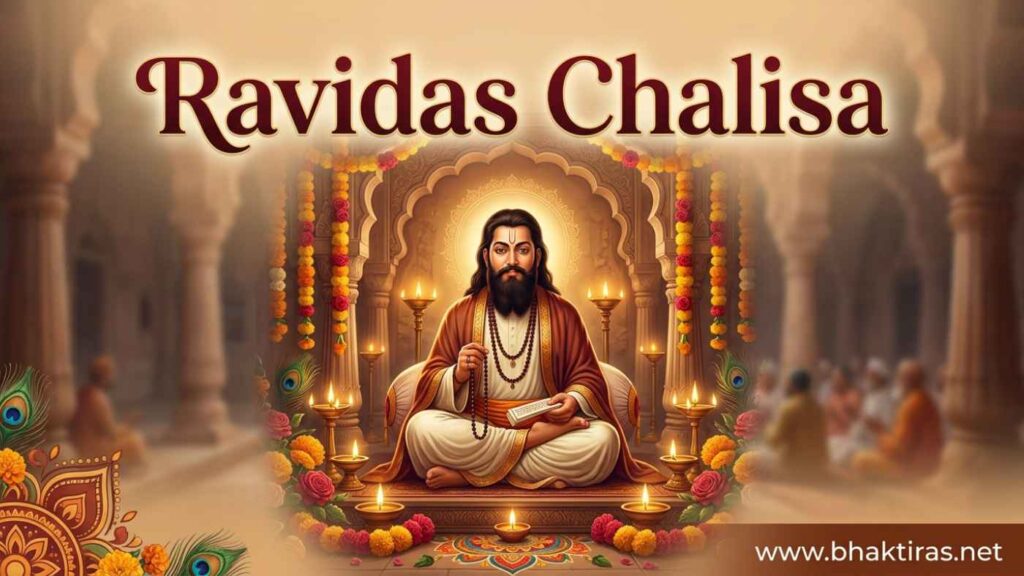
The Ravidas Chalisa is a forty-verse hymn that retells the life and teachings of Sant Ravidas (Guru Raidas), the 15th-century Bhakti saint-poet of Varanasi and guru of the Ravidassia tradition. It moves through his humble birth, his learning under Ramanand, his famous miracles, and his message that God looks only at a pure heart, never at caste or rank. This page carries the full chalisa in easy English transliteration, with an original line-by-line meaning for every verse so you can read it aloud and understand each word.
Ravidas Chalisa Lyrics in English (Transliteration)
Roman transliteration for easy chanting. Tap “Meaning” under any verse for the English translation.
Bandau veena pani ko, dehu aay mohi gyaan
Paay buddhi Ravidas ko, karau charitra bakhaan
Meaning
The poet bows to the lord who holds the veena and asks to be granted understanding. Having received the wisdom of Ravidas, he sets out to describe the saint's life and deeds.
Matu ki mahima amit hai, likhi na sakat hai daas
Taate aayo sharan mein, puravahu jan ki aas
Meaning
The glory of the Mother is endless, and this humble servant cannot fully write it. So he has come for shelter, asking that the hopes of the devotees be fulfilled.
Jai hovai Ravidas tumhari
Kripa karahu harijan hitkari
Meaning
Victory and praise to you, Ravidas. Pour out your grace, O friend and well-wisher of God's devotees.
Rahu bhakt tumhare taata
Karma naam tumhari maata
Meaning
Your father was a devout man named Rahu, and your mother carried the name Karma.
Kashi dhing Madur sthana
Varn achhut karat gujarana
Meaning
You were born near Kashi in the Madur locality. Counted among the so-called untouchables, you earned your living by working with hides.
Dwadash varsh umra jab aayi
Tumhare man hari bhakti samayi
Meaning
By the time you were twelve years old, love for Hari had already settled deep in your heart.
Ramanand ke shishya kahaaye
Paay gyaan nij naam badhaaye
Meaning
You came to be known as a disciple of Ramanand. Receiving true knowledge from him, your name and standing grew.
Shastra tark Kashi mein keenho
Gyanin ko updesh hai deenho
Meaning
You held scriptural debates in Kashi and offered teaching even to the learned scholars there.
Gang matu ke bhakt apara
Kaudi deenh unahi upahara
Meaning
A devotee of Mother Ganga came to you, and you gave him a single cowrie shell as a humble offering to carry.
Pandit jan tako lai jayi
Gang matu ko deenh chadhayi
Meaning
The pandit took that small shell to the river and offered it to Mother Ganga on your behalf.
Hath pasari leenh chaugani
Bhakt ki mahima amit bakhani
Meaning
Mother Ganga reached out her hand and accepted the gift, and the boundless glory of her devotee was thus made known.
Chakit bhaye pandit Kashi ke
Dekhi charit bhav bhay nashi ke
Meaning
The pandits of Kashi stood amazed when they witnessed this act of the one who removes the fears of worldly life.
Ratn jatit kangan tab deenha
Ravidas adhikari keenha
Meaning
Then the river sent back a jewel-set bracelet, marking Ravidas as a true and worthy devotee.
Pandit deejau bhakt ko mere
Aadi janm ke jo hai chere
Meaning
O pandit, hand this to my devotee, the one who has served the divine from his very first birth.
Pahunche pandit dhig Ravidasa
Dai kangan purai abhilasha
Meaning
The pandit came to Ravidas and gave him the bracelet, fulfilling the wish that had been set in motion.
Tab Ravidas kahi yah baata
Doosar kangan lavahu taata
Meaning
Then Ravidas said gently, 'Bring me a second bracelet to match this one, my friend.'
Pandit jan tab kasam uthayi
Doosar deenh na Ganga maayi
Meaning
The pandit swore an honest oath that Mother Ganga had given only this one and no second bracelet.
Tab Ravidas ne vachan uchaare
Pandit jan sab bhaye sukhaare
Meaning
Then Ravidas spoke words of calm wisdom, and all the pandits were set at ease.
Jo sarvada rahai man changa
Tau ghar basti matu hai Ganga
Meaning
If the mind stays always pure and good, then Mother Ganga herself dwells within one's own home.
Hath kathauti mein tab dara
Doosar kangan ek nikara
Meaning
He then dipped his hand into his small leather-worker's water pot and drew out a second bracelet from it.
Chit sankochit pandit keenhe
Apne apne marag leenhe
Meaning
The pandits felt humbled and abashed in their hearts, and quietly went their separate ways.
Tab se prachalit ek prasanga
Man changa to kathauti mein Ganga
Meaning
From that day a saying spread far and wide: if the heart is pure, the Ganga flows even in a humble water pot.
Ek baar phiri paryo jhamela
Mili panditjan keenho khela
Meaning
Once more a dispute arose, as the pandits gathered together and set up a test.
Salig Ram Gang utaravai
Soi prabal bhakt kahlavai
Meaning
Whoever could make a Saligram stone float upon the Ganga, they said, would be called the truly powerful devotee.
Sab jan gaye Gang ke teera
Murat tairavan beech neera
Meaning
Everyone went to the banks of the Ganga to set their sacred stones floating on the water.
Doob gayi sabki majhdhara
Sabke man bhayo dukh apara
Meaning
All the other stones sank in midstream, and every heart filled with deep dismay.
Patthar ki murti rahi utarayi
Sur nar mili jaikar machayi
Meaning
Only Ravidas's stone stayed afloat, and gods and people alike raised shouts of joyful praise.
Rahyo naam Ravidas tumhara
Machyo nagar mah hahakara
Meaning
Your name, Ravidas, rang out in honour, while a stir of wonder ran through the whole city.
Cheeri deh tum dugdh bahayo
Janm janeu aap dikhayo
Meaning
When challenged, you opened your own chest and let milk flow, revealing the sacred thread present from birth within.
Dekhi chakit bhaye sab nar nari
Vidwanan sudhi bisari saari
Meaning
Seeing this, every man and woman was astonished, and the learned ones forgot all their pride and arguments.
Gyaan tark Kabira sang keenho
Chakit unahu ka tum kari deenho
Meaning
You engaged in deep discussion of knowledge with Kabir, and left even him struck with wonder at your insight.
Guru Gorakhahi deenh updesha
Un manyo taki sant vishesha
Meaning
You gave guidance to Guru Gorakh as well, and he honoured you as a saint of rare distinction.
Sadna Peer tark bahu keenha
Tum tako updesh hai deenha
Meaning
Sadna Pir argued long with you, and you patiently offered him your teaching.
Man mah haryo Sadan kasai
Jo Dilli mein khabari sunai
Meaning
Sadna the butcher was won over within his heart, and word of this reached as far as Delhi.
Muslim dharm ki suni kubrayi
Lodhi Sikandar gayo gussai
Meaning
Hearing rumours that his faith had been slighted, Sikandar Lodi was filled with anger.
Apne grih tab tumhi bulava
Muslim hon hetu samujhava
Meaning
He summoned you to his court and pressed you with reasons to convert to his religion.
Maani nahi tum uski baani
Bandigrih kaati hai raani
Meaning
You refused to accept his demand, and so you were thrown into prison.
Krishn darash paaye Ravidasa
Saphal bhayi tumhari sab aasha
Meaning
In that confinement you received the vision of Krishna, and all your deepest hopes were fulfilled.
Taale tooti khulyo hai kaara
Maan Sikandar ke tum maara
Meaning
The locks broke open and the prison gave way, and the pride of Sikandar was brought low.
Kashi pur tum kah pahunchayi
Dai prabhuta aru maan badayi
Meaning
You returned in honour to the city of Kashi, received there with respect, dignity, and acclaim.
Meera yogavati guru keenho
Jinko kshatriya vansh praveeno
Meaning
You became the guru of Meera, the devoted yogini who came from a noble Kshatriya line.
Tinko dai updesh apara
Keenho bhav se tum nistara
Meaning
You gave her boundless teaching and carried her safely across the ocean of worldly existence.
Aise hi Ravidas ne, keenhe charit apaar
Koi kavi gaavai kitai, tahu na paavai paar
Meaning
In this way Ravidas performed countless wondrous deeds. However much any poet may sing of them, none can ever reach their end.
Niyam sahit harijan agar, dhyaan dharai chalisa
Taaki raksha karenge, jagatpati Jagdisha
Meaning
If a devotee meditates on this chalisa with discipline and faith, the Lord of the universe himself will guard and protect them.
Benefits of Reciting the Ravidas Chalisa
Reciting the Ravidas Chalisa is a way to honour Sant Ravidas and to carry his teaching of inner purity into daily life. Devotees turn to it for several reasons:
- Deepens devotion: The verses steady the mind in bhakti and draw the heart closer to the divine.
- Teaches equality: Ravidas’s example dissolves the habit of judging by caste or rank, replacing it with respect for every person.
- Builds self-respect: His life story instils dignity and the confidence to stand firm in one’s own worth.
- Brings inner calm: Regular recitation settles a restless mind and invites quiet and clarity.
- Strengthens resolve: Reflecting on how the saint faced injustice gives courage to meet one’s own hardships.
- Fosters unity: The hymn encourages goodwill and brotherhood across communities and faiths.
When and How to Chant the Ravidas Chalisa
The most cherished day to recite the Ravidas Chalisa is Magh Purnima, the full moon that marks Ravidas Jayanti, and it is also fitting on Sundays and other full-moon days. Many devotees read it daily in the early morning after bathing, seated before an image of Guru Ravidas with a lamp and incense lit. Read each line slowly, follow the meaning, and let the recitation be guided by faith and a calm, sincere heart rather than haste.
About the Ravidas Chalisa
The Ravidas Chalisa follows the classic forty-verse form: two opening dohas (couplets), forty chaupais, and a pair of closing dohas, composed in plain devotional Hindi. Rather than praising abstract qualities alone, it works as a short life story, recounting Sant Ravidas’s birth in a leather-working family near Varanasi, his discipleship under Ramanand, the cowrie and bracelet episode at the Ganga, the floating-stone test, his meetings with Kabir, Gorakh and Sadna, his firmness before Sikandar Lodi, and his role as guru to Meera. Throughout, it returns to his central message that purity of heart, not birth, is what reaches God.
Frequently Asked Questions
What is the Ravidas Chalisa?
The Ravidas Chalisa is a forty-verse devotional hymn that praises Sant Ravidas (Guru Raidas), the 15th-century Bhakti saint-poet of Varanasi. Through its verses it tells the story of his life, his miracles, and his teaching that God values a pure heart above caste or status.
What are the benefits of reciting the Ravidas Chalisa?
Reciting it deepens devotion, brings calm to the mind, and strengthens self-respect and courage. It also reinforces Sant Ravidas's message of equality and goodwill across all communities, helping the listener carry that spirit into everyday conduct.
Which day is best to recite the Ravidas Chalisa?
Magh Purnima, the full moon celebrated as Ravidas Jayanti, is the most auspicious day. Sundays and other full-moon days are also favoured, and many devotees recite it every morning as a daily practice.
How many verses are in the Ravidas Chalisa?
It has forty main verses, called chaupais, which is what the word 'chalisa' (forty) refers to. These are framed by two opening dohas and two closing dohas that begin and end the hymn.
Who was Sant Ravidas?
Sant Ravidas, also called Guru Raidas, was a mystic poet-saint of the Bhakti movement, born in Varanasi into a family of leather workers. He rose above caste prejudice through devotion and wisdom, became the guru of the Ravidassia tradition, and some of his verses are preserved in the Guru Granth Sahib.
Can the Ravidas Chalisa be recited in English?
Yes. This page provides the full hymn in clear English transliteration with a plain meaning for each verse, so anyone can recite it with devotion even without reading Hindi script. Understanding the meaning as you read deepens the experience.
॥ Ravidas Chalisa ॥