
ॐ
Ketu Chalisa
श्री केतु चालीसा
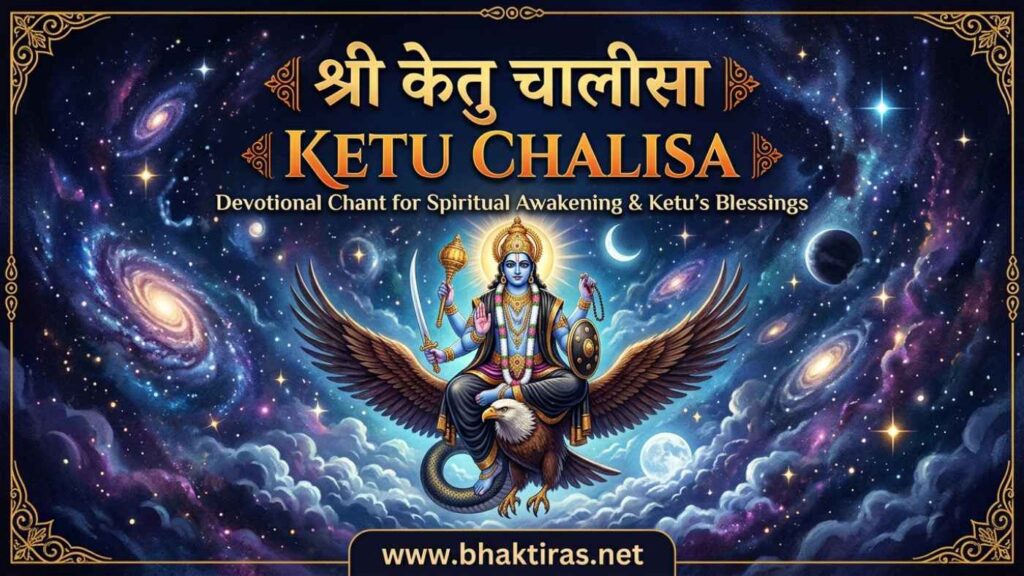
The Ketu Chalisa is a forty-verse Hindi devotional addressed to Ketu, the south lunar node of the Navagraha and a shadow planet linked to detachment, moksha and inner wisdom. Devotees turn to it during a difficult Ketu period, for relief from Ketu dosha, and as part of Kaal Sarp remedies. This page carries the full text in easy English transliteration along with a plain-English meaning for every verse, so you can both recite it and follow what each line is saying.
Ketu Chalisa Lyrics in English (Transliteration)
Roman transliteration for easy chanting. Tap “Meaning” under any verse for the English translation.
Ketu deva dhvaja rupa prabhu, moksha marga vistara.
Maya bandhana katiae, dijai jnana apara.
Meaning
O Lord Ketu, whose form is the banner, widen the road to liberation for me. Sever the chains of illusion and grant knowledge without limit.
Jaya jaya Ketu deva dukha hari.
Moksha marga ke tum rakhwali.
Meaning
Victory and praise to Lord Ketu, who carries away sorrow; you keep watch over the path that leads to release.
Dhvaja svarupa jagata vikhyata.
Karma rahasya ke tum data.
Meaning
Known across the world in your flag-like form, you are the one who reveals the hidden workings of karma.
Chhaya graha tum gudha vichara.
Maya kato jnana hamara.
Meaning
As the shadow planet of deep and secret thought, cut away our illusion and awaken true understanding in us.
Rahu se tana bhinna kahae.
Mukti patha para mana ko lae.
Meaning
You are spoken of as the body set apart from Rahu, and you turn the mind toward the road of liberation.
Dhumra varna rupa nirala.
Kate ajnana tamas janjala.
Meaning
Your smoke-coloured form is unlike any other; it slices through the tangle of ignorance and darkness.
Mina vahana shubha phalakari.
Bhaktana para kripa tumhari.
Meaning
Your fish mount carries blessings and good outcomes, and your kindness pours over those who are devoted to you.
Ketu kala jaba kathina banave.
Nama tumhara raha dikhave.
Meaning
When the season ruled by Ketu turns harsh, simply calling your name lights up the way ahead.
Kutte ko bhojana jo dei.
Daya bhava se pida hara lei.
Meaning
Whoever feeds dogs out of genuine compassion finds their own pain quietly lifted away.
Tila kambala dana karavo.
Karma dosha saba shanta banavo.
Meaning
By giving sesame and blankets in charity, the faults carried over from past actions are calmed and settled.
Ganapati sang nata pyara.
Vighna hate ho shubha ujiyara.
Meaning
Your dear bond with Lord Ganesha clears obstacles and lets a gentle, fortunate light shine through.
Dhyana samadhi patha dikhalate.
Chanchala mana ko shunya banate.
Meaning
You point out the route of meditation and deep absorption, emptying and stilling a mind that will not stay quiet.
Ahankara ka mula hatao.
Satya atma ka bodha karao.
Meaning
Pull out the very root of pride and let the awareness of the real Self dawn.
Purva janma ke bandhana kato.
Karma granthi saba shighra chhurao.
Meaning
Cut the ties brought from earlier lives and swiftly loosen every knot that karma has tied.
Rahasya vidya tumase jage.
Antara dipa ajnana se bhage.
Meaning
Through you, hidden wisdom comes alive; the inner lamp glows and ignorance runs from it.
Achanaka hani jaba a jae.
Ketu kripa dhairya dilae.
Meaning
When loss strikes without warning, the grace of Ketu steadies the heart and gives patience.
Vairagya ka shubha dipa jalao.
Lobha moha saba dura bhagao.
Meaning
Kindle the welcome lamp of detachment and chase greed and clinging far away.
Shatru bhitara sandeha hamara.
Tumase ho usaka uddhara.
Meaning
The enemy inside us is doubt; it is through you that we are freed from it.
Ketu mantra jo nita jana gave.
Bhaya bhrama bandhana dura bhagave.
Meaning
Anyone who sings the Ketu mantra each day drives off fear, confusion and the things that hold them captive.
Dhvaja arpana prema se karai.
Jivan mein shubha gati vaha dharai.
Meaning
One who offers a flag to you with love takes on a favourable course in life.
Roga rahasya harane vale.
Sukshma karana jananahare.
Meaning
You take away illnesses that defy explanation, for you know their subtle, unseen causes.
Sarpa dosha ki shanti karao.
Vansha pida dura hatao.
Meaning
Bring peace to serpent-related afflictions and remove the distress that runs through a family line.
Adhyatma marga sarala banao.
Guru charana mein bhava jagao.
Meaning
Smooth the spiritual road and stir up heartfelt devotion at the feet of the teacher.
Mana ki ulajhana kato natha.
Dikhalao muktipatha satha.
Meaning
Untangle the knots of the mind, O Lord, and walk beside me showing the way to freedom.
Mauna tumhara jnana batave.
Bina shabda mana satya ko pave.
Meaning
Your silence itself teaches; without a single word, the mind arrives at truth.
Kundali mein jaba Ketu bhari.
Karo kripa sankata nivari.
Meaning
When Ketu sits heavily in the birth chart, extend your grace and lift away the troubles it brings.
Adrishya raksha tum kara dena.
Bhakta ko nija dhyana mein lena.
Meaning
Grant protection that cannot be seen and keep your devotee held within your attention.
Tantrika marga jo sadhaka dhyave.
Guru ajna se siddhi pave.
Meaning
Seekers on the tantric path who meditate on you reach their goal by the sanction of their guru.
Bhramita prasiddhi dura karao.
Atma satya mein mana lagavao.
Meaning
Take away fame that only misleads and fix the mind on the truth of the Self.
Nirasha mana mein jyoti jalao.
Jivan ko nutana artha dilao.
Meaning
Light a flame of hope in a mind sunk in despair and give life a fresh sense of purpose.
Ulkapata sa karma dikhate.
Achanaka parivartana sikhalate.
Meaning
Like a falling meteor you show how karma can strike, and you teach the lesson of sudden change.
Moksha karaka deva tumhare.
Nama jape bhava bandhana tare.
Meaning
You are the deity who brings liberation; repeating your name dissolves the bonds of worldly life.
Dhyana mein jo badha avai.
Ketu deva use dura hata vai.
Meaning
Whatever disturbance arises during meditation, Lord Ketu pushes it aside.
Tarka jahan para thaka-sa jae.
Antarjnana patha batalae.
Meaning
Where reasoning grows tired and falters, inner knowing steps in to point the way.
Viccheda mein bhi kripa chipi.
Chhootan mein bhi mukti likhi.
Meaning
Even within separation a hidden grace is at work; even in letting go, liberation is already written.
Sadhaka jaba saba chhora sake.
Tab hi satya se jora sake.
Meaning
Only when the seeker is able to give up everything can they truly be joined with truth.
Jo Chalisa prema se padhe.
Ketu dosha saba shanta pade.
Meaning
Whoever reads this Chalisa with love finds every Ketu-related affliction growing quiet.
Anta samaya vairagya dilana.
Hari smarana se para lagana.
Meaning
At life's close, grant the gift of detachment and carry us over through remembrance of the Lord.
Bhakta tumhare charana nihare.
Ketu deva saba klesha nivare.
Meaning
For the devotees who keep their gaze on your feet, Lord Ketu clears away every trouble.
Jaya Ketu jnana prakashaka.
Maya bandhana ke vinashaka.
Meaning
Glory to Ketu, who throws light on knowledge and breaks apart the chains of illusion.
Karo kripa he moksha data.
Raksha karo chhaya vighnaharta.
Meaning
Be gracious, O giver of liberation; protect us, O shadow-formed one who removes obstacles.
Ketu deva kripa karo, do vairagya vichara.
Maya bandhana katakara, kara do bhava se para.
Meaning
O Lord Ketu, be gracious and give us detachment and clear discernment. Cut the bonds of illusion and carry us safely across the ocean of worldly existence.
Benefits of Reciting the Ketu Chalisa
Devotees recite the Ketu Chalisa to soften the testing effects of Ketu and to grow inwardly. Commonly cited benefits include:
- Eases Ketu dosha: Regular recitation is used to lessen the unsettling effects of a weak or troubled Ketu in the birth chart.
- Kaal Sarp relief: Because Ketu is one of the two nodes involved in Kaal Sarp dosha, the Chalisa is a popular part of remedies for serpent-related afflictions.
- Mental clarity: It is chanted to settle a restless, scattered mind and bring back focus and calm.
- Detachment and moksha: The verses turn the heart toward letting go of ego and clinging, supporting the longing for liberation.
- Steadiness in sudden change: Since Ketu rules abrupt events, the prayer is recited for patience and balance when life shifts unexpectedly.
- Support during Ketu dasha: Many keep up the recitation through a Ketu planetary period as a daily anchor of protection and faith.
When and How to Chant the Ketu Chalisa
Saturday is widely regarded as the most fitting day for Ketu worship, and many also recite on Tuesdays or daily through a Ketu period. Bathe and sit in clean clothes in a quiet spot, light a lamp (a mustard-oil lamp is traditional), and begin with a short prayer to Ganesha. You may chant the Ketu beej mantra a few times, then read the Chalisa slowly, keeping the meaning of each verse in mind rather than rushing. Acts of compassion such as feeding dogs or donating sesame and blankets are traditionally paired with the practice. What matters most is sincere attention, not elaborate ritual.
About the Ketu Chalisa
The Ketu Chalisa follows the familiar chalisa form: an opening doha, forty short chaupai verses, and a closing doha, here totalling forty-two units of text. It is composed in simple Hindi and belongs to the wider Navagraha devotional tradition, in which each of the nine planetary forces has its own hymn. Ketu, the south lunar node and a shadow planet, is treated as a power of detachment, hidden knowledge and liberation, and the verses repeatedly ask for release from illusion, relief from karmic and serpent-related troubles, and a steady mind on the spiritual path.
Frequently Asked Questions
What is the Ketu Chalisa?
The Ketu Chalisa is a forty-verse Hindi hymn dedicated to Ketu, the south lunar node of the Navagraha and a shadow planet associated with detachment, inner wisdom and moksha. It is recited for relief from Ketu dosha, support during a Ketu period, and as part of Kaal Sarp remedies.
What are the benefits of reciting the Ketu Chalisa?
Devotees recite it to ease the effects of a troubled Ketu, to help with Kaal Sarp dosha, to calm a restless mind, and to encourage detachment and spiritual progress. It is also chanted for steadiness during sudden changes and for protection through a Ketu dasha.
Which day is best to recite the Ketu Chalisa?
Saturday is generally considered the most suitable day for Ketu worship, though many also recite on Tuesdays or every day during a Ketu period. It can be chanted any morning after bathing, ideally before meditation.
How many verses are in the Ketu Chalisa?
This Ketu Chalisa has forty chaupai verses, with an opening doha and a closing doha, making forty-two units of text in total.
Can the Ketu Chalisa be recited in English?
Yes. If you cannot read Hindi, you can recite it from the English transliteration provided on this page. Reading the per-verse meaning alongside helps you connect with the prayer.
What is the difference between Rahu and Ketu?
Rahu is the north lunar node and Ketu is the south lunar node, often described as the headless counterpart. Rahu is linked with worldly desire and ambition, while Ketu is linked with detachment, spirituality and liberation.
॥ Ketu Chalisa ॥