
ॐ
Vaishno Devi Chalisa
श्री वैष्णो देवी चालीसा
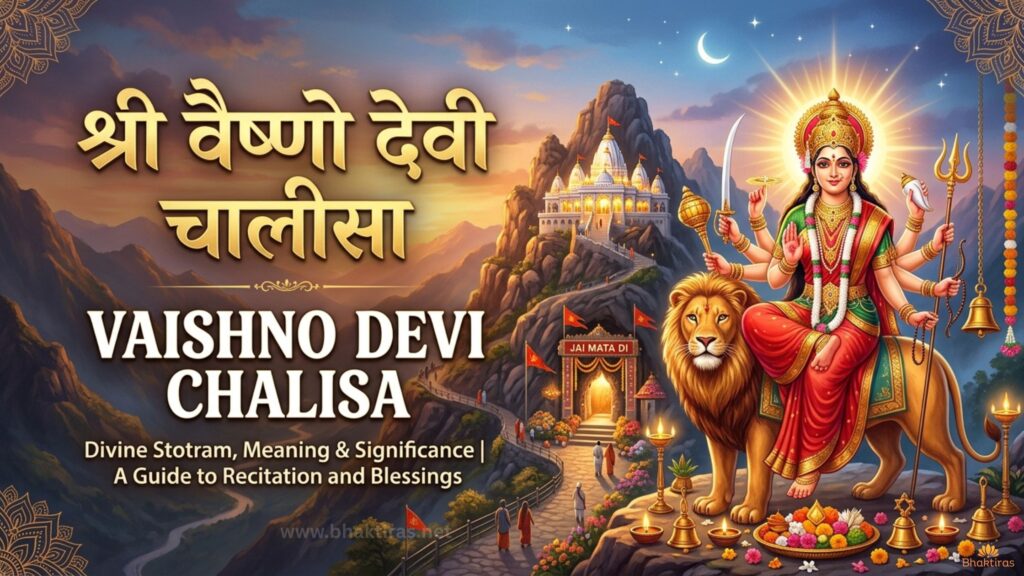
The Vaishno Devi Chalisa is a 40-verse devotional hymn to Maa Vaishno Devi, the Mother enshrined as the holy Pindi in the Trikuta cave at Katra. Its verses trace her vow, her journey, the Bhairon episode, and the worship offered to her by millions of pilgrims. This page gives the full Roman (English) transliteration with a clear meaning for every verse, so you can both recite the lines and follow what each one says.
Vaishno Devi Chalisa Lyrics in English (Transliteration)
Roman transliteration for easy chanting. Tap “Meaning” under any verse for the English translation.
Garuda vahini Vaishnavi, Trikuta parvata dhama
Kali, Lakshmi, Saraswati, Shakti tumhen pranam.
Meaning
O Vaishnavi who rides Garuda, whose home is the Trikuta peak; you are Kali, Lakshmi and Saraswati in one, and I bow to you, Mother Shakti.
Namo namo Vaishno varadani
Kali kaal mein shubh kalyani.
Meaning
Salutations again and again to Vaishno, the giver of boons, who brings welfare and good fortune in the dark age of Kali.
Mani parvata par jyoti tumhari
Pindi rupa mein ho avatari.
Meaning
Your divine light shines on Mani mountain, where you have taken form as the sacred Pindi rock.
Devi devata amsha diyo hai
Ratnakara ghara janma liyo hai.
Meaning
The gods each gave a portion of their power for you, and you were born in the household of the sage Ratnakar.
Kari tapasya rama ko paun
Treta ki shakti kahalaun.
Meaning
You undertook penance to attain Lord Rama, and so you are known as the Shakti of the Treta age.
Kaha rama mani parvata jao
Kaliyuga ki devi kahalao.
Meaning
Rama told you to go to Mani mountain, where you would come to be called the Goddess of the Kali age.
Vishnu rupa se kalki banakara
Lunga shakti rupa badalakara.
Meaning
He said that he himself, in the form of Vishnu, would appear as Kalki, while you would take on the form of Shakti.
Taba taka trikuta ghati jao
Gupha andheri jakara pao.
Meaning
Until that time, he asked you to go to the Trikuta valley and make your home in a dark cave.
Kali lakshmi sarasvati man
Karemgi rakshana parvati man.
Meaning
Kali, Lakshmi and Saraswati, together as Mother Parvati, would stand as your guardians.
Brahma vishnu shamkara dvare
Hanumata bhairom prahari pyare.
Meaning
Brahma, Vishnu and Shankara remain at your gates, while the dear Hanuman and Bhairon keep watch as sentinels.
Riddhi siddhi chanvara dulavem
Kaliyuga vasi pujata avem.
Meaning
Riddhi and Siddhi fan you with the fly-whisk, and the people of the Kali age come to offer you worship.
Paan supari dhvaja nariyal
Charanamrit charnon ka nirmal.
Meaning
Devotees bring betel leaves, areca nuts, flags and coconuts, and receive the pure charanamrit that flows from your feet.
Diya phalit var Maa muskayi
Karan tapasya parvat aayi.
Meaning
The boon bore fruit and the Mother smiled; she had come to the mountain to perform her penance.
Kali Kaalki bhadki jwala
Ek din apna roop nikala.
Meaning
The fierce flame of Kali-Kalki blazed within her, and one day she revealed her true divine form.
Kanya ban Nagrota aayi
Yogi Bhairon diya dikhai.
Meaning
Appearing as a young maiden, she came to Nagrota, where the yogi Bhairon caught sight of her.
Roop dekh sundar lalchaya
Peechhe-peechhe bhaga aaya.
Meaning
Drawn by her beautiful form and overcome with craving, Bhairon chased after her.
Kanyaon ke saath mili Maa
Kaul-Kandouli tabhi chali Maa.
Meaning
The Mother joined a group of young girls and then set out toward Kaul and Kandouli.
Deva Maai darshan deena
Pavan roop ho gayi praveena.
Meaning
The Divine Mother granted her vision and, swift as the wind, moved on with skill.
Navratron mein leela rachai
Bhakt Shridhar ke ghar aayi.
Meaning
During the Navratri days she enacted her divine play and came to the home of her devotee Shridhar.
Yogin ko bhandara deeni
Sabne ruchikar bhojan keena.
Meaning
She hosted a feast for the assembled yogis, and everyone ate the tasty food with relish.
Maans madira Bhairon maangi
Roop pavan kar ichcha tyagi.
Meaning
Bhairon demanded meat and wine; the Mother kept her form pure and refused his desire.
Baan maarkar Ganga nikli
Parvat bhagi ho matwali.
Meaning
She shot an arrow and a stream of Ganga sprang forth; then she sped off across the mountain, full of fierce energy.
Charan rakhe aa ek sheela
Jab Charan-Paduka naam pada tab.
Meaning
She set her foot upon a rock, and from that moment the spot became known as Charan-Paduka.
Peechhe Bhairon tha balkaari
Choti gufa mein jaay padhaari.
Meaning
With the powerful Bhairon still chasing her, she entered a small cave to take shelter.
Nau mah tak kiya nivaasa
Chali fodkar kiya prakaasha.
Meaning
She dwelt in that cave for nine months, then broke through it and emerged into the light.
Aadya Shakti-Brahm Kumari
Kehlai Maa Aad Kunwaari.
Meaning
As the primordial Shakti and celestial maiden, she came to be called Mother Adi Kunwari.
Gufa dwar pahunchi muskai
Laangur Veer ne aagya pai.
Meaning
She reached the mouth of the cave with a smile, and the brave Langur received her command.
Bhaaga-bhaaga Bhairon aaya
Raksha hit nij shastra chalaaya.
Meaning
Bhairon came rushing after her, and to defend herself the Mother struck out with her weapon.
Pada sheesh ja parvat oopar
Kiya kshama ja diya use var.
Meaning
His severed head fell on the mountaintop; she forgave him and granted him a boon.
Apne sang mein pujvaungi
Bhairon Ghaati banvaungi.
Meaning
She promised to have him worshipped alongside her and to establish the shrine of Bhairon Ghati.
Pehle mera darshan hoga
Peechhe tera sumiran hoga.
Meaning
She declared that her own darshan would come first, and only afterward would Bhairon be remembered.
Baith gayi Maa Pindi hokar
Charanon mein bahta jal jhar-jhar.
Meaning
The Mother settled in as the holy Pindi, with sacred water flowing endlessly at her feet.
Chaunsatha Yogini Bhairon Barvana
Saptrishi aa karate sumarana.
Meaning
The sixty-four Yoginis and Bhairon guard the place, and the seven great sages come to chant her name.
Ghanta dhvani parvata para baje
Gupha nirali sundara lage.
Meaning
The peal of bells rings out across the mountain, and the cave appears wonderfully unique and beautiful.
Bhakt Shridhara pujan kina
Bhakti seva ka vara lina.
Meaning
The devotee Shridhar carried out her worship and was granted the gift of loving service.
Sevaka dhyanun tumako dhyaya
Dhvaja va chola ana chadhaya.
Meaning
Your servants meditate upon you and come to offer flags and robes at your shrine.
Sinha sada dara pahara deta
Panja shera ka dukha hara leta.
Meaning
The lion forever stands guard at your door, and its mighty roar takes away every sorrow.
Jambu Dvipa Maharaja manaya
Sara sone ka chhatra chadhaya.
Meaning
The king of Jambudvipa honored you and offered a canopy made of pure gold.
Hire ki murata sanga pyari
Jage akhanda eka jota tumhari.
Meaning
The beloved diamond image stays with you, and your single unbroken flame burns ever awake.
Ashvina Chaitra navaratri aave
Koti-koti bhakt darshana paave.
Meaning
When the Navratris of Ashvin and Chaitra arrive, countless millions of devotees come for your darshan.
Jo yeh chalisa path kare
Mana vanchita phala avashya bhare.
Meaning
Whoever recites this Chalisa will surely have the wishes of their heart fulfilled.
Vaishno Devi ki kripa, sada rahe sukh sar
Jo chalisa niyam kare, tako milai avatar.
Meaning
By the grace of Vaishno Devi may happiness always remain; whoever recites this Chalisa with regularity attains the highest reward.
Benefits of Reciting the Vaishno Devi Chalisa
Devotees recite the Vaishno Devi Chalisa with faith for both inner steadiness and the Mother’s blessings in daily life.
- Fulfilment of wishes: It is recited to ask the Mother for the sincere desires of the heart, the manvanchit phal she is known to grant.
- Relief from fear and obstacles: Regular chanting is believed to ease worries, hurdles and troubles.
- Peace of mind: The rhythm and meaning of the verses help calm the mind and support a steady devotional practice.
- Well-being: Many chant it to reduce stress and invite better health into the home.
- Prosperity: Devotees turn to it seeking happiness, abundance and success in their efforts.
When and How to Chant the Vaishno Devi Chalisa
The Chalisa can be read every day, ideally in the early morning or at dusk, and it carries special weight during the nine days of Navratri in the months of Ashvin and Chaitra, as well as on a yatra to the cave shrine at Katra. Bathe and wear clean clothes, sit facing north or the Mother’s image, light a lamp and offer red flowers or a chunri. Recite the verses slowly, keeping the meaning and the Mother’s story in mind, and close with the Vaishno Devi Aarti and the call of “Jai Mata Di”.
About the Vaishno Devi Chalisa
The Vaishno Devi Chalisa follows the classic chalisa form: forty chaupai verses framed by an opening and a closing doha. It is set in Hindi and is traditionally attributed to an unnamed devotee. Across its verses it narrates the Mother’s vow during the Treta age, her descent to the Trikuta hills, the episode with Bhairon, her settling as the self-manifested Pindi, and the worship that surrounds her shrine, ending with the promise that sincere recitation is rewarded.
Frequently Asked Questions
What is the Vaishno Devi Chalisa?
It is a 40-verse devotional hymn to Maa Vaishno Devi that recounts her divine story, her shrine at Trikuta in Katra, and her grace toward devotees who recite it with faith.
What are the benefits of reciting the Vaishno Devi Chalisa?
Devotees recite it seeking the fulfilment of heartfelt wishes, relief from fear and obstacles, peace of mind, well-being and prosperity, especially when chanted regularly with devotion.
Which day is best to recite the Vaishno Devi Chalisa?
It can be read daily, morning or evening. It carries special significance during the nine days of Navratri in Ashvin and Chaitra, and on a pilgrimage to the cave shrine.
How many verses are in the Vaishno Devi Chalisa?
It has 40 chaupai verses, with an opening doha and a closing doha that frame the hymn, in keeping with the traditional chalisa form.
Can the Vaishno Devi Chalisa be recited in English?
Yes. This page gives the full Roman (English) transliteration of every verse along with its meaning, so anyone can recite it accurately even without reading Devanagari.
What is the significance of the Pindi at the shrine?
The Pindi is the sacred rock inside the cave at Katra, regarded as the self-manifested form of the Goddess. It is the main object of worship and is referred to directly in the Chalisa.
॥ Vaishno Devi Chalisa ॥