
ॐ
Narasimha Chalisa
श्री नृसिंह चालीसा
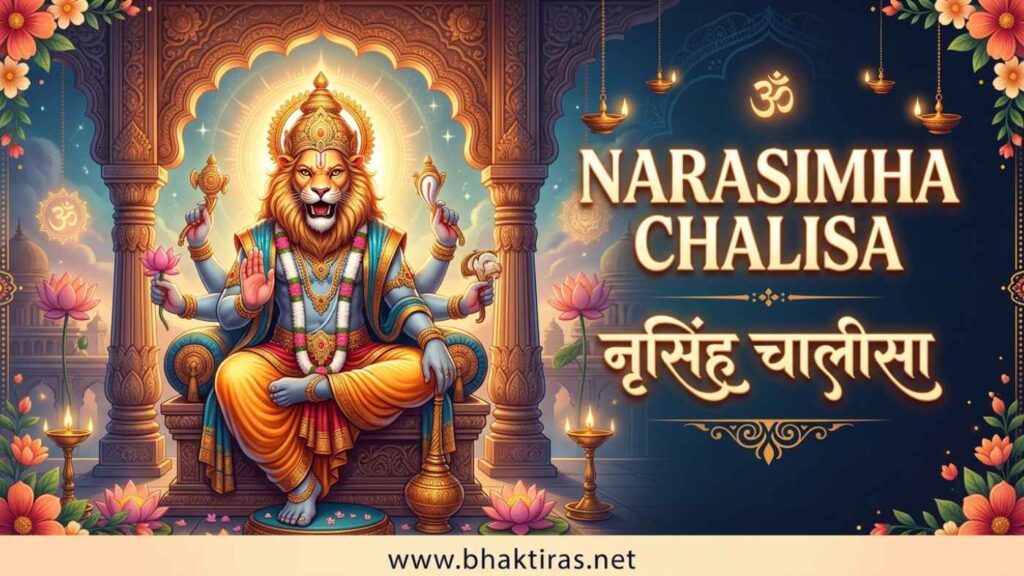
The Narasimha Chalisa is a forty-verse hymn to Lord Narasimha, the half-man, half-lion avatar of Vishnu who tore apart the tyrant Hiranyakashipu to protect his young devotee Prahlad. Its verses recall that fierce rescue and ask the same protector to shield the reciter from enemies, disease, fear and evil influence. This page gives the complete chalisa in easy English (Roman) transliteration, with a clear, original meaning under every verse so you can both recite it and understand what each line says.
Narasimha Chalisa Lyrics in English (Transliteration)
Roman transliteration for easy chanting. Tap “Meaning” under any verse for the English translation.
Maas Vaishakh Krittika yut, haran mahi ko bhaar
Shukla Chaturdashi sma din, liyo Narasimha avataar
Meaning
In the month of Vaishakh, under the Krittika star, to lift the burden of the earth, Lord Narasimha took his form on the fourteenth day of the bright fortnight.
Narasimha Dev main sumarom tohi
Dhan bal vidya daan de mohi
Meaning
Lord Narasimha, I hold you in my heart and call on you; grant me wealth, strength and the gift of knowledge.
Jai jai Narasimha kripaala
Karo sada bhaktan pratipala
Meaning
Victory to you, compassionate Narasimha; always watch over and sustain those who are devoted to you.
Vishnu ke avataar dayaala
Mahakaal kaalan ko kaala
Meaning
You are the merciful descent of Vishnu, the great ender of time, death even to death itself.
Naam anek tumhaaro bakhaano
Alpa buddhi main na kachhu jaano
Meaning
Your names are countless and beyond praise; with my small understanding I can grasp almost none of them.
Hiranyakashyap nrip ati abhimaani
Tehi ke bhaar mahi akulaani
Meaning
The king Hiranyakashipu grew swollen with arrogance, and under his weight the very earth grew distressed.
Hiranyakashyap Kayadhu ke jaaye
Naam bhakt Prahlad kahaaye
Meaning
To Hiranyakashipu and Kayadhu a son was born, and that child was known as the devotee Prahlad.
Bhakt bana Vishnu ko daasa
Pita kiyo maaran parayaasa
Meaning
The boy became a true servant of Vishnu, and for this his own father tried every way to have him killed.
Astra shastra bhuja dand prachanda
Agni daah kiye prachanda
Meaning
Weapons, blades and mighty arms were turned on him, and he was even thrown into a raging fire.
Bhakt hetu tum liyo avataara
Dushta dalan haran mahi bhaara
Meaning
For the sake of your devotee you took this form, crushing the wicked and lifting the burden of the earth.
Tum bhaktan ke bhakt tumhaare
Prahlad ke praan piyaare
Meaning
You belong to your devotees and they belong to you; to Prahlad you were dearer than his own life.
Pragat bhaye phaad kar tum khambha
Dekh dusht-dal bhaye achambha
Meaning
You burst forth by splitting open the pillar, and seeing this the band of evildoers was struck with terror.
Khadag jihva tanu sundar saaja
Urdhva kesh maha damshtra viraaja
Meaning
Your tongue was like a sword and your form fearsome yet splendid, your hair standing on end and great fangs blazing.
Tapt swarn sama badan tumhaara
Ko varne tumhaaro vistaara
Meaning
Your body shone like molten gold; who could ever fully describe your vast and dazzling appearance?
Roop chaturbhuj badan vishaala
Nakh jihva hai ati vikaraala
Meaning
Four-armed and broad of face you appeared, your claws and tongue terrifying to behold.
Swarn mukut badan ati bhaari
Kaanan kundal ki chhavi pyaari
Meaning
A heavy golden crown rested on your head, and the rings in your ears made a beautiful, gentle sight.
Bhakt Prahlad ko tumne ubaara
Hiranyakashyap khal kshan mah maara
Meaning
You rescued the devotee Prahlad, and the cruel Hiranyakashipu you destroyed in a single moment.
Brahma Vishnu tumhe nit dhyaave
Indra Mahesh sada man laave
Meaning
Brahma and Vishnu meditate on you daily, and Indra and Lord Shiva keep their minds fixed on you.
Ved Puran tumharo yash gaave
Shesh Sharada paar na paave
Meaning
The Vedas and Puranas sing your glory, yet even Shesha and Saraswati cannot reach its limit.
Jo nar dharo tumhaaro dhyaana
Taako hoy sada kalyaana
Meaning
Whoever holds you in steady meditation finds well-being and good fortune always at hand.
Traahi traahi dukh nivaaro
Bhava bandhan prabhu aap hi taaro
Meaning
Save me, save me, take away my sorrow; Lord, it is you alone who can release me from the bonds of worldly life.
Nitya jape jo naam tihaara
Dukh vyaadhi ho nistaara
Meaning
Whoever chants your name each day is carried safely past sorrow and disease.
Sthaan heen jo jaap karaaye
Man ichchhit so nar sukh paaye
Meaning
Even one who has lost his place and standing, by reciting this, gains the happiness his heart longs for.
Vandhya naari susantaan ko paaye
Nar daridra dhani hoye jaaye
Meaning
The childless woman is blessed with good children, and the poor man is turned into one who prospers.
Jo Narasimha ka jaap karaave
Taahi vipatti sapne nahin aave
Meaning
For one who recites the name of Narasimha, misfortune will not approach, not even in a dream.
Jo kaamna kare man maahi
Sab nishchay so siddh hui jaahi
Meaning
Whatever wish such a person holds in the mind will surely come to fulfilment.
Jeevan mein jo kuchh sankat hoye
Nishchay Narasimha sumare soi
Meaning
When any crisis arises in life, one should firmly turn the mind to Narasimha and remember him.
Rog grasit jo dhyaave koi
Taaki kaaya kanchan hoi
Meaning
If one weighed down by illness meditates on him, the body is restored and made whole as gold.
Dakini Shakini pret betaala
Graha vyaadhi aru yam vikaraala
Meaning
Witches and spirits, ghosts and goblins, planetary affliction and the dread power of death itself,
Pret pishaach sabe bhay khaaye
Yam ke doot nikat nahin aave
Meaning
all such ghosts and demons are themselves seized with fear, and the messengers of death do not come near.
Sumar naam vyaadhi sab bhaage
Rog-shok kabahu nahin laage
Meaning
At the remembrance of your name every disease flees, and sickness and grief never take hold.
Jaake nazar dosh ho aai
So Narasimha Chalisa gaai
Meaning
Whoever has fallen under the harm of an evil eye should sing this Narasimha Chalisa.
Hate nazar hove kalyaana
Vachan satya saakhi bhagwaana
Meaning
The evil eye is lifted and good fortune follows; this word is true, with the Lord himself as witness.
Jo nar dhyaan tumhaaro laave
So nar man vanchhit phal paave
Meaning
The person who fixes meditation on you receives the very fruit his heart has wished for.
Banvaaye jo mandir gyaani
Ho jaave vah nar jag maani
Meaning
The wise one who has a temple built in your honour becomes honoured and respected throughout the world.
Nit prati paath karo ek baara
So nar rahe tumhaara pyaara
Meaning
Whoever reads this hymn once every day remains forever dear to you.
Narasimha Chalisa jo jan gaave
Dukh daridra taake nikat na aave
Meaning
For anyone who sings the Narasimha Chalisa, sorrow and poverty do not come near.
Chalisa jo nar padhe padhaave
So nar jag mein sab kuchh paave
Meaning
The person who recites this chalisa and teaches it to others gains everything worth having in this world.
Yah Shri Narasimha Chalisa
Padhe rank hove avaneesa
Meaning
By reading this Shri Narasimha Chalisa, even a pauper can rise to become a lord of the land.
Jo dhyaave so nar sukh paave
Tohi vimukh bahu dukh uthaave
Meaning
Whoever meditates on you finds happiness, while one who turns away from you bears much suffering.
Shiv swaroop hai sharan tumhaari
Haro naath sab vipatti hamaari
Meaning
You are one with Shiva himself, and I take refuge in you; Lord, take away all our troubles.
Chaaron yug tihu mahima apaar
Nij bhaktan ke praan hit liyo jagat avataar
Meaning
Through all four ages and the three worlds your glory is boundless; for the very life of your devotees you took form in this world.
Benefits of Reciting the Narasimha Chalisa
Reciting the Narasimha Chalisa is traditionally done to call on the fierce, protective side of the divine in times of fear or threat.
- Protection from enemies: Narasimha is invoked as the destroyer of tyranny, asked to guard the reciter from those who wish harm.
- Fearlessness: The verses promise that ghosts, evil spirits and the dread of death lose their grip on a steady devotee.
- Relief from illness: Several verses ask for the body to be restored and for disease and grief to fall away.
- Removal of evil eye: The chalisa is recited specifically to lift the harm of an evil or jealous gaze.
- Fulfilment of sincere wishes: Verse after verse links honest devotion to the granting of the heart’s true desires.
- Courage in crisis: It is turned to whenever a sudden difficulty or danger arises in life.
When and How to Chant the Narasimha Chalisa
The Narasimha Chalisa is recited most fittingly on Narasimha Jayanti (the appearance day in the month of Vaishakh) and on Saturdays, though daily recitation is encouraged. After a bath, sit before an image of Lord Narasimha, light a lamp, and read the hymn aloud with full attention, ideally once or several times in one sitting. What matters is not speed but sincerity: read with a settled mind and genuine surrender, letting the meaning of each verse stay with you rather than rushing the words.
About the Narasimha Chalisa
This is a traditional Hindi devotional composition in the standard chalisa form: a pair of opening dohas (couplets), forty chaupais (four-line verses), and a closing doha. The text retells the heart of the Narasimha story, the splitting of the pillar, the slaying of Hiranyakashipu and the saving of Prahlad, and then turns to the protection and blessings the avatar grants his devotees. Like most chalisas, it is anonymous folk-devotional poetry passed down and printed in many slightly varying recensions; the version here follows the widely circulated forty-verse text.
Frequently Asked Questions
What is the Narasimha Chalisa?
The Narasimha Chalisa is a forty-verse Hindi devotional hymn praising Lord Narasimha, the man-lion avatar of Vishnu who killed the demon-king Hiranyakashipu to save his devotee Prahlad. It is recited for protection, courage and the lifting of fear and misfortune.
What are the benefits of reciting the Narasimha Chalisa?
Devotees recite it for protection from enemies and evil influence, freedom from fear, relief from disease and grief, removal of the evil eye, and the fulfilment of sincere wishes. The verses promise that a steady reciter is guarded even in crisis.
Which day is best to recite the Narasimha Chalisa?
Narasimha Jayanti, the appearance day of Lord Narasimha in the month of Vaishakh, is the most auspicious occasion. Saturdays are also favoured, and many devotees recite it every day.
How many verses are in the Narasimha Chalisa?
It follows the standard chalisa structure: opening dohas, forty chaupai verses, and a closing doha. The forty main verses give the form its name.
Can the Narasimha Chalisa be recited in English?
Yes. This page provides the full chalisa in Roman (English) transliteration so it can be read aloud by anyone who does not read Devanagari, along with a clear meaning for every verse so the words can be understood as well as recited.
॥ Narasimha Chalisa ॥