
ॐ
Durga Chalisa
श्री दुर्गा चालीसा
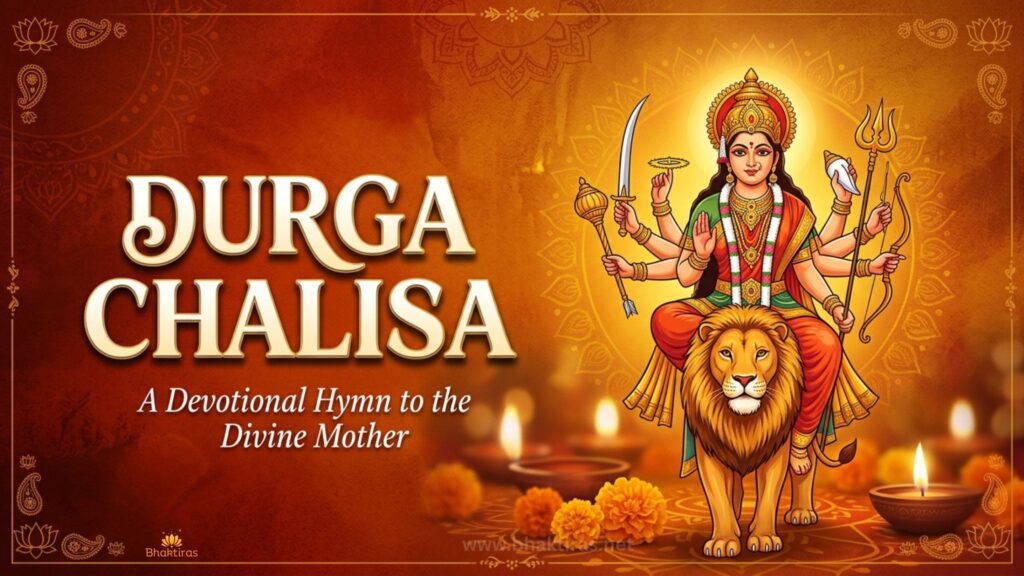
The Durga Chalisa is a forty-verse devotional hymn that praises Goddess Durga as the source of all strength and the destroyer of suffering. Its couplets recall her many forms — Annapurna who feeds the world, Saraswati who grants wisdom, Lakshmi who brings abundance, and Kali who slays the demons Mahishasura, Shumbha, Nishumbha and Raktabija. Devotees recite it to invite courage, protection from adversity, and the calm that comes from surrendering to the Divine Mother.
Durga Chalisa Lyrics in English (Transliteration)
Roman transliteration for easy chanting. Tap “Meaning” under any verse for the English translation.
Namo namo Durge sukh karani
Namo namo Ambe dukh harani
Meaning
Salutations again and again to Durga, the giver of joy, and to Mother Amba, who carries away all sorrow.
Nirankar hai jyoti tumhari
Tihun lok pheli ujayari
Meaning
Your light is formless and boundless; its radiance fills and illumines all three worlds.
Shashi lalat mukh maha vishala
Netra lal brikuti vikrala
Meaning
Your forehead shines like the moon and your face is vast; your eyes glow red and your knitted brow is fearsome to behold.
Roop matu ko adhika suhave
Daras karat jan ati sukh pave
Meaning
O Mother, your form is supremely beautiful, and merely beholding you fills the devotee with deep happiness.
Tum sansar shakti laya kina
Palan hetu anna dhan dina
Meaning
You are the power that holds the whole world together, and you provide the food and wealth that sustain it.
Annapurna hui jag pala
Tumhi adi sundari bala
Meaning
As Annapurna you nourish all creation, and you are the timeless, ever-youthful Adi Sundari, the original beauty.
Pralaya kal sab nashan hari
Tum Gauri Shiv Shankar pyari
Meaning
At the time of cosmic dissolution you withdraw all that exists; you are Gauri, the beloved consort of Lord Shiva.
Shiv yogi tumhare gun gave
Brahma Vishnu tumhe nit dhyaven
Meaning
Shiva and the yogis sing your praises, while Brahma and Vishnu constantly meditate upon you.
Roop Saraswati ko tum dhara
De subudhi rishi munin ubara
Meaning
Taking the form of Saraswati, you grant clear wisdom and uplift the sages and seers.
Dharyo roop Narsimha ko Amba
Pragat bhayin phar kar kamba
Meaning
O Amba, you assumed the form of Narasimha and burst forth by splitting open the pillar.
Raksha kari Prahalad bachayo
Hiranakush ko swarg pathayo
Meaning
You protected and saved the devotee Prahlada, and by slaying Hiranyakashipu you sent even him to heaven.
Lakshmi roop dharo jag mahi
Shree Narayan ang samahi
Meaning
As Goddess Lakshmi you appear in this world and abide at the side of Lord Narayana.
Ksheer Sindhu karat vilasa
Daya Sindhu deejai man aasa
Meaning
You dwell joyfully upon the ocean of milk; O ocean of compassion, please grant the wishes of my heart.
Hingalaj mein tumhi Bhavani
Mahima amit na jaat bakhani
Meaning
At Hinglaj it is you alone who reside as Bhavani; your glory is infinite and beyond all description.
Matangi Dhoomavati Mata
Bhuvneshwari Bagala Sukhdata
Meaning
You are Mother Matangi and Dhumavati, and as Bhuvaneshwari and Bagalamukhi you bestow happiness.
Shree Bairav Tara jog tarani
Chhinnabhala bhav dukh nivarani
Meaning
As Bhairavi and Tara you ferry souls across through yoga, and as Chhinnamasta you remove the sorrows of worldly existence.
Kehari Vahan soh Bhavani
Langur veer chalat agavani
Meaning
Bhavani is resplendent riding upon her lion, while the brave Langur (Hanuman) goes ahead to welcome her.
Kar men khappar khadag viraje
Jako dekh kal dar bhaje
Meaning
In your hands the skull-bowl and sword shine forth, the very sight of which makes even Death flee in fear.
Sohe astra aur trishoola
Jase uthata shatru hiya shoola
Meaning
Your weapons and trident are dazzling, and at the sight of them a sharp pang of dread strikes the heart of your enemies.
Nagarkot mein tumhi virajat
Tihun lok mein danka bajat
Meaning
At Nagarkot (Kangra) you are enthroned, and your triumphant drum resounds throughout all three worlds.
Shumbhu Nishumbhu Danuja tum mare
Rakta-beeja shankhan samhare
Meaning
You slew the demons Shumbha and Nishumbha and destroyed Raktabija along with his countless replicas.
Mahishasur nripa ati abhimani
Jehi agha bhar mahi akulani
Meaning
The arrogant demon-king Mahishasura, whose burden of sin made the earth groan in distress, was overcome by you.
Roop karaal Kalika dhara
Sen sahita tum tin samhara
Meaning
Assuming the terrible form of Kali, you destroyed him together with his entire army.
Pari garha santan par jab jab
Bhayi sahaya Matu tum tab tab
Meaning
Whenever danger or hardship has befallen the devout, you, O Mother, have come to their aid.
Amarpuri aru basava loka
Tava mahima sab rahen asoka
Meaning
In the city of the gods and in every realm of beings, by your glory all dwell free from grief.
Jwala mein hai jyoti tumhari
Tumhen sada pujan nar nari
Meaning
At Jwala Ji it is your sacred flame that burns, and men and women everywhere offer you constant worship.
Prem bhakti se jo yash gaye
Dukh-daridra nikat nahin ave
Meaning
Those who sing your praises with love and devotion are never approached by sorrow or poverty.
Dhyave tumhen jo nar man laee
Janam-maran tako chuti jaee
Meaning
Whoever meditates upon you with a focused mind is freed from the cycle of birth and death.
Jogi sur-muni kahat pukari
Jog na ho bin shakti tumhari
Meaning
Yogis, gods and sages proclaim aloud that no spiritual union is possible without your divine power.
Shankar Aacharaj tap keenhon
Kam krodh jeet sab leenhon
Meaning
Shankaracharya performed great austerities and thereby conquered desire, anger and every other vice.
Nisidhin dhyan dharo Shanker ko
Kahu kal nahin sumiron tum ko
Meaning
He held Shiva alone in meditation day and night, yet for a time he failed to remember you, the Mother.
Shakti roop ko maram na payo
Shakti gayi tab man pachitayo
Meaning
He did not grasp the mystery of your power as Shakti, and when that power left him he was filled with remorse.
Sharnagat hui keerti bakhani
Jai jai jai Jagdamb Bhavani
Meaning
Then he took refuge in you, extolling your glory and crying, 'Victory, victory, victory to Jagadamba Bhavani!'
Bhayi prasanna Aadi Jagdamba
Dayi shakti nahin keen vilamba
Meaning
The primordial Mother Jagadamba was pleased and, without the least delay, restored his power to him.
Mokun Matu kashta ati ghero
Tum bin kaun hare dukh mero
Meaning
O Mother, grave troubles surround me; apart from you, who can take away my suffering?
Asha trishna nipat sataven
Moh madadik sab binsaven
Meaning
Craving and endless desire torment me without relief; pray destroy my delusion, pride and all such failings.
Shatru nash keeje Maharani
Sumiron ekachita tumhen Bhavani
Meaning
O great Queen, vanquish my enemies; I call upon you, Bhavani, with single-pointed remembrance.
Karo kripa hey Matu dayala
Riddhi-Siddhi de karahu nihala
Meaning
Be merciful, O compassionate Mother; bless me with prosperity and accomplishment and make me wholly content.
Jab lagi jiyoon daya phal paoon
Tumro yash mein sada sunaoon
Meaning
As long as I live, may I enjoy the fruit of your grace and forever sing and proclaim your glory.
Durga chalisa jo gaye
Sab sukh bhog parampad pave
Meaning
Whoever sings this Durga Chalisa enjoys every happiness and ultimately attains the supreme state.
Devidas sharan nij jani
Karahu kripa Jagdamb Bhavani
Meaning
Knowing that Devidas has taken refuge at your feet, O Jagadamba Bhavani, bestow your grace upon him.
Benefits of Reciting the Durga Chalisa
Regular recitation of the Durga Chalisa is cherished for the strength and steadiness it brings to body and mind. Devotees turn to it in difficult times as a prayer for the Mother’s protection.
- Courage and confidence: the hymn’s images of Durga defeating Mahishasura help dispel fear and inner doubt.
- Protection from harm: it is chanted to seek shelter from enemies, obstacles and negative influences.
- Relief from worry: the verses invoke peace of mind and freedom from anxiety and want.
- Prosperity and well-being: as the giver of food, wealth and accomplishment, Durga is asked to bless the household with abundance.
When and How to Chant the Durga Chalisa
The Durga Chalisa is most often chanted during the nine days of Navratri, when devotees recite it daily before an image or lamp of the Goddess. Many also take it up every Tuesday and Friday, days traditionally dedicated to the Divine Mother. Light a lamp or incense, sit facing the deity, and recite the verses slowly and attentively — alone or with family — ideally after a morning bath.
About the Durga Chalisa
The Durga Chalisa belongs to the Shakta tradition, which worships the Goddess as the supreme creative power, or Shakti, behind the universe. Its forty verses move through Durga’s many manifestations — the nurturing Annapurna, wise Saraswati, bountiful Lakshmi, and the fierce Mahavidya forms such as Kali, Tara and Chhinnamasta. Much of the hymn celebrates her as the slayer of demons, recounting how she destroyed Mahishasura, Shumbha, Nishumbha and the self-replicating Raktabija to restore order to the worlds. The closing verse, signed by the poet Devidas, turns from praise to surrender, asking the Mother for refuge, protection and grace.
Frequently Asked Questions
Who is the Durga Chalisa dedicated to?
It is dedicated to Goddess Durga, the Hindu Divine Mother worshipped as the embodiment of Shakti, who is praised across her gentle and fierce forms including Annapurna, Saraswati, Lakshmi and Kali.
How many verses are in the Durga Chalisa?
It contains forty chaupais (four-line praise verses), which is what the word 'chalisa' means, followed by a closing couplet bearing the signature of the poet Devidas.
What are the benefits of reciting the Durga Chalisa?
Devotees recite it for courage, protection from enemies and obstacles, peace of mind, relief from financial difficulty, and the Mother's blessing of overall well-being.
When should the Durga Chalisa be chanted?
It is commonly chanted on Tuesdays and Fridays and daily throughout the nine days of Navratri, usually in the morning after bathing, before a lamp or image of the Goddess.
Is the Durga Chalisa recited during Navratri?
Yes. Navratri is the most popular time to recite it, with many devotees chanting it every day of the nine-night festival as part of their worship of Goddess Durga.
॥ जय माता दी ॥ • ॥ जय दुर्गे ॥