ॐ
Chandi Devi Temple, Haridwar
Goddess Chandika (Durga) • Neel Parvat, Haridwar, Uttarakhand
॥ ॐ दुं दुर्गायै नमः ॥
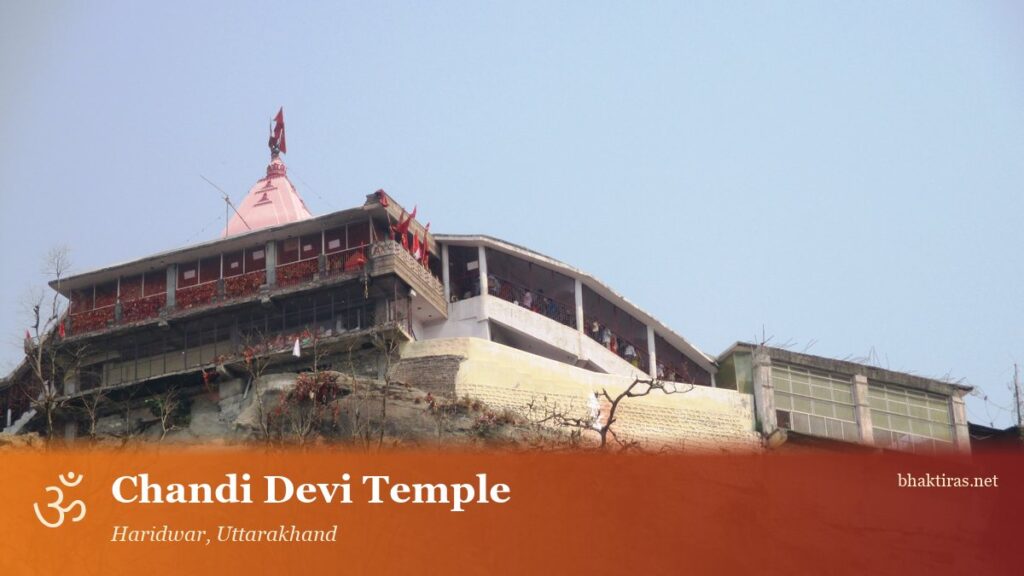
High on Neel Parvat, on the eastern bank of the Ganga across from Haridwar, the Chandi Devi Temple honours Chandika — the wrathful form Durga took to end the demon brothers Shumbha and Nishumbha. Pilgrims reach it by the Udankhatola ropeway or a climb of roughly three kilometres, and the shrine is counted among the town’s three Siddhapeethas. Crowds swell at Chandi Chaudas and through the nine nights of Navaratri.
The goddess who answered a war of the gods
The temple’s name traces back to the Devi Mahatmya episode in which the gods, driven from heaven by Shumbha and Nishumbha, turned to the great goddess for rescue. From Parvati’s body emerged a luminous form called Kaushiki, and the fierce energy that broke away to fight the demons was Chandika — dark, swift and unstoppable. It is this victorious aspect, seated above the battlefield of Neel Parvat in tradition, that worshippers come to salute.
Because Chandika is invoked as the slayer of arrogance and cruelty, devotees often arrive with petitions that feel impossible — a stubborn illness, a court matter, a long-blocked wish. The mood at the summit is less about grandeur than about appeal: people leave red chunnis, coconuts and folded notes, trusting the goddess who once settled a quarrel the gods themselves could not.
A 1929 shrine over a far older image
The structure visitors see today was raised in 1929 by Suchat Singh, a ruler of Kashmir, who funded the compact hilltop temple that crowns the peak. The deity image enshrined within, however, is held by local tradition to be far older and is attributed to Adi Shankaracharya, the philosopher-reformer credited with reviving many Devi seats across the subcontinent.
That layering — a modern building sheltering an ancient murti — is part of why the site reads as both a fresh pilgrimage stop and a link to older Shakta worship. The temple itself is small and unfussy; its pull comes from the deity and the height, not from elaborate carving.
One of Haridwar’s three Siddhapeethas
Chandi Devi forms a triangle of power-spots with two other hilltop shrines that ring Haridwar, and many pilgrims try to visit all three in a single trip for a complete darshan.
The three are traditionally taken together because each guards a different quality the devotee seeks, and a circuit of all three is considered especially auspicious during Navaratri.
- Chandi Devi on Neel Parvat — the fierce, demon-slaying aspect
- Mansa Devi on Bilwa Parvat — the wish-granting goddess
- Maya Devi in the old town — the presiding deity of Mayapuri, Haridwar’s ancient name
Getting up the hill
Two ways lead to the summit. The Udankhatola ropeway lifts visitors over the forested slope in a few minutes and is the easiest option for elders, children and anyone short on time, with the lower station near the Chandighat area. Those who prefer to walk follow a paved path of about three kilometres that climbs steadily through trees, with tea and prasad stalls along the way.
The shrine sits within the same forest belt as the Rajaji landscape, so morning visits are cooler and quieter. Footwear is left below the sanctum, and the queue tightens sharply on festival days — arriving early is the simplest way to keep the darshan unhurried.
Frequently Asked Questions
Which goddess is worshipped at Chandi Devi Temple?
The temple is dedicated to Chandika, a fierce form of Durga. In tradition she is the energy that broke away from the goddess to destroy the demon brothers Shumbha and Nishumbha, and she is invoked here as a remover of strong obstacles.
How do you reach Chandi Devi Temple?
You can take the Udankhatola ropeway, which carries visitors up Neel Parvat in a few minutes, or climb a paved trail of about three kilometres. The ropeway is the practical choice for elderly pilgrims and families.
When was the present temple built?
The current temple was built in 1929 by Suchat Singh, a ruler of Kashmir. The deity image inside is considered much older and is traditionally attributed to Adi Shankaracharya.
What are the three Siddhapeethas of Haridwar?
They are Chandi Devi on Neel Parvat, Mansa Devi on Bilwa Parvat, and Maya Devi in the old town. Many pilgrims visit all three in one trip, which is regarded as especially auspicious.
What is the best time to visit?
Navaratri and Chandi Chaudas are the peak occasions, when devotion is at its height but crowds are heavy. For a calmer darshan, early mornings on ordinary days are ideal, and the cooler months are more comfortable for the climb.
Where exactly is the temple located?
It stands atop Neel Parvat on the eastern bank of the Ganga, across the river from the main town of Haridwar in Uttarakhand. It is one of the most visited hill shrines around the pilgrimage city.
॥ जय माता दी ॥ • Bhaktiras.net Temple Guide
| Primary Deity | Chandika (Durga) |
| Location | Neel Parvat, Haridwar |
| State | Uttarakhand |
| Built | 1929 (by Suchat Singh of Kashmir) |
| Image Attributed To | Adi Shankaracharya (tradition) |
| Significance | One of Haridwar’s three Siddhapeethas |
| Access | Udankhatola ropeway or ~3 km climb |
| Major Festivals | Chandi Chaudas, Navaratri |
Related Temples
Explore more sacred temples connected by deity and region.