
ॐ
Rasmancha, Bishnupur
Krishna • Bishnupur, Bankura, West Bengal
॥ ॐ नमो भगवते वासुदेवाय ॥
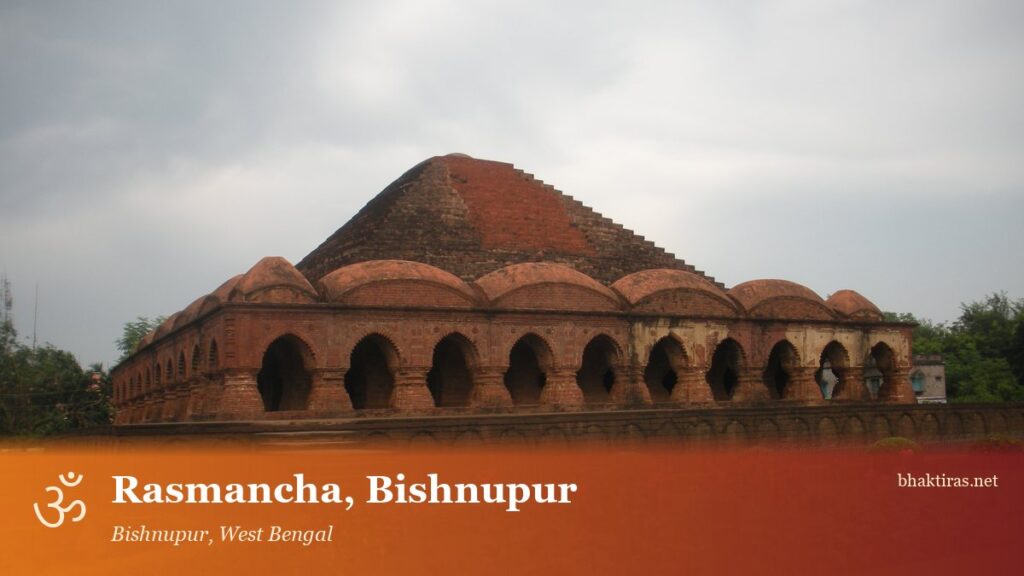
Rasmancha is a laterite pavilion in Bishnupur built around 1600 by the Malla king Bir Hambir, designed not for daily worship but to host the town’s Ras festival. Once a year the Radha-Krishna images from Bishnupur’s many temples were carried here and arranged together so the whole community could take darshan in a single place. Its pyramidal tower over an arcaded hall makes it one of the most distinctive structures of the old Malla capital.
Why Rasmancha matters
Rasmancha was conceived as a gathering point for the Ras Yatra, the autumn festival of Krishna’s circle dance. Rather than housing a permanent deity, it served as a temporary stage where the presiding images of Bishnupur’s scattered shrines could be displayed side by side, letting devotees honour them all without travelling temple to temple.
This pooling of deities under one roof reflects the devotional life of the Malla court, where Vaishnava worship was woven into civic ceremony. For the days of the festival the pavilion became the spiritual centre of the kingdom, and that role gave the building its name and its enduring place in local memory.
Architecture and the Malla capital
The structure rises in tiers: a square hall ringed by arched galleries, above which an elongated pyramidal superstructure climbs to a single point. The arches open the interior on every side, so the displayed images could be viewed from the surrounding ambulatories. The whole was raised in laterite, the rust-coloured stone that gives Bishnupur’s monuments their warm tone.
Bishnupur in Bankura district was the seat of the Malla rulers, who made it a centre of terracotta temple craft. The Jor Bangla, Shyam Rai and Madan Mohan temples nearby carry detailed terracotta panels of Krishna legends and courtly scenes. Rasmancha, plainer in surface but bolder in form, anchors this cluster and is protected by the Archaeological Survey of India.
- Square hall encircled by arched galleries on three concentric levels
- Tall pyramidal tower instead of the usual curved temple shikhara
- Built in local laterite stone, ASI-protected since the colonial era
Visiting the pavilion
Rasmancha sits within easy reach of Bishnupur’s other heritage temples, and most visitors see it as part of a walking circuit of the old capital. A modest entry ticket covers the ASI monuments, and early morning or late afternoon light suits the laterite surfaces and the long shadows of the arcades.
The pavilion no longer holds the annual deity gathering it was built for, so today it is appreciated chiefly as architecture and history. Guides at the site explain the Ras festival tradition, and the surrounding lawns make it an unhurried stop before moving on to the terracotta temples.
Bishnupur’s terracotta legacy
The town is also known for Baluchari silk weaving and the Bishnupur gharana of Hindustani classical music, both nurtured under Malla patronage. Visitors who come for the temples often leave with an appreciation of how deeply the arts were tied to devotion here.
Seeing Rasmancha alongside the terracotta temples gives a fuller picture of the Malla period: the same court that commissioned narrative wall panels also built this unusual festival hall, showing a culture that expressed faith through both intricate ornament and inventive form.
Frequently Asked Questions
What is Rasmancha and what was it used for?
Rasmancha is a laterite pavilion in Bishnupur built to host the annual Ras festival of Krishna. Instead of housing one fixed deity, it was the place where the Radha-Krishna images from the town’s many temples were brought together for public darshan during the festival days.
Who built Rasmancha and when?
The Malla king Bir Hambir built Rasmancha around the year 1600. It dates from the height of Malla rule in Bishnupur, the same era that produced the town’s celebrated terracotta temples.
Where is Rasmancha located?
Rasmancha stands in Bishnupur, in Bankura district of West Bengal. It is part of a compact cluster of historic temples that made Bishnupur the Malla capital.
Is Rasmancha an active temple?
No, Rasmancha is not used for daily worship today and is preserved as a heritage monument. It is protected by the Archaeological Survey of India and visited mainly for its history and unusual architecture.
What makes Rasmancha’s design unusual?
Rasmancha has a tall pyramidal tower rising over a hall ringed by arched galleries, rather than the curved shikhara of a typical temple. The open arches let the gathered images be viewed from all sides during the Ras festival.
What else can visitors see near Rasmancha?
Bishnupur’s famous terracotta temples are close by, including the Jor Bangla, Shyam Rai and Madan Mohan temples. The town is also known for Baluchari silk and its own gharana of classical music.
॥ राधे राधे ॥ • Bhaktiras.net Temple Guide
| Deity | Radha-Krishna (festival pavilion) |
| Built | around 1600 CE |
| Patron | Malla king Bir Hambir |
| Material | Laterite stone |
| Form | Pyramidal tower over arcaded hall |
| Location | Bishnupur, Bankura |
| State | West Bengal |
| Protection | ASI-protected monument |
Related Temples
Explore more sacred temples connected by deity and region.
 KrishnaAntpur Radha Govinda Temple📍 West Bengal
 KrishnaISKCON Mayapur (Temple of the Vedic Planetarium)📍 West Bengal
 KrishnaJaydev Kenduli Temple (Joydev)📍 West Bengal
 KrishnaJor Bangla Temple, Bishnupur📍 West Bengal
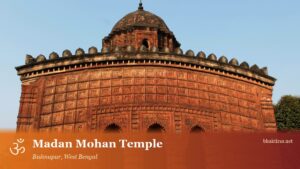 KrishnaMadan Mohan Temple, Bishnupur📍 West Bengal
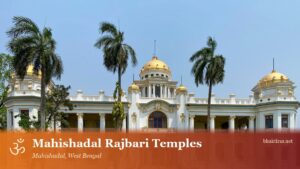 KrishnaMahishadal Rajbari Temples📍 West Bengal